Strategic Conquest
 Apple II
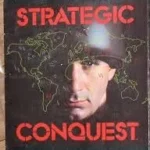
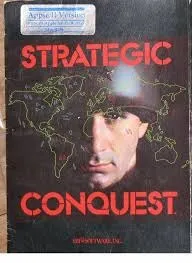
trategic Conquest (commonly referred to by fans as Stratcon) is a critically acclaimed turn-based strategy 4X video game originally designed and programmed by Peter Merrill. First developed on an Apple Lisa for the Apple Macintosh and released in 1984/1985 by PBI Software, the game was subsequently ported to the Apple II in 1986 by Arthur Britto.
Based heavily on the mechanics of Walter Bright’s legendary mainframe wargame Empire, Strategic Conquest holds a vital historical milestone: it was published on personal computers before Empire received its own official commercial ports.
The game single-handedly introduced the early Macintosh community to the pure city-capturing, map-exploring strategy loops that defined early 4X designs. Later handed over to Delta Tao Software for distribution and modernization, the title became a signature staple of early Mac OS gaming through its clever use of procedural maps, multiplayer local network play, and highly tactical combined-arms rules.
Technical Specifications
| Attribute | Details |
| Developer | Peter Merrill (Later versions/ports: Arthur Britto, Delta Tao Software) |
| Publisher | PBI Software / Delta Tao Software |
| Designer | Peter Merrill |
| Engine | Proprietary 2D Grid Engine |
| Platform(s) | Apple Macintosh (Classic Mac OS), Apple II |
| Release Date | 1985 (Full Commercial Release) |
| Genre(s) | Turn-based strategy, 4X |
| Mode(s) | Single-player, Multiplayer (Hotseat or AppleTalk LAN) |
The Procedural Sandbox: World Generation
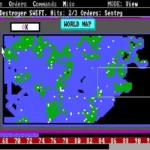
Unlike standard strategy titles of the mid-1980s that relied on hardcoded static maps, Strategic Conquest integrated a robust, pseudo-fractal Procedural World Generation System. When initializing a match, the engine crunched calculations to manifest one of over two billion possible map configurations.
The world is rendered as a flat, non-wrapping rectangular grid. Players can tailor their operational theater through specific initialization dimensions:
- Small: $48 \times 32$ grid tiles, optimized for lightning-fast, high-density skirmishes.
- Medium: $96 \times 64$ grid tiles, offering a balanced mix of exploration and territorial expansion.
- Large: $124 \times 96$ grid tiles, creating a sweeping operational sandbox requiring long-term naval and aerial logistics.
Later editions handled by Delta Tao Software expanded this generation engine by introducing tailored Terrain Setting Presets. Players could toggle the map style to be “Wet” (shattering the world into thousands of tiny archipelago islands), “Dry” (generating vast, unbroken continental masses pockmarked by tiny lakes), or “Normal” (balancing the geography with massive major islands and deep open ocean lanes).
Core Gameplay: The Conquest Loop
The ultimate objective of the game is absolute planetary dominance. Every match drops the player into an uncompromising geopolitical race against the computer’s artificial intelligence or a live human opponent.
The Fog of War and Expansion
Every player starts stranded inside a single, lone City center. The entire remainder of the planet map is covered by an absolute, pitch-black Fog of War.
To break this shroud, players must command their city to spend 100% of its industrial throughput to manufacture military hardware on a turn-based countdown timer. Trained units are systematically routed tile-by-tile into the blackness to map out geography, discover neutral cities, and locate hostile movements.
The Asymmetric Difficulty Scaling
The game features an escalating difficulty matrix from Level 1 to 15. In a design touch that tested the willpower of early strategy enthusiasts, playing at higher difficulty thresholds (above Level 10) did not just make the computer AI make better tactical choices—the engine actively applied an Asymmetric Production Penalty against the human player.
On high levels, the human player is spawned with significantly fewer neutral cities nearby to easily conquer, and their domestic factories take twice as long to manufacture any given military unit compared to the computer’s accelerated production loops.
Combined-Arms Unit Logistics
Strategic Conquest partitions its military forces across three tactical theaters: Land, Air, and Sea. Units are allowed to move and attack up to two times per individual turn.
Crucially, the combat engine enforces an explicit Damage Degeneration Penalty. While aircraft maintain constant metrics, all tanks and heavy naval vessels that possess a starting strength greater than one suffer a direct, permanent reduction to their maximum moves-per-turn if they sustain heavy damage during a battle encounter without being completely destroyed, requiring them to limp back to a friendly city or carrier for manual repair.
The Specialized Roster
- Infantry: The foundational ground asset. They move slowly but are the absolute only unit type capable of capturing neutral or enemy cities. They also possess the exclusive ability to set up field Airbases.
- Armor (Tanks): Fast-moving, heavy ground vanguards designed for rapid land blitzkriegs. Armor cannot enter mountain tiles and takes up twice as much cargo space inside naval transports as baseline infantry.
- Artillery: High-damage, long-range support weapons added in later version overhauls to crack fortified city defenses.
- Fighters: Swift, high-mobility aerial scouting units used to push back the fog of war. Fighters must end their turn on a friendly city, airbase, or carrier deck, or they will instantly run out of fuel and crash.
- Bombers: Heavy, destructive aerial units built to deliver catastrophic explosive payloads over large tile radii.
- Transports: Unarmed, fragile maritime cargo ships mandatory for ferrying land infantries and tanks across deep ocean lanes.
- Destroyers & Submarines: Agile naval escorts and stealth under-sea predators designed for fast reconnaissance and maritime counter-measures.
- Cruisers & Battleships: Heavily armored capital surface ships that command immense hit point pools and project devastating long-range Shore Bombardments to shatter coastal armies and soften city centers.
- Aircraft Carriers: Floating, mobile airbases capable of storing and refueling fighter squadrons directly out at sea.
Legacy & Open-Source Succession
Throughout the late 1980s and 1990s, Strategic Conquest remained an institution of early Macintosh network play, famously celebrating its ability to host zero-latency multiplayer campaigns across separate machines linked via local AppleTalk networks.
When PBI Software folded, Delta Tao Software stepped in to continuously maintain the title up through version 4.0, integrating 16-color visual options and optional voice prompts handled via the Apple MacinTalk speech synthesizer.
The visual layout and core rules of Strategic Conquest proved so incredibly timeless that they have been cleanly preserved and adapted for modern mobile platforms. Independent developer Les Bird officially coded and released Mother Of All Battles, a highly polished, fully licensed spiritual mobile port distributed across the Apple App Store.
The modern app brings the classic procedural world maps, turn-based combined-arms unit stacking, and intense city-capturing loops of the original 1985 Peter Merrill design straight onto modern high-definition smartphone displays, keeping the ancestral 4X blueprint actively played and beautifully preserved.