Empire
Empire (often referred to as Classic Empire) is a landmark 1977 turn-based wargame designed and programmed by Walter Bright. Originally written for the DEC PDP-10 mainframe computer at the California Institute of Technology (Caltech), the game is widely celebrated by computer gaming historians as the absolute grandfather of the 4X genre (eXplore, eXpand, eXploit, and eXterminate).
Synthesizing elements of traditional board games into a clean, digital ecosystem, Empire pioneered the concept of localized unit production, fog of war, and global map domination.
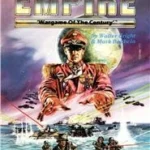
The game virally spread across university timesharing networks via leaked source code, eventually evolving into major commercial adaptations—most notably the 1987 graphical overhaul Empire: Wargame of the Century—and permanently altering the design trajectory of the strategy genre.
Technical Specifications
| Attribute | Details |
|---|---|
| Developer | Walter Bright (Later versions: Mark Baldwin, Bob Rakosky, Mark Kinkead) |
| Publisher | Self-published / Leaked Mainframe Shareware (Commercial: Interstel, New World Computing, Killer Bee Software) |
| Designer | Walter Bright |
| Engine | Text-based CLI / Orthogonal Grid ASCII Engine |
| Platform(s) | PDP-10 (1977), Heathkit H11, IBM PC (MS-DOS), Amiga, Atari ST, Commodore 64, Apple II, Macintosh, Windows |
| Release Date | 1977 |
| Genre(s) | Turn-based strategy, Wargame, 4X |
| Mode(s) | Single-player (vs. CPU), Multiplayer |
The Core Loop: The Birth of the 4X Blueprint
Despite originating on high-energy, text-only mainframes, Empire codified a brilliant, minimalist gameplay loop that modern strategy titles still rely upon.
At the initialization of a match, the game engine procedurally generates a randomized rectangular overworld map on a square grid basis, typically scattering numerous isolated land masses and islands across a massive digital ocean.
- The Starting Seed: Every player (and the computer AI opponent) starts the match in control of a single, isolated City. The rest of the globe is completely blacked out by an absolute, pioneer Fog of War.
- Industrial Allocation: Cities do not gather generic gold or science points. Instead, they function strictly as automated manufacturing hubs. Players open a city’s production menu and choose what class of military hardware to construct:
- Armies: The fastest units to manufacture, spent to scout land coordinates and forcefully capture new neutral cities.
- Aircraft: High-speed scouting assets with immense tactical mobility but limited fuel parameters.
- Naval Vessels: Ranging from nimble Destroyers to slow, resource-heavy, and devastating Battleships built to control the sea lanes.
- Territorial Expansion: Units move step-by-step to physically clear the fog of war. As players scout adjacent grid coordinates, they uncover independent neutral cities. Marching an army unit into a neutral city center immediately annexes the town, adding its manufacturing bays straight into your imperial production grid.
- The Victory Horizon: As your industrial footprint grows, you balance your production lines—setting some cities to rapidly churn out cheap defensive infantries while dedicating massive production hubs to forging heavy capital warships. The game runs continuously until one emperor successfully conquers and flag-claims every single city on the map, completely exterminating the opposition.
The Development Journey: From Board Game to Mainframe
The genesis of Empire began long before Walter Bright ever touched a computer keyboard. As a child, Bright had custom-designed an elaborate, homebrew tabletop board game heavily inspired by mechanical elements of Risk, Stratego, and the cinematic aerial logistics of the 1969 historical war film Battle of Britain.
However, playing the game by hand proved immensely tedious due to the crushing bookkeeping required to track hidden unit movements, production turns, and manual dice-rolling calculations.
Bright eventually realized that a digital computer could comfortably execute the tedious background rules while acting as a real-time, automated artificial intelligence opponent.
He authored an initial, crude iteration in BASIC before completely rewriting the entire codebase in FORTRAN IV in 1977 to execute on the DEC PDP-10 mainframe computer during his studies at Caltech.
Because the PDP-10 was a premier timesharing network, the game’s source code was quickly copied, leaked, and compiled virally across global university networks and corporate mainframes throughout the late 1970s and early 1980s.
Evolution: Wargame of the Century (1987)
In the mid-1980s, Bright successfully recoded the game from scratch using the C programming language to port it over to the rapidly expanding IBM PC home computer market. After initially receiving a massive flood of direct mail orders via an announcement blurb in BYTE Magazine, he officially licensed the software rights to a small publisher named Interstel Corporation.
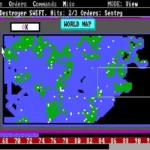
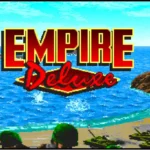
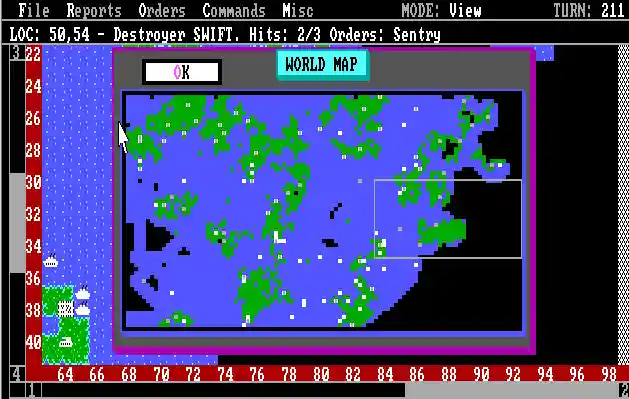
Interstel brought in veteran game designer Mark Baldwin to completely re-engineer the software for the commercial mass market. Released in 1987 as Empire: Wargame of the Century, this edition completely retired the legacy command-line ASCII characters (. for sea, + for land, * for neutral cities).
Baldwin injected a fully interactive, vibrant EGA graphical user interface that implemented native mouse-driven click-and-drag controls—a revolutionary luxury for 1980s strategy clients.
This commercial package added critical tactical improvements—including unit patrol routing, convoy naval escorts, and giving Battleships the explicit ability to conduct long-range shore bombardments to soften up fortified coastal defenses before an army invasion.
Legacy and Sid Meier’s Civilization
The architectural influence of the 1977 original Empire cannot be overstated. It effectively demystified computer wargaming, demonstrating that a deep, turn-based strategic sandbox could remain incredibly addictive without relying on overwhelming rulebooks.
Most famously, legendary designer Sid Meier has openly stated in numerous historical interviews that playing Walter Bright’s Empire served as the absolute primary gameplay inspiration for the development of the original 1991 Sid Meier’s Civilization.
The concept of a lone starting city, dropping settler units to push back a blacked-out fog of war, and organizing localized production queues to construct military units step-by-step was pulled directly out of the 1977 PDP-10 blueprint, forever cementing Empire as the genetic bedrock of the grand strategy genre.
Modern Preservation Status
As of May 2026, Empire stands beautifully preserved and fully accessible to contemporary strategy enthusiasts. Walter Bright actively maintains an official, legacy Classic Empire web page (classicempire.com), where he generously distributes the original compiled source code, historical design documentation, and free executable binaries for modern desktop systems completely free of charge.
For players seeking to experience the definitive 1987 Empire: Wargame of the Century graphical client, the game is completely preserved and playable directly within web browsers via emulator containers hosted on the Internet Archive.
Alternatively, players running desktop environments can execute the legacy MS-DOS versions utilizing DOSBox, where aspect ratio locking can be safely applied to scale the historic EGA tiles, mouse-driven army commands, and pioneering fog-of-war systems flawlessly on modern high-resolution displays.