 Amiga,
  Apple II,
  Atari ST,
  Commodore 64,
  PC
PC
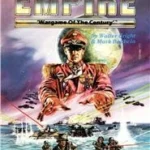
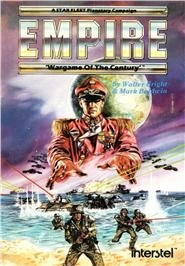
Empire: Wargame of the Century is a landmark 1987 turn-based strategy video game developed by Mark Baldwin and Walter Bright, and published by Interstel Corporation. Released for MS-DOS, Amiga, Atari ST, Apple II, and Commodore 64, the title is the definitive commercial, graphical reimagining of Walter Bright’s legendary 1977 mainframe game Empire.
By successfully wrapping Bright’s abstract, text-based code in a vibrant graphical user interface, Wargame of the Century became a massive commercial success. It was named “Game of the Year” by Computer Gaming World in 1988 and permanently established the mechanics of production loops, tactical troop transport, and operational fog of war that birthed the modern 4X genre.
Technical Specifications
| Attribute | Details |
| Developer | Mark Baldwin, Walter Bright |
| Publisher | Interstel Corporation (Later versions: New World Computing) |
| Designers | Walter Bright (Core Rules), Mark Baldwin (Commercial Adaptation) |
| Engine | Proprietary 2D Isometric/Top-Down Graphical Engine (CGA/EGA rendering) |
| Platform(s) | MS-DOS, Amiga, Atari ST, Commodore 64, Apple II, Classic Mac OS |
| Release Date | 1987 |
| Genre(s) | Turn-based strategy, Computer Wargame, 4X |
| Mode(s) | Single-player (vs. CPU), Multiplayer (Hotseat or Play-by-Email) |
From Mainframe to Commercial Masterpiece
The road to Wargame of the Century began in 1977 when Walter Bright programmed a text-only, FORTRAN IV version of Empire on a PDP-10 mainframe computer at Caltech. Throughout the late 1970s and early 1980s, the game spread as a viral, open-source shareware phenomenon across university timesharing networks.
Recognizing the game’s immense commercial potential, Bright ported the game’s core logic to the C programming language for the IBM PC. After receiving an overwhelming flood of direct mail orders, Bright partnered with Interstel Corporation.
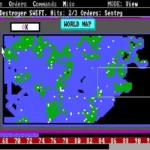
Interstel tasked veteran designer Mark Baldwin with completely re-engineering the visual presentation. Baldwin stripped out the primitive command-line ASCII characters (. for sea, + for land, * for neutral cities) and replaced them with detailed, mouse-driven graphical tiles. This transition transformed a hyper-dense mainframe simulation into an elegant, highly accessible commercial video game.
Gameplay Mechanics: The Conquest Loop
The core gameplay loop of Wargame of the Century centers on total global domination. At the start of a match, the engine procedurally generates a randomized world map composed of scattered islands, massive continents, and deep ocean lanes.
The Starting Condition and Expansion
Every player (human and CPU) initializes the match with zero visibility, stranded inside a single, isolated City surrounded by a total Fog of War. To expand, players order their city to allocate 100% of its industrial capacity toward manufacturing military hardware. Units are systematically produced on a turn-based countdown timer:
- Armies (1 Turn): Ground infantries spent to scout land coordinates and claim independent neutral cities.
- Fighters (5 Turns): High-speed, long-range aerial scouting assets limited by strict operational fuel limits.
- Transports (3 Turns): Fragile, unarmed cargo vessels mandatory for ferrying Armies across ocean hexes.
- Destroyers (3 Turns): Fast, lightly armored naval escorts designed to hunt enemy transports and submarines.
- Submarines (5 Turns): Stealth maritime predators optimized for high-impact surprise attacks against capital ships.
- Battleships (21 Turns): Heavily armored, intensely expensive floating fortresses that dictate ocean control.
The Tactical Mechanics Shift
While preserving the core rulebook of Bright’s 1977 mainframe version, Baldwin injected critical tactical features that vastly deepened the strategy:
- Shore Bombardment: Battleships were granted the explicit mechanical ability to fire long-range ballistic shells directly onto adjacent land tiles. This allowed naval forces to actively soften up heavily fortified coastal defenses before executing a ground army invasion.
- Unit Patrol Paths: Players could manually map out repetitive scouting loops for Fighters and Destroyers, allowing the engine to automatically manage boundary patrols without forcing the player to click every individual unit every single turn.
- The Stack Death Penalty Rules: Units moving on land or sea could stack on a single tile. However, combat remained brutally binary. If an elite enemy unit successfully attacked and defeated the top-most unit defending an open-ground or sea stack, the entire stack was instantly destroyed, vaporizing massive production investments in a single calculated strike.
Legacy and the Civilizational Connection
Empire: Wargame of the Century is recognized by gaming historians as the primary bridge that connected old mainframe computing to the modern era of 4X strategy design. By demonstrating that a deep, complex geopolitical wargame could be smoothly navigated using a mouse and a clear, visual tile system, it set the standard for user interface design in computer gaming.
Most notably, the 1987 Interstel version served as the absolute catalyst for the creation of the Civilization franchise. Sid Meier and Bruce Shelley have openly recorded that playing Empire: Wargame of the Century for endless hours at the MicroProse offices directly inspired the core architecture of 1991’s Sid Meier’s Civilization.
The concept of starting with a single base, using military units to clear a pitch-black fog of war, and toggling city production menus to construct a globe-spanning empire step-by-step was lifted directly from Bright and Baldwin’s 1987 blueprint.
Modern Preservation Status
As of May 2026, Empire: Wargame of the Century remains fully preserved and accessible to retro strategy purists. The game’s complete legacy footprint is hosted on digital preservation archives including the Internet Archive, where players can execute the classic Amiga and MS-DOS versions directly inside integrated web browser emulators.
For strategy enthusiasts seeking to run the game natively on modern desktop setups, the original MS-DOS executable runs flawlessly utilizing DOSBox frameworks. By locking native 4:3 display aspect ratios and applying standard pixel-smoothing filters, contemporary players can experience the precise graphical layouts, deep naval blockades, and historic production loops that fundamentally birthed the strategy genre.