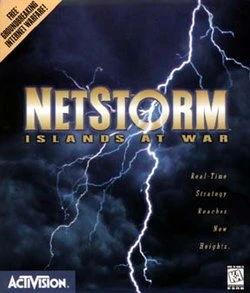
NetStorm: Islands at War
 PC
PC Activision
NetStorm: Islands at War (1997) stands as one of the most critical turning points in the history of the legendary real-time strategy franchise. Following the exhausting market fatigue of hyper-fast, high-APM traditional Command & Conquer and Warcraft clones and the subsequent stagnation of the classic mobile-army formula, the future of the genre was highly uncertain.
American developer Titanic Entertainment—composed of legendary ex-Activision veterans—stepped in, boldly re-engineered the sub-genre rules, and focused development duties on a calculated, stationary tactical pacing. Faced with the intense task of salvaging a deeply fractured RTS community after the highly polarizing mechanics of modern micro-intensive titles, Titanic delivered a stellar, redemptive chapter that bridged classic nostalgic mechanics with modern technological leaps.
The Grand Reset: A Brand New Universe
NetStorm completely severed ties with the classic historical or sci-fi battlefields of traditional real-time strategy. Instead, it established a completely fresh, tightly constructed dark-fantasy lore continuity: The Shattered Sky-World of Nimbus.
Nimbus’s geopolitical landscapes, harsh atmospheric environments, and faction alignments are strictly governed by a pantheon of four primordial elemental entities known as the Furies (Sun, Rain, Thunder, and Wind). The massive multi-chapter campaign plays out like an interconnected political thriller, tracking a desperate High Priest as a global cataclysm disrupts the floating islands, sparking a sky-wide war that drags rival floating bastions, airships, and ancient mechanical golems into a grand struggle to prevent a world-shattering drop into the dark abyss below.
The Core Evolution: Bridge-Building & Tower Dynamics
Titanic Entertainment deliberately looked back at board game geometry and classic puzzle anchors, discarding traditional continuous map mobility and endless resource spams. However, they heavily evolved the engine:
- The Leap to Static Tower RTS: The combat grid completely abandoned mobile tank rushes and wandering soldier blobs. NetStorm was the first entry to ditch active unit movement for completely stationary offensive and defensive towers. Once placed on your floating island, your defensive assets cannot move; instead, you wage tactical artillery warfare across massive open chasms, transforming combat into a precise, spatial puzzle.
- The Dynamic Tetris Bridge Mechanics: The economic grid completely abandoned unpunished, open-terrain base building. Titanic implemented a real-time bridge-construction timeline. Players must deploy mechanical Golems to physically place randomized, Tetris-shaped bridge pieces across the sky. You use these bridges to actively snake across the open void, hunting for resource geysers, blocking enemy expansion lines, and paving an assault route directly to the opponent’s home island.
- The Priest Sacrifice Win Condition: The combat grid completely abandoned standard base-demolition victory tracks. Titanic implemented a unified High Priest capture mechanic. Matches cannot end by merely blowing up towers; instead, your ultimate goal is to use specialized units to completely incapacitate the enemy High Priest, physically haul their body back across your bridge network via a transport golem, and sacrifice them upon your faction’s Altar to siphon their spiritual knowledge and claim absolute victory.
The Deep Meta: Elemental Factions & Storm Power
To maximize faction asymmetry, NetStorm completely threw out generic tech trees. Every alignment was granted a mandatory, entirely exclusive Elemental Power that dictated their macro-strategy:
- Thunder Alignment: Allows damage-heavy priests to construct Tesla Generators and Heavy Bolt Cannons to physically multiply direct line-of-sight strikes across open air chasms.
- Wind Alignment: Aerial squads can channel their inner kinetic energy to deploy fast-moving kamikaze aircraft and long-range crossbow spires, bypassing traditional line-of-sight requirements.
- Rain Alignment: The classic defensive staple, re-engineered. Housing ice towers and toxic acid rain pools generates a passive, screen-wide area-of-effect slowdown, ensuring absolute protection against aggressive bridge rushes.
- Sun Alignment: Mystical temples specialize in raw, high-yield energy projection. Their unique trait allows them to deploy bouncing energy disks and melting laser beams that rapidly incinerate heavy enemy infrastructure.
The Hidden Storm Sink Economy
Progression was governed by a massive, intricately complex web of resource balancing. The game’s singular currency, Storm Power, must be actively harvested by placing Sinks directly over volatile, swirling Storm Geysers floating in the void. To unlock game-breaking endgame death-balls, players must follow highly specific, branch-aligned pathways across their resource lines—carefully balancing the cost of bridge expansion with the passive defense upkeep of their current active towers, turning sky-island cultivation into a precise science.
The Expansions and Alternate Upgrades
Through a continuous pipeline of post-launch maps and tournament patches, the engine introduced game-changing combat variances, bringing advanced dual-element hybrid towers, balloon transport vessels, and orbital shields into the mix. Operating on a completely separate tactical economy, players utilize battlefield filtration systems. At the start of an expansion phase, players can choose specialized defensive rules, granting specific island zones immediate elemental resistance priorities like grounding lightning strikes or deflecting incoming air raids.
More importantly, the tactical meta finalized Alternate Upgrades for your baseline offensive and utility infrastructure via specialized branching unit perk paths. For example:
| Base Defensive Asset (Element) | Primary Offensive Variant | Tactical Utility Variant (Alternate) |
| Thunder Tower | Heavy Bolt Cannon (Executes massive, direct line-of-sight kinetic damage) | Lightning Generator (Gains sustained, area-of-effect chain lightning passives) |
| Wind Spire | Crossbow Tower (Fires rapid, low-damage bolts to shred incoming enemy bridges) | Whirligig Launch-Pad (Deploys roaming, flying blade saws to terrorize enemy worker nodes) |
| Sun Temple | Sun Disk (Fires volatile energy spheres that bounce dynamically between enemy structures) | Radiant Beam (Concentrated melting laser that ramps up damage over time against heavy altars) |
The Modern Standard: The NetStormHQ Preservation Meta
While the official retail lifecycle concluded in the late 90s, NetStorm experiences an incredible competitive and casual renaissance today through its unified, community-maintained server architecture. Following the closure of Titanic Entertainment, the game’s passionate player base formed NetStormHQ, a monumental preservation framework that completely reconstructed the legacy engine stability.
It integrates a fast, optimized 64-bit executable, implements a vastly superior, balanced, and fully visible interactive multiplayer matchmaking lobby inside the UI, adds a massive randomized map generator system, and unifies all separate elemental alignments, fan patches, and widescreen high-definition display fixes into a singular, flawlessly polished modern gameplay client operating beautifully on Windows 10 and Windows 11.
Release History
- NetStorm: Islands at War (Base Game): November 10, 1997 (North America) / November 1997 (Europe)
- The ReStormed Overhaul Project (Community Patch): Ongoing Active Updates
- Modern Packaging: Natively preserved and distributed as a free, open-source community package hosted globally via NetStormHQ, serving as a pristine historical monument to the birth of experimental real-time strategy gaming.