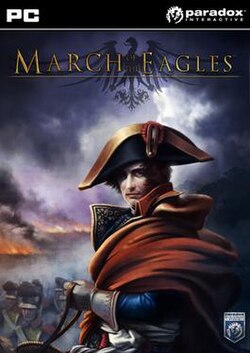
March of the Eagles
 71
★ /10
71
★ /10
 PC
PCWhere to buy

March of the Eagles (2013) occupies a fascinating, highly distinct, and almost mythic “cult” status within Paradox Interactive’s historical catalog. Released on February 19, 2013, for Microsoft Windows (followed by an OS X port on May 9, 2013), this title took the massive scale of grand strategy and stripped away the deep, multi-century empire building in favor of a hyper-focused, aggressively paced real-time tactical wargame.
The game had a fascinating origin story: it originally began development as Napoleon’s Campaigns II, a planned turn-based sequel by developer AGEOD. When Paradox acquired AGEOD, they moved the project entirely in-house, scrapped the original architecture, and completely rebuilt the concept from the ground up on the Clausewitz Engine—effectively using it to test high-intensity warfare and coalition mechanics that would later influence Europa Universalis IV.
The Chronological Crucible: 1805–1820
Unlike its sister franchises that span hundreds of years, March of the Eagles isolates its sandbox to a tight, explosive 15-year window tracking the absolute peak of the Napoleonic Wars.
Domestic economic management is heavily streamlined: gold budgets are easy to balance, technology is unlocked via a direct, combat-earned “Idea” perk system, and there are absolute zero legal restrictions or Casus Belli hoops required to declare war. The game treats the European continent as a giant, volatile chessboard where your only true currencies are raw human manpower, operational logistics, and military dominance.
Key Mechanical Masterstrokes
1. The Tactical Flank Matrix (Left, Center, Right, Reserve)
While other Paradox titles resolve army combat as an abstract clashing stack of numbers, March of the Eagles introduced a deeply innovative, multi-tier combat layout.
Players manually slot individual brigades of infantry, cavalry, and artillery into these specific flank vectors. Appointing generals with specialized combat traits to explicit flanks dynamically triggers unique tactical behaviors (such as Grand Battery or Encirclement) during combat resolution, turning battles into an intense game of matching your counters to the enemy’s formation.
2. Logistical Depots & Rapid Territorial Attrition
The map features an incredibly fluid territory-snatching loop. Marching a single unit of cavalry across the countryside will instantly flip undefended, rural provinces to your nation’s color without a fight. However, the real war is fought over Fortified Cities.
Armies must maintain a secure, traceable line of supply back to a friendly home city or a constructed Supply Depot. Advancing deep into hostile territories like Spain or Russia without executing successful fort sieges will instantly cut your vanguard off from supplies, triggering devastating attrition starvation loops that can butcher your manpower pool within a single winter phase.
3. The Land vs. Sea Supremacy Victory Engine
The game completely discards traditional open-ended sandbox endings in favor of a clear, competitive Victory System driven by geopolitical hegemonies. The simulation designates eight distinct Major Powers, giving each a customized deck of explicit geographical province objectives scattered across the map. To win, a nation must successfully capture and secure its targets to be officially crowned the dominant Land Hegemon or Naval Hegemon of Europe.
The Eight Major Powers Matrix
While any minor state or protectorate on the map is technically selectable, the core balance of the game revolves around the intense friction between the eight official global titans:
| Major Power | Starting Geopolitical Footprint | Unique Focus & Hegemonic Alignment |
| The French Empire | Western/Central Europe | The Ultimate Land Hegemon: Commands elite military leaders, unparalleled starting manpower, and unique ideas designed to aggressively blitz continental Europe. |
| The United Kingdom | The British Isles | The Absolute Naval Hegemon: Insulated by the English Channel; possesses an unrivaled global fleet and massive wealth, built to heavily subsidize continental allies. |
| The Russian Empire | Eastern Europe | The Endless Redoubt: Backed by massive territory and immense raw manpower reserves, making it an attrition trap for any foreign invader. |
| The Austrian Empire | Central Europe / Balkans | The Vulnerable Shield: Sits in a dangerous central position bordered by multiple rivals; relies heavily on forming early coalitions to survive. |
| The Kingdom of Prussia | North-Central Europe | The Quality Vanguard: Possesses smaller territory but holds highly disciplined infantry models and rapid reinforcement tech tracks. |
| The Kingdom of Spain | The Iberian Peninsula | The Guerrilla Bastion: Geographically secure but plagued by weaker baseline armies; built to wear down invaders via local partisan operations. |
| The Ottoman Empire | The Levant / Balkans | The Gatekeeper: Controls critical chokepoints between Europe and Asia; boasts high starting unit numbers but experiences late-game technology group slowdowns. |
| The Kingdom of Sweden | Scandinavia / Baltic Rim | The Northern Wildcard: Protected by the Baltic Sea; hyper-focused on securing dominance over northern trade routes and checking Russian expansion. |
Multiplayer Focus & The “Meme” Legacy
Because the game was streamlined to process lightning-fast day-by-day time ticks and featured highly compressed campaign clocks compared to other Paradox games, it was heavily engineered to support competitive multiplayer lobbies for up to 32 players. The multiplayer meta turns into a cutthroat game of human diplomacy, where players continuously form temporary coalitions, trade war subsidies, lend out specialized expeditionary forces, and relentlessly backstab their neighbors to prevent any single nation from locking down a victory condition.
Over the years, March of the Eagles passed into an ironic meme status within the grand strategy community as the “forgotten stepchild” of the studio’s golden era. Yet, its brilliant supply systems, unique flanking combat layout, and fast-paced matches make it highly respected by wargaming purists.
Modern Storefront Status & Availability
The title remains fully preserved, stable, and legally accessible on PC today via Steam. Because the code architecture was completely finalized upon Patch 1.02, the game is highly optimized and exceptionally lightweight compared to modern releases. The digital download client functions seamlessly on modern Windows 10 and Windows 11 desktop environments out-of-the-box, allowing you to experience Paradox’s quickest, most action-heavy exploration of the Napoleonic era without any manual compatibility modding required.