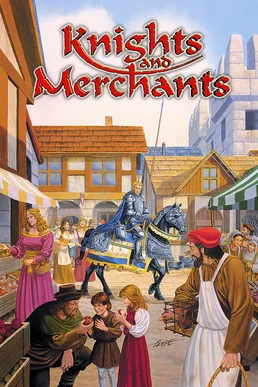
Knights and Merchants: The Shattered Kingdom
 PC
PC
 TopWare Interactive


Knights and Merchants: The Shattered Kingdom is a 1998 real-time strategy and economic simulation game developed by the German studio Joymania Entertainment and published by TopWare Interactive. Releasing during the golden age of isometric city-builders, it shares a massive amount of its mechanical DNA with the legendary Settlers franchise. However, it sets itself apart by blending that incredibly deep, slow-paced economic management with a much heavier focus on military logistics and battlefield formations.
The narrative is set in a fictional medieval realm that has been torn apart by a bitter civil war. After decades of peace, the King’s own son has rebelled, fracturing the once-great nation into dozens of warring provinces. Players take on the role of the captain of the royal palace guard, tasked with rebuilding the shattered kingdom province by province, managing the economy, raising an army, and ultimately defeating the traitorous prince to restore the King to the throne.
Gameplay
Knights and Merchants is notorious for its incredibly deliberate pace. You cannot simply build a barracks, mine some gold, and immediately pump out an army. Every single soldier requires a staggering amount of logistical groundwork.
Key gameplay mechanics include:
- Hyper-Detailed Production Chains: The economic simulation is incredibly granular. To build a single bowman, you cannot just spend “wood.” You must build a Woodcutter to chop trees, a Sawmill to turn the logs into timber, and a Weapons Workshop to craft the timber into a bow. To recruit the unit, you must then build a School to train a raw Recruit, and finally combine the Recruit and the Bow in a Barracks.
- The Serf Network: Resources do not magically teleport to your storehouse. You must train Serfs, who act as the lifeblood of your empire. They physically carry every single log, stone, piece of coal, and loaf of bread from one building to the next via a network of stone roads that you must carefully lay out to prevent massive traffic jams.
- The Hunger Mechanic: This is the game’s most defining (and often punishing) feature. Every single citizen and soldier in your kingdom gets hungry over time. If they don’t eat, they will literally starve to death. While civilian workers will automatically visit the local Inn to eat, soldiers stationed on the battlefield cannot leave their posts. You must manually command Serfs to carry sausages, wine, and bread out to the front lines to feed your army mid-battle.
- Split Control Systems: The game uses two different control methods. For your economy, you use indirect control—you place building blueprints and roads, and your autonomous Laborers and Serfs will eventually get around to building them. However, your military units (pikemen, cavalry, archers) are controlled directly like a traditional RTS.
- Directional Combat: Combat is heavily reliant on formations and facing direction. Units cannot quickly spin around. If a squad of heavily armored knights is flanked from the side or rear by cheap militia, the knights will be easily slaughtered.
Development and Legacy
Developed by a small German team, Knights and Merchants perfectly tapped into the late-90s European obsession with deep, methodical economic simulators. Upon its release in 1998, it received positive reviews for its beautiful, highly detailed 2D pixel art and charming animations (watching the baker knead dough or the blacksmith hammer hot iron is a joy). However, it was also criticized for its agonizingly slow pacing and a lack of a skirmish mode at launch.
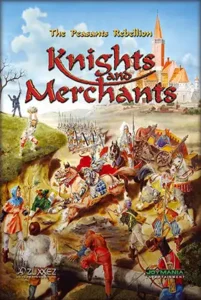
In 2001, an expansion pack/standalone sequel titled Knights and Merchants: The Peasants Rebellion was released, adding a few new buildings, new units (like the powerful Barbarians), and a brand-new campaign.
Unfortunately, the original game engine was notoriously buggy and struggled heavily as Windows operating systems advanced. For years, the game was nearly unplayable on modern machines. However, the game’s incredibly passionate cult following stepped in to save it. A team of dedicated fans reverse-engineered the game and built the KaM Remake—a completely free, open-source engine built from scratch. The KaM Remake fixes hundreds of original bugs, allows for modern widescreen resolutions, drastically improves the AI, and features robust online multiplayer. Today, downloading the original game via Steam or GOG and running it through the KaM Remake is universally considered the definitive way to experience this medieval classic.
Key Features:
- Granular Economics — Master highly complex production chains, turning raw wheat, pigs, and iron ore into bread, leather armor, and steel swords.
- Logistical Warfare — Manage the supply lines of your army, utilizing serfs to physically carry food to your soldiers on the front lines to prevent them from starving.
- Cozy Isometric Pixel Art — Enjoy incredibly detailed 2D animations that bring every single profession in your bustling medieval village to life.
- Tactical Formations — Command squads of troops, utilizing directional facing, flanking maneuvers, and hard counters to defeat enemy armies.
- The KaM Remake — Enjoy the game flawlessly on modern hardware thanks to a legendary, fan-built open-source engine that modernizes the entire experience.
Release Platforms:
- Microsoft Windows (PC) — September 1998
- (The original game, alongside The Peasants Rebellion, is currently available via Steam and GOG.com under the “Historical Version”, which is highly recommended to be played using the free KaM Remake mod).