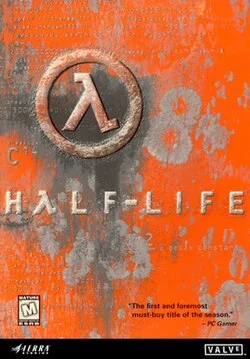
Half Life
 96
★ /10
96
★ /10
 PC
PC PS 2
PS 2 Valve Corporation
 Sierra
Where to buy

Half-Life is a 1998 first-person shooter game developed by Valve Corporation and published by Sierra Studios. As Valve’s debut product, it is widely considered one of the most important and influential video games of all time. Moving away from the arcade-style, “run-and-gun” design of its contemporaries like Doom and Quake, Half-Life pioneered the use of unbroken, real-time narrative in first-person shooters, blending seamless storytelling with environmental puzzle-solving and sophisticated artificial intelligence.
The story follows Dr. Gordon Freeman, a theoretical physicist working at the clandestine Black Mesa Research Facility deep in the New Mexico desert. During a routine experiment involving anomalous materials, a catastrophic event known as a “resonance cascade” occurs, tearing a dimensional rift between Earth and the border world of Xen. As hostile alien lifeforms flood the facility, Freeman must fight to survive and escape, battling not only the alien invaders but also a specialized unit of the U.S. military sent to cover up the disaster by eliminating all surviving personnel.
Gameplay
Half-Life fundamentally changed the structure of the first-person shooter. Rather than dividing the game into distinct, disconnected levels or relying on pre-rendered cutscenes to deliver the story, the entire game unfolds as a continuous journey experienced through the eyes of Gordon Freeman. The player retains control of Freeman at almost all times, watching narrative events occur in real-time within the game world.
Key gameplay mechanics include:
- Unbroken Perspective: The game is presented without chapter breaks or loading screens that pull the player out of the experience (loading occurs seamlessly during gameplay).
- Environmental Storytelling & Puzzles: Players must navigate complex environments using platforming and puzzle-solving, often utilizing the facility’s machinery, environmental hazards, and Freeman’s hazard suit (the HEV suit) to progress.
- The Crowbar: Freeman’s starting weapon, the iconic red crowbar, became an instantly recognizable symbol of the franchise, used for both melee combat and smashing crates or obstacles.
- Advanced AI: Half-Life introduced highly advanced artificial intelligence for its time. Alien enemies like the Houndeyes pack-hunt, while the Human Grunts of the Hazardous Environment Combat Unit (HECU) use squad tactics, flush the player out with grenades, and retreat when wounded.
- Non-Player Character Interaction: The player frequently interacts with friendly security guards (who provide covering fire) and scientists (who open secure doors and provide exposition), making the world feel lived-in and reactive.
Development and Legacy
Founded in 1996 by former Microsoft employees Gabe Newell and Mike Harrington, Valve set out to create an immersive, story-driven shooter. The game was built using the GoldSrc engine, a heavily modified version of the Quake engine licensed from id Software. Early prototypes of the game were considered derivative, leading the team to completely scrap and redesign the game’s levels and pacing in 1997 to focus intensely on narrative immersion and AI behaviors.
The game’s narrative was heavily influenced by Stephen King’s The Mist and an episode of The Outer Limits titled “The Borderland.” Valve enlisted science fiction author Marc Laidlaw to help craft the story and world-building, a rarity for game development at the time.
Upon its release in November 1998, Half-Life was a monumental critical and commercial success, winning over 50 Game of the Year awards. It forever changed the trajectory of the FPS genre, forcing the industry to adopt more cinematic, narrative-driven game design.
Furthermore, Valve’s release of the game’s software development kit (SDK) sparked a legendary modding community. Fan-made modifications such as Counter-Strike, Day of Defeat, and Sven Co-op eventually became massive standalone franchises, fundamentally shaping the future of multiplayer gaming. The game spawned several official expansions (such as Opposing Force and Blue Shift) and a highly anticipated sequel, Half-Life 2, in 2004. In 2020, a critically acclaimed fan-made remake titled Black Mesa was officially released with Valve’s blessing.
Key Features:
- Seamless Narrative — Experience an unbroken, real-time story told entirely from the first-person perspective without reliance on traditional cutscenes.
- Tactical AI — Engage with enemies that employ flanking maneuvers, squad tactics, and environmental awareness to challenge the player.
- Black Mesa Research Facility — Explore a highly detailed, interconnected setting that feels like a functional, logical scientific complex descending into chaos.
- The HEV Suit — Manage Gordon’s health and protective suit energy while navigating hazardous environments, toxic spills, and radioactive materials.
- The Resonance Cascade — Witness one of the most famous opening sequences in gaming, setting the stage for a sprawling, multidimensional conflict.
Release Platforms:
- Microsoft Windows (PC) — November 19, 1998
- PlayStation 2 — November 11, 2001
- Mac OS X — January 25, 2013
- Linux — January 25, 2013