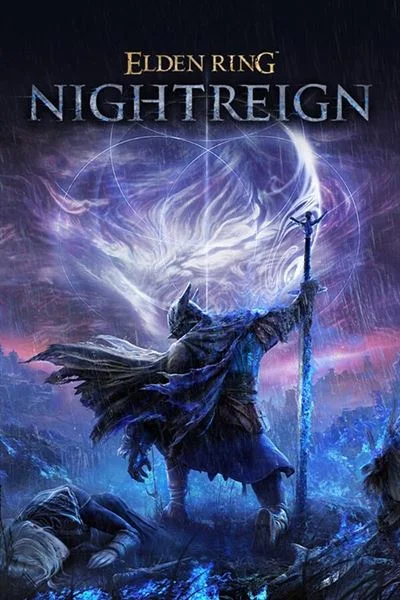
Elden Ring Nightreign
 79
★ /10
79
★ /10
 PC,
PC,  PS4,
PS4,  PS5,
PS5,  Xbox One,
  Xbox Series X/S
 FromSoftware, Inc.
 Bandai Namco Entertainment, FromSoftware


Elden Ring: Nightreign is a 2025 standalone action game developed by FromSoftware and published by Bandai Namco Entertainment. Released on May 30, 2025, for PC, PS4, PS5, Xbox One, and Xbox Series X/S, it is a co-operative roguelite spin-off set in the Elden Ring universe — neither a sequel to Elden Ring (2022) nor a DLC expansion, but a separate product with a fundamentally different design.
It holds a Metacritic score of 78 on PS5 and 81 on PC, making it the lowest-rated FromSoftware game in over two decades. Peak concurrent players on Steam reached 313,593 within ninety minutes of launch. The Reddit thread “Elden Ring Nightreign: What It Is and Isn’t” is the fourth-highest organic result for the game in Google search, with 6,795 monthly visits — reflecting the degree to which the game’s format requires explanation to players arriving from Elden Ring.
Technical Specifications
| Attribute | Details |
|---|---|
| Developer | FromSoftware |
| Publisher | Bandai Namco Entertainment |
| Director | Junya Ishizaki |
| Platform(s) | PC · PS4 · PS5 · Xbox One · Xbox Series X/S |
| Release Date | May 30, 2025 |
| Price | $39.99 (Standard) · $54.99 (Deluxe, includes The Forsaken Hollows DLC) |
| Genre | Co-op action roguelite |
| Mode(s) | 3-player co-op (solo and duo matchmaking available) |
What Nightreign Is — and Isn’t
The community thread that best explains Nightreign‘s reception is titled “What it is and isn’t,” and the distinction is the most useful starting point.
What it is not: a sequel to Elden Ring, a DLC for Elden Ring, an open-world game, a traditional Soulslike, or a game where character builds persist between sessions. It does not require Elden Ring to play.
What it is: a three-player co-op game using Elden Ring‘s combat framework, structured as a series of self-contained “Expeditions” lasting approximately 45 to 60 minutes each. Players select a premade character, enter a dynamically shifting map called the Shifting Earth, survive three escalating nights, and attempt to defeat a Nightlord boss at the end of the third night. Character progress from gear and weapons found during a run does not carry between runs; a separate meta-progression system (Relics) unlocks permanent improvements between Expeditions.
This structure is closer to Hades, Risk of Rain, or battle royale survival games than to anything FromSoftware has previously built. It uses Elden Ring‘s combat vocabulary — the timing windows, the weapon categories, the spell archetypes — and applies them to a genre with entirely different pacing and structural logic.
Limveld: The Setting
Nightreign is set in Limveld, a world adjacent to but separate from the Lands Between of Elden Ring. Limveld’s geography changes between Expeditions through the Shifting Earth system — environmental configurations vary run-to-run, altering which points of interest, bosses, and items appear. The map begins large and shrinks over the course of each night in a battle royale-style contracting zone that pushes all three players toward the same central areas as night progresses.
The Nightlords — the bosses at the end of Night 3 — draw from across FromSoftware’s catalogue rather than exclusively from Elden Ring. Enemies from the Dark Souls series appear as opponents within expeditions alongside Elden Ring-derived creatures. This cross-franchise inclusion was described by GamesRadar as making the game feel “like a mod in the best way” — a compliment directed at the celebration of FromSoftware’s legacy rather than the game’s own originality.
The Eight Nightfarers
Nightreign replaces Elden Ring‘s character creation with eight premade characters called Nightfarers, each with a fixed stat spread, a starting weapon, a unique passive ability, and an ultimate skill that charges over the course of a run. The eight cover the major combat archetypes from the broader Elden Ring ecosystem: a melee warrior, a tank, a sorcerer, an agile dagger user, an archer, an assassin, a strength-focused berserker, and a spirit/undead archetype. Characters level up within a run from enemies defeated, with each level granting a choice of three passive upgrades specific to that character.
The eight-character system was designed to make each run’s feel dependent on the combination of the trio rather than individual build customisation. A team of three ranged characters plays very differently from a mixed melee-and-mage composition, and the game’s internal balancing was built around the interaction between the archetypes rather than the refinement of a single one.
How a Run Works: Three Nights
Each Expedition follows the same structural template, though the specific content varies:
Night 1 begins with the three Nightfarers in Limveld, able to explore the Shifting Earth’s initial configuration. The zone begins contracting as the night progresses. Players collect weapons, upgrade their gear at field shrines, and fight the enemies in their path. Night 1 ends with a Field Boss — a named enemy of moderate power that drops significant items and provides a clear checkpoint for gear level.
Night 2 extends the same loop at higher intensity. Enemies are harder, the zone contracts faster, and the Field Boss is more demanding. Survivors of Night 2 enter the final phase with whatever gear and levels they have accumulated.
Night 3 presents the Nightlord — the run’s final boss, significantly more powerful than the Field Bosses and often pulling from Elden Ring‘s or FromSoftware’s wider catalogue. If the trio defeats the Nightlord, the Expedition succeeds; all three players receive Remembrances and Relics for their performance.
Death during a run allows teammates to revive downed players within a time window. A player who is not revived is eliminated from that run but remains spectating. If all three players are eliminated, the Expedition ends in failure with partial Relic rewards.
Without a Full Trio: The Central Criticism
Nightreign‘s design, combat calibration, and matchmaking are built around three players. This is the source of most of the gap between its Metacritic score (78) and the enthusiasm of players who engaged with it as intended.
Solo play is described in nearly every review as severely hampered — balancing tuned for three players does not scale appropriately to one, and the absence of in-game communication tools (voice chat or a pinging system equivalent to Apex Legends‘) makes co-ordination with random matchmaking players reliant on timing and inference. At launch, there was no crossplay between platforms, meaning PC, PlayStation, and Xbox players could not fill their trios from the combined player pool — a significant constraint on matchmaking quality. Crossplay was added in a subsequent update.
Players who consistently ran with two friends reported the game at a substantially different level of enjoyment — the reviews that score it highest (several 9/10 outlets) are uniformly from reviewers who played with a stable trio. The Metacritic aggregate primarily reflects experiences that included some proportion of underpopulated or random-matched runs, which the game handles significantly less well.
The Forsaken Hollows
Elden Ring Nightreign: The Forsaken Hollows was released December 4, 2025, as the first paid DLC expansion for the game ($15 standalone; included in the Deluxe Edition). It added:
- Two new Nightfarers: Scholar (an academic with arcane and consumable-focused abilities) and Undertaker (an abbess wielding a hammer, focused on strength and faith)
- Two new Nightlord expeditions: Balancers (a multi-enemy encounter) and Dreglord (the expansion’s primary new Nightlord)
- One new Shifting Earth environment: The Great Hollow — an underground crystal cavern with its own point-of-interest layout, enemies, and bosses
- Quality-of-life improvements to matchmaking, passive skills, and invasion events
A December 17 update expanded The Forsaken Hollows content into the game’s Deep of Night mode — the hardest available difficulty setting — bringing the expansion’s bosses into that tier and further extending endgame content. Kadokawa’s FY2025 earnings report confirmed additional Nightreign content is in development.
Reception and the r/Nightreign Community
The game’s 78 Metacritic on PS5 places it as the lowest-reviewed FromSoftware game since 2000, when the studio released two platform games that scored identically. The comparison is frequently cited to contextualise the score — it is low for FromSoftware, not low in any absolute sense, and the criticism is specific: the trio requirement, the crossplay absence, the matchmaking quality, and the map variety. None of these relate to the combat quality, which is universally considered to carry the Elden Ring standard.
The most significant SERP data point for this game is not its Metacritic score but its r/Nightreign subreddit, which draws 37,986 monthly organic visitors — the single highest traffic result in the game’s search landscape, nearly double Wikipedia and three times the game’s PlayStation store page. That traffic level, for a dedicated subreddit of a year-old standalone spin-off, reflects a player community that found what it was looking for despite the critical score and is actively engaged in runs, builds, and Relic theorycrafting more than twelve months after launch.
Elden Ring: Nightreign is, accurately, a game that either delivers or doesn’t depending entirely on whether the player has two committed co-op partners. For players who do, it is consistently described as one of the best implementations of FromSoftware’s combat in a genre pivot. For players who don’t, it is a frustrating and underserved experience. The Metacritic score averages those two populations and arrives at 78.