Elden Ring
 96
★ /10
96
★ /10
 PC,
PC,  PS4,
PS4,  PS5,
PS5,  Xbox One,
  Xbox Series X/S
 FromSoftware, Inc.
 Bandai Namco Entertainment, FromSoftware


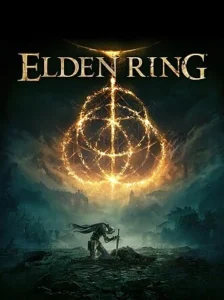
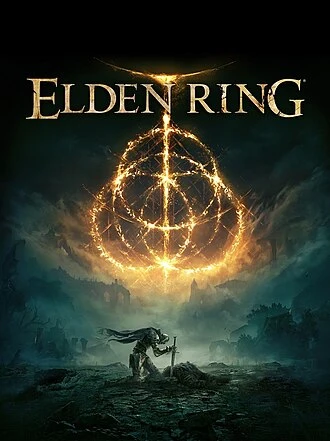
Elden Ring is a 2022 action role-playing game developed by FromSoftware and published by Bandai Namco Entertainment. Released on February 25, 2022, for PlayStation 4, PlayStation 5, Xbox One, Xbox Series X/S, and PC, it is the first open-world game in FromSoftware’s catalogue and the product of a collaboration between director Hidetaka Miyazaki and novelist George R.R. Martin, who wrote the world’s foundational mythology.
The game received Metacritic scores of 96 on PS5, 95 on PC, and 97 on Xbox Series X — making it the highest-rated game of 2022 by aggregate and one of the highest-rated games ever recorded. It won Game of the Year at The Game Awards 2022, the BAFTA Games Awards 2023, and virtually every equivalent award of that cycle. It has sold over 25 million copies. It held the record for the highest-rated RPG on Metacritic until Baldur’s Gate 3 (2023) surpassed it.
Technical Specifications
| Attribute | Details |
|---|---|
| Developer | FromSoftware |
| Publisher | Bandai Namco Entertainment |
| Director | Hidetaka Miyazaki |
| Mythology | George R.R. Martin |
| Composers | Tsukasa Saitou · Shoi Miyazawa · Yoshimi Kudo · Tai Tomisawa |
| Platform(s) | PlayStation 4 · PlayStation 5 · Xbox One · Xbox Series X/S · PC |
| Release Date | February 25, 2022 |
| Genre | Action RPG, Open world |
| Mode(s) | Single-player · Online multiplayer (co-op, PvP) |
The Lands Between: Setting and the Shattering
Elden Ring is set in the Lands Between — a vast, dying realm once governed by a divine force called the Elden Ring and its holder, the Elden Lord. The Elden Ring has been shattered. Its fragments, the Great Runes, are held by the demigod children of the absent god Marika, each of whom went to war with the others in an event called the Shattering. The Lands Between is a kingdom in the aftermath of a divine civil war, its institutions collapsed, its armies still fighting, its geography warped by the power the demigods carry.
The player character is a Tarnished — one of the exiles who lost the grace of the Elden Ring’s power and were driven from the Lands Between. They are called back by a guiding light, charged with gathering the Great Runes, defeating the demigods who hold them, and becoming Elden Lord. What that means — and whether it is a goal worth pursuing — is the question the game’s lore returns to again and again without ever answering cleanly.
George R.R. Martin wrote the world’s prehistory: the creation myths, the lineages of the demigods, the events that preceded the game’s opening. Hidetaka Miyazaki and FromSoftware developed the playable present from that foundation. The result is a Soulslike game with a denser, more elaborate backstory than any previous FromSoftware title — a world that rewards obsessive reading of item descriptions and environmental geometry, in which the relationships between characters mostly described in past tense can sustain entire communities of lore analysis years after release.
FromSoftware and the Soulslike
FromSoftware had built its modern reputation through Demon’s Souls (2009), Dark Souls (2011), Dark Souls II (2014), Bloodborne (2015), Dark Souls III (2016), and Sekiro: Shadows Die Twice (2019) — a consistent lineage of action games defined by precision combat, environmental storytelling, high consequence death mechanics, and deliberate opacity in narrative design. Elden Ring extended this lineage into a new structural format.
The core combat is recognisable from the Dark Souls series: attacks require stamina management, blocking consumes the same resource, dodging with correct timing produces an invincibility window (“i-frames”) that passes through enemy attacks, and enemies deal significant damage relative to most action-game contemporaries. The formula was refined rather than reconceived — Elden Ring’s combat improvements include Spirit Ashes (summoning AI companions mid-fight), horseback combat across the open world, and a broader range of weapon archetypes than any prior FromSoftware game. The Stance system, which allows staggering enemies with consecutive heavy attacks for critical strikes, was the most consequential mechanical change from Dark Souls III.
Death sends the player back to the last resting point (a Site of Grace, equivalent to bonfires in Dark Souls), drops all accumulated Runes (the currency used for levelling), and respawns all enemies. Runes can be recovered if the player reaches the place of death before dying again. The system is familiar to anyone who played previous FromSoftware games; for players new to the studio, it is the mechanic that most requires adjustment to accept.
The Open World
Elden Ring was the first FromSoftware game to use an open-world structure, and the design approach differed meaningfully from the open worlds of contemporaries like Breath of the Wild or Bethesda’s games. The Lands Between is divided into six major regions — Limgrave, Liurnia of the Lakes, Caelid, Altus Plateau, Mountaintops of the Giants, and the underground Siofra River system and Nokron — each with a defining visual identity, a major Legacy Dungeon (the large, tightly structured areas that inherit the level design tradition of Dark Souls), and a populated open field containing optional dungeons, caves, enemy camps, and NPC questlines.
The open world rewards exploration over direction. There is no quest log. Optional content, significant items, and entire questlines that affect the ending can be missed without warning. The game does not mark all dungeon entrances on the map. Players who approach it expecting a guided experience will find it disorienting; players who engage with its exploration on its own terms will find the Lands Between consistently yields discoveries in proportion to attention.
The interconnected world design of Dark Souls — the famous shortcut revelation from Firelink Shrine to the Undead Burg — is extended here to a continental scale. Reaching a region normally accessed late in the game through an early-game path is possible and occasionally delivers rewards calibrated for the destination rather than the origin.
Spirit Ashes and Build Diversity
Elden Ring‘s ten starting classes provide initial stat distributions, but the game’s deep progression allows any build to develop toward any archetype. A starting Warrior becomes a mage; a Prophet becomes a dual-weapon berserker. The level cap is high enough that most builds can eventually access their preferred tools regardless of starting class.
Spirit Ashes are summon items that call AI-controlled companions into fights — a new mechanic for FromSoftware’s games that was designed to lower the barrier of entry for the studio’s most demanding encounters without making them trivial, since many bosses respond to Ashes by splitting attention rather than becoming easier. The Mimic Tear Ash, which creates a copy of the player character, became the most discussed Spirit Ash for its combination of effectiveness and absurdist logic.
The result was the most build-diverse FromSoftware game at release, with the community identifying functional and powerful expressions of archetypes — pure intelligence, strength-scaling colossal weapons, arcane bleed, faith lightning — that produced substantively different combat experiences depending on investment.
Lore and the Item Description Tradition
FromSoftware’s narrative delivery method — information embedded in item descriptions, architecture, enemy placement, and NPC fragments rather than cutscenes and exposition — reaches its most elaborate expression in Elden Ring. The game does not explain who Ranni the Witch is when the player first meets her. It does not explain the Shattering. It does not explain what the Elden Ring actually is. All of this is deducible through sustained engagement with the world, but nothing is handed over.
The lore community that assembled around Dark Souls — YouTube channels like Vaatividya, community wikis, Reddit threads reconstructing boss backstories from weapon descriptions — grew substantially with Elden Ring. The Fextralife wiki for Elden Ring draws 15,000 monthly organic visits from a single Google search alone. The wiki.gg alternative draws 3,700 more. The game’s lore is actively debated and investigated more than three years after release, with a rate of new community discovery that suggests the full scope of what FromSoftware embedded has not been catalogued.
Online: Co-op and Invasion
Elden Ring uses FromSoftware’s established online systems with modifications for the open world. Players can leave messages (short preset sentences that other players can read and rate) at any point in the world, see faint ghost images of other players moving through the same space, and view the death locations of online strangers as red bloodstains.
Cooperative multiplayer allows up to three players simultaneously in another player’s world, entered through a summoning system involving Furlcalling Finger Remedies and Tarnished’s Furled Fingers (a deliberately obtuse item set that initially baffled players and was addressed through community documentation). Co-op is restricted to specific locations rather than the entire open world when playing with strangers.
PvP invasion allows hostile players to enter another’s world and attack them — an optional but always-possible system in Dark Souls that Elden Ring retained. The invasion balance was contested throughout the first year, with solo players arguing the system was unfair, invasion players arguing the removal of certain restrictions hobbled competitive play. Updates adjusted the system multiple times.
Shadow of the Erdtree
Elden Ring‘s first and currently only major DLC expansion, Shadow of the Erdtree, released on June 21, 2024. Set in the Realm of Shadow — a parallel space accessible through Mohg’s arena after defeating the Blood Lord — it introduces a new region of equivalent scale to several of the base game’s main areas, with new weapons, new bosses, and a new progression system (Scadutree Fragments) that scales the player’s power in the DLC zone specifically.
The expansion received a Metacritic score of 94 on PS5, making it the highest-rated DLC in the history of the platform at the time of release. Its primary antagonist, Messmer the Impaler, was received as one of the strongest boss designs in the studio’s history. The final boss — Radahn, Consort of Miquella — became the subject of intense difficulty debate, with many players describing him as the hardest boss FromSoftware had ever produced, and FromSoftware applying a balance patch that reduced his damage output while community sentiment about the fight remained divided.
The DLC’s story connects directly to the game’s deepest lore threads and is recommended to be played after completing the base game’s main areas, particularly Mohg’s questline.
Elden Ring: Nightreign
Elden Ring: Nightreign is a standalone spin-off released May 30, 2025 — not a DLC, not a sequel, but a separate product built on Elden Ring’s engine and combat for a fundamentally different format. Three-player co-op is the designed mode; players choose from eight premade characters called Nightfarers and complete runs of approximately 40 minutes across three increasingly dangerous nights in a separate world called Limveld, culminating in a boss encounter. The run structure borrows from roguelite design, with build progression resetting between expeditions and meta-progression applied between them.
It received a Metacritic score of 78 — the lowest for a FromSoftware game in over two decades, reflecting criticism of its dependence on a full trio and the absence of crossplay at launch — while retaining praise for its combat. A DLC expansion, The Forsaken Hollows, followed in December 2025. A separate card covers Nightreign in detail.
Reception and Legacy
Elden Ring swept 2022’s critical and industry awards with a consistency that had not been seen since The Witcher 3 (2015) and would not be replicated until Baldur’s Gate 3 the following year. At The Game Awards 2022, it won Game of the Year, Best Game Direction, Best Art Direction, and Best Score/Music. At the BAFTA Games Awards 2023, it won Best Game. At the Golden Joystick Awards, it won Game of the Year for both 2022 and in the Ultimate Game of the Year category.
The game’s accessibility relative to prior FromSoftware titles — larger and more directive in its world structure, more accommodating of different build philosophies through Spirit Ashes, more forgiving in its rune recovery mechanics than early Dark Souls — brought in a substantially broader audience than the studio had previously reached, while the depth and difficulty retained the core Soulslike audience. The balance between breadth and depth was the critical factor in its crossover reception.
The highest-trafficked single result for the game in Google search — more than any review, any guide, or any official page — is the game’s Steam store page, with 38,928 monthly visitors. Elden Ring is the kind of game people find, buy, and return to discuss online. That cycle, three years after release, continues.