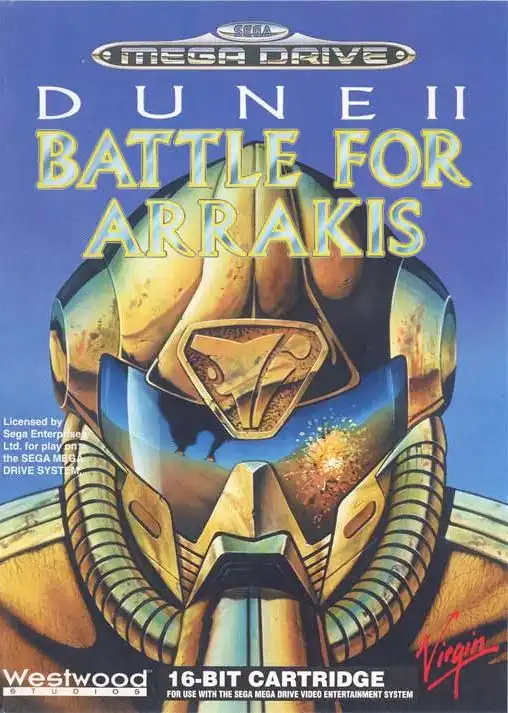
Dune: The Battle for Arrakis
Expansion of Dune 2: The Building of a Dynasty Sega Genesis
 Westwood Studios
 Virgin Interactive Entertainment
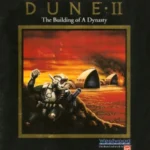
Dune: The Battle for Arrakis is the alternate title for the legendary 1992 RTS Dune II: The Building of a Dynasty. While it was used as the official name for the European MS-DOS and Amiga releases, the title is most famously associated with the phenomenal 1993 Sega Genesis / Mega Drive port.
Adapting a highly complex, mouse-driven PC strategy game for a home console with a mere three-button gamepad was considered near-impossible at the time. However, Westwood Studios managed to deliver an incredibly polished port that not only worked flawlessly on a TV screen but actually introduced interface improvements that pre-dated the quality-of-life features of modern PC strategy games.
Gameplay and Console Adaptations
While the core mechanics remained identical to the PC version—harvest Spice, build a base on concrete slabs, avoid Sandworms, and wipe out the enemy—the interface was completely rebuilt from the ground up to accommodate the Sega Genesis controller.
Key gameplay mechanics and console-specific innovations include:
- The Context-Sensitive Cursor: This was a massive, revolutionary improvement over the original PC version. On PC, if you wanted to shoot an enemy tank, you had to click your unit, click the word “Attack” on a sidebar menu, and then click the enemy. In The Battle for Arrakis on the Genesis, Westwood eliminated the sidebar menu. If you selected your tank and clicked on an enemy, the game automatically knew you wanted to attack. If you clicked on empty sand, it knew you wanted to move. This “smart cursor” became the absolute standard for all future RTS games.
- Full-Screen Battlefield: Because the bulky PC sidebar menu was removed, the battlefield took up the entire television screen. Build menus and unit commands only popped up as unobtrusive overlays when a specific building or unit was actively selected.
- Streamlined Building and Harvesting: The pacing was slightly adjusted for console players. Harvesting Spice felt a bit faster, and managing the base was streamlined to ensure players weren’t overwhelmed while wrestling with a D-pad.
- The Password System: Because Sega Genesis cartridges lacked massive internal save batteries, the game utilized a robust password system. After completing a brutal, hour-long mission, players were given a code to write down in a notebook so they could resume their campaign the next day.
The Factions
Just like the PC release, players were tasked with choosing one of the three Great Houses vying for control of the planet, each retaining their unique super-weapons and late-game units:
- House Atreides: The noble faction, utilizing Sonic Tanks and the ability to summon Fremen warriors.
- House Harkonnen: The brutal faction, utilizing the heavily armored Devastator tanks and the apocalyptic Death Hand missile.
- House Ordos: The insidious, Westwood-exclusive merchant faction, utilizing high-speed trikes and the mind-controlling Deviator tanks.
Development and Legacy
Porting PC games to 16-bit consoles often resulted in notoriously terrible, watered-down experiences (like the infamous SNES ports of Doom or Wolfenstein 3D). Dune: The Battle for Arrakis is widely celebrated as one of the rare exceptions to this rule.
To make the game shine on Sega’s hardware, legendary Westwood composer Frank Klepacki completely re-arranged the soundtrack. He utilized the Genesis’s Yamaha YM2612 FM synthesizer chip to create a driving, heavy, electronic soundtrack that many retro-audio enthusiasts argue sounds vastly superior to the original PC MIDI files.
Ultimately, The Battle for Arrakis proved to the gaming industry that Real-Time Strategy wasn’t strictly confined to the desktop computer. By demonstrating that complex macro-management could be elegantly mapped to a gamepad, Westwood laid the critical groundwork for their own future console ports, leading directly to the highly successful PlayStation and Nintendo 64 versions of Command & Conquer and Red Alert just a few years later.
Key Features:
- The Console RTS Pioneer — Experience the grandfather of the RTS genre brilliantly adapted for a 16-bit home console, proving the genre could thrive off the PC.
- Context-Sensitive Controls — Play with a streamlined UI that automatically determines whether you want to move or attack, removing the archaic menu-clicking of the original PC release.
- Full-Screen Warfare — Enjoy an unobstructed view of the Arrakis deserts, completely freed from the bulky, screen-hogging UI sidebars of early 90s PC games.
- Klepacki’s Genesis Soundtrack — Vibe to one of the most iconic, driving 16-bit soundtracks of the era, heavily utilizing the Sega Genesis’s FM synthesis capabilities.
- Password Progression — Relive the ultimate 90s gaming experience of carefully writing down 16-character passwords in a notebook to save your campaign progress.
Release Platforms:
- Sega Genesis / Mega Drive — 1993 (North America) / 1994 (Europe)
- (Note: The title ‘Dune: The Battle for Arrakis’ was also used for the European regional packaging of the PC and Amiga floppy disk versions).