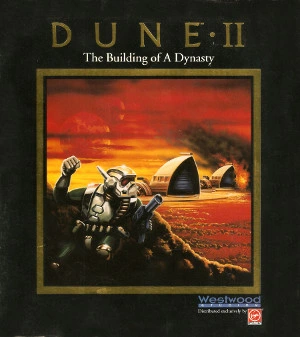
Dune 2: The Building of a Dynasty
 Acorn Archimedes,
  Amiga,
  PC
PC
 Westwood Studios
 Virgin Interactive Entertainment
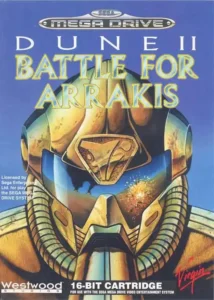
Dune II: The Building of a Dynasty (released in Europe and on consoles as Dune II: Battle for Arrakis) is a 1992 video game developed by Westwood Studios and published by Virgin Games. If games like Warcraft and StarCraft are the undisputed kings of the Real-Time Strategy (RTS) genre, Dune II is the sacred text that birthed them. It is widely considered one of the most important and influential titles in PC gaming history, codifying the absolute blueprint for the modern RTS genre.
Based on Frank Herbert’s legendary sci-fi universe (and drawing heavy visual inspiration from David Lynch’s 1984 film), the premise drops players onto the harsh, desert planet of Arrakis. The Padishah Emperor Shaddam IV has issued a challenge to three Great Houses: whoever can harvest the most of the invaluable Spice Melange will gain sole governorship of the planet. There are no rules of engagement, leading to a brutal, three-way planetary war.
Gameplay
While earlier games like Herzog Zwei experimented with real-time tactical elements, Dune II was the first game to combine all the foundational mechanics of the RTS genre into one cohesive, mouse-driven package.
Key gameplay mechanics and historical innovations include:
- The Core RTS Loop: Dune II invented the holy trinity of strategy games: construct a base, harvest a single vital resource (Spice) to fund your economy, and build a massive army to wipe out the enemy base.
- The Fog of War: The map starts completely shrouded in darkness. Players have to physically send scouts out into the unknown to uncover the terrain, locate enemy outposts, and find lucrative Spice fields.
- Base Building and Tech Trees: You start with a Construction Yard. From there, you must build Wind Traps for power, Refineries to process Spice, and specialized factories to build advanced units. Crucially, players had to lay down Concrete Slabs before building structures; otherwise, the harsh desert environment would rapidly degrade their buildings.
- The Shai-Hulud: The planet itself is hostile. If players left their heavy tanks or slow-moving Spice Harvesters sitting on the open sand for too long, massive, indestructible Sandworms would breach the surface and instantly swallow the units whole. Players had to use solid rock outcroppings as safe havens.
- Archaic Interface: By modern standards, the controls are agonizingly archaic. There was no “click-and-drag” box to select multiple units at once, and no right-click context menus. To launch an attack, a player had to click a single unit, physically click the “Attack” button on the UI menu, and then click the target.
The Three Factions
Dune II pioneered the concept of asymmetrical factions. While they shared a basic pool of units, each House possessed unique super-weapons, specialized endgame units, and entirely different strategic philosophies:
- House Atreides: The noble faction. They play a balanced, conventional military game. In the late game, they gain access to Sonic Tanks (which fire damaging soundwaves) and the ability to call upon native Fremen warriors to ambush enemies.
- House Harkonnen: The brutal, heavily armored faction. They sacrifice speed for pure, unadulterated firepower. Their signature unit is the massive Devastator tank, and their super-weapon is the devastating “Death Hand” nuclear missile.
- House Ordos: A deeply fascinating addition. House Ordos does not exist in Frank Herbert’s original novels; they were created entirely by Westwood Studios for this game. They are insidious, wealthy traders who rely on speed, mercenaries, and the “Deviator” tank—a vehicle that fires a nerve gas that temporarily mind-controls enemy units.
Development and Legacy
Developed by a small team led by Brett Sperry and Aaron Powell, the game was originally pitched simply as a strategy game in the Dune universe. During development, Sperry actually coined the term “Real-Time Strategy” specifically to market Dune II, needing a phrase to separate it from the slow, turn-based wargames of the era.
Upon its release in late 1992, it was a massive critical and commercial success. It proved that fast-paced, mouse-driven strategy games were not only possible but incredibly addictive.
The legacy of Dune II cannot be overstated. A couple of years later, Blizzard Entertainment would play Dune II and decide to put their own fantasy spin on the formula, creating Warcraft: Orcs & Humans (1994). Meanwhile, Westwood Studios took the exact engine and mechanics they built for Dune II, polished the interface, and created the monumental Command & Conquer (1995).
Today, while the original MS-DOS version is incredibly clunky to play, its DNA lives on in every single base-building strategy game on the market. It is heavily preserved by the retro community through open-source engine remakes like Dune Legacy and OpenDUNE, which allow modern players to experience the grandfather of the RTS genre with quality-of-life updates like multi-unit selection and high-resolution support.
Key Features:
- The Original Blueprint — Experience the 1992 masterpiece that literally coined the term “Real-Time Strategy” and invented the modern base-building genre.
- Harvest the Spice — Manage your economy by sending Harvesters out into the treacherous sands, defending them from enemy raids and the terrifying Sandworms.
- Three Unique Houses — Command the noble Atreides, the brutal Harkonnen, or the insidious, Westwood-exclusive House Ordos.
- Fog of War — Explore the shrouded map, utilizing radar outposts and fast-moving trikes to uncover the enemy’s location.
- Super Weapons — End the game in spectacular fashion by unleashing House-specific super-weapons, from Fremen uprisings to the terrifying Death Hand missile.
Release Platforms:
- MS-DOS (PC) — December 1992
- Amiga — 1993
- Sega Genesis / Mega Drive — 1993 (Released under the title ‘Dune: The Battle for Arrakis’ with a slightly modified UI and controls).