Diplomacy
 58
★ /10
58
★ /10
 PC
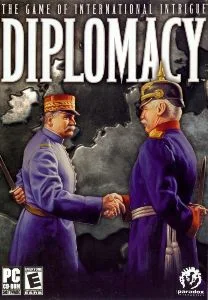
PCDiplomacy (2005) holds a highly unique, transitional, and deeply experimental position in Paradox Interactive’s early catalog. Released in North America on October 4, 2005 (and rolling out to Europe on December 9, 2005), this title was a rare detour for Paradox Development Studio. Rather than crafting an original sandbox built upon an internal grand strategy engine, they set out to create a direct digital translation of Allan B. Calhamer’s legendary, friendship-destroying 1959 board game of the same name.
It stands as Paradox’s pure, uncompromising exploration of raw geopolitical psychology, backstabbing, and non-binding contracts—packaged with an animated 3D graphical presentation that was heavily ambitious for its era.
The Tabletop Canvas: Europe 1901
The game entirely bypasses the deep tech trees, industrial economies, and random dice rolls of the Europa Universalis or Hearts of Iron series. Instead, it perfectly replicates the rigid, deterministic ruleset of the tabletop classic:
- Seven players assume command of the major European powers at the dawn of the 20th century: Great Britain, France, Germany, Italy, Austria-Hungary, Russia, and the Ottoman Empire.
- The map canvas is carved into specialized land provinces and sea zones peppered with Supply Centers.
- The ultimate objective is simple: capture and hold a majority of the map’s 34 Supply Centers. Every center you control allows you to maintain exactly one army or fleet; losing a center forces you to disband a unit.
Key Mechanical Design & Paradox Adaptations
1. Zero Randomness: The Order Resolution Engine
True to the Calhamer blueprint, combat in Diplomacy features absolutely no luck. Every military unit has an identical strength rating of exactly 1. If an Army moves into a province defended by an enemy Army, the attack results in a pure mathematical bounce—unless a third adjacent unit is ordered to Support the attack.
Because all actions are evaluated simultaneously, players cannot react on the fly. You must lock in your commands blindly, praying that the allies who promised to support your flank don’t execute a sudden, devastating betrayal.
2. The Language-Independent Negotiation Grid
To solve the friction of negotiating complex military movements in online lobbies, Paradox designed a localized Iconographic Proposal System.
Instead of typing long text paragraphs, players used an interface of drag-and-drop symbols to forge complex, conditional treaty clauses (e.g., “If France attacks Belgium in Spring, then Germany will support England in Holland”). This symbolic grid allowed players who spoke entirely different real-world languages to clearly communicate, coordinate multi-front battle plans, and effortlessly lie to one another in multiplayer lobbies.
3. Animated 3D AI Avatars
In a major departure from the static map sprites of older Paradox games, the 2005 client represented your AI opponents as fully modeled, stylized 3D character avatars mapping historical leaders.
The developers attempted to inject psychological life into these AI personalities by programming them to react visually. If you proposed a mutually beneficial trade, they smiled; if you broke a non-binding alliance or marched troops into their core territories, their avatars would dynamically pop up on screen, perform distressed grunting sounds, and display visible anger before flashing away.
The Factions Matrix
| Playable Power | Starting Board Footprint | Core Strategic Reality & Playstyle Meta |
| Great Britain | The British Isles | The Maritime Turtle: Insulated by sea lanes; completely dependent on securing early naval dominance in the North Sea to bottleneck Germany and France. |
| Russian Empire | Eastern Europe | The Sprawling Vanguard: The only power that begins the match with four active units; heavily overextended, requiring immediate diplomatic pacts to avoid multi-front wars. |
| German Empire | Central Europe | The Continental Crossroads: Sits right in the center of the board; highly prone to early elimination if France and Russia coordinate an immediate alliance. |
| Kingdom of Italy | Southern Europe | The Opportunistic Spoiler: Possesses a highly defensive peninsula base but low early expansion vectors; relies on picking off vulnerable centers during the Austro-Ottoman clashes. |
| Austria-Hungary | Central Balkans | The Powder Keg: Positioned in a highly volatile territory bordered by three rival factions, forcing an immediate alliance with either Russia or the Ottomans to survive. |
| Republic of France | Western Europe | The Flexible Titan: Highly secure borders paired with excellent access to neutral Iberian centers, built to act as a major power broker in early negotiations. |
| Ottoman Empire | Asia Minor / Levant | The Corner Stronghold: Protected by the edges of the map grid; can accumulate massive naval and land momentum if they securely bottleneck Russia in the Black Sea. |
Reception, Flaws, & The AI Bottleneck
Upon its late 2005 release, Diplomacy was met with a mixed, highly lukewarm response from critics, securing an aggregate score of 58/100 on Metacritic. While publications praised Paradox for successfully modernizing the visual style of the classic board game, the execution suffered from two critical vulnerabilities:
- The AI Paradox: Diplomacy is fundamentally a game of human psychology, nuance, and emotional manipulation. Paradox’s programmed AI proved completely incapable of replicating this human element. Veteran players quickly discovered the computer could easily be beaten using “gunboat” tactics—completely ignoring the negotiation phase and out-maneuvering the predictable AI pathfinding scripts on the map grid through raw positioning.
- Interface Friction: Critics like IGN and GameSpot slammed the game’s erratic resolution phase camera, which would cut frantically between map angles without explicitly detailing why specific support moves failed or got cut. Furthermore, the online netcode was unstable at launch, severely hamstringing the multiplayer lobbies that the game required to thrive.
Modern Digital Availability Notice
Because Diplomacy was a licensed adaptation of a property currently held by Avalon Hill/Hasbro, the game eventually ran into permanent digital distribution hurdles.
Unlike Paradox’s mainline proprietary franchises, the 2005 Diplomacy video game is completely unavailable on modern digital storefronts like Steam or GOG. It remains trapped in legacy retail limbo. To play this unique piece of Paradox history today, strategy preservationists must hunt down an original 2005 physical retail CD-ROM or turn to abandonware archival libraries, configuring the installation using legacy 32-bit compatibility wrappers to let the Clausewitz engine prototype boot up on modern Windows architectures.