Armies of Exigo
 PC
PC
 Softclub
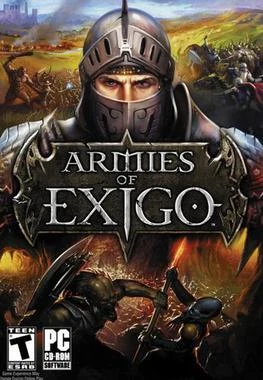
Armies of Exigo is a 2004 real-time strategy (RTS) game developed by the Hungarian studio Black Hole Entertainment and published by Electronic Arts (with backing from Cinergi Interactive). Releasing during the absolute peak of the early-2000s fantasy RTS boom, the game was widely seen as a direct, highly ambitious challenger to Blizzard Entertainment’s massive juggernaut, Warcraft III.
The story is set in the vibrant high-fantasy world of Exigo. For years, the world has been divided by a bitter, traditional war between The Empire (a noble alliance of humans, elves, and dwarves) and The Beast (a savage horde of orcs, goblins, and ogres). However, this familiar surface war is violently interrupted by the arrival of The Fallen—a terrifying, insectoid, and demonic race of aliens that emerges from the deep subterranean caverns of the world. The Empire and The Beast are forced to halt their feud and deal with this apocalyptic new threat from below.
Gameplay
While Armies of Exigo heavily borrows its visual style, interface, and basic economic loop (gathering gold, wood, and gems) from Warcraft III, it introduces one massive, literal game-changing mechanic that completely alters how players approach strategy.
Key gameplay mechanics include:
- The Dual-Layered Map: The defining feature of the game. Every single multiplayer map and campaign mission is split into two fully simulated, concurrent layers: the Surface and the Underground. Players can seamlessly switch their camera between the two planes.
- Vertical Strategy: The two layers are physically connected by cave entrances and tunnels. This opens up incredible strategic opportunities. If an enemy has heavily fortified a surface chokepoint, you can send your army underground, march beneath their defenses, and emerge directly inside their base. Furthermore, certain spells affect both layers—casting a massive Earthquake spell on the surface might cause stalactites to crush enemy units hiding directly below it in the underground.
- The Three Factions: The game features three highly asymmetrical factions:
- The Empire: Traditional, highly organized fantasy armies utilizing knights, elven archers, and powerful human mages.
- The Beast: Relies on brute strength and swarm tactics, utilizing shamans and massive, screen-shaking behemoths.
- The Fallen: A highly unique, Zerg-like faction. They do not build traditional structures; instead, they summon buildings that must be placed on “The Creep,” a corrupted biological mass that they spread across the terrain.
- Massive Armies: Unlike Warcraft III, which heavily focused on small unit counts and micromanaging individual heroes, Armies of Exigo allowed for massive armies. Players could select and command “Supergroups” of up to 200 units simultaneously, leading to spectacular, screen-filling clashes.
- Unit Veterancy: Surviving units earn experience points in battle, eventually leveling up to gain increased health, damage, and glowing auras to signify their veteran status.
Development and Legacy
Armies of Exigo was the debut title for Black Hole Entertainment, a studio founded with the financial backing of legendary Hollywood film producer Andy Vajna (famous for producing movies like Terminator 2 and Rambo). Vajna’s cinematic influence was heavily felt in the game’s production values. The CGI cutscenes, created by Digic Pictures, were absolutely breathtaking for 2004, rivaling the legendary cinematic quality of Blizzard Entertainment.
Upon its release in late 2004, the game received generally positive but somewhat conflicted reviews. Critics highly praised the innovative dual-layered map mechanic, the stunning graphics, and the epic scale of the battles. However, it was also heavily criticized for being a bit too derivative of Warcraft III and StarCraft in its unit design and narrative tropes.
Unfortunately for Black Hole Entertainment, the game launched into an incredibly crowded market. It had to compete not only against the continued dominance of Warcraft III: The Frozen Throne, but also against the release of Relic’s genre-defining Warhammer 40,000: Dawn of War and creative heavyweights like Rome: Total War. As a result, Armies of Exigo failed to gain a massive multiplayer foothold and faded into relative obscurity.
However, the impressive technical foundation of the game put Black Hole Entertainment on the map. The studio would later be tapped to develop Warhammer: Mark of Chaos (2006) and Might & Magic Heroes VI (2011). Today, Armies of Exigo is remembered by RTS veterans as a gorgeous, highly competent hidden gem that dared to add a literal new dimension to the genre.
Key Features:
- Two Fronts at Once — Wage war on a revolutionary dual-layered map, managing massive armies on both the sunlit surface and the dark, treacherous underground simultaneously.
- Vertical Flanking — Utilize cave networks to bypass enemy blockades, launch surprise attacks from below, and use environmental magic that bleeds between the two map layers.
- Three Distinct Factions — Command the noble Empire, the savage Beast horde, or the terrifying, shape-shifting Fallen.
- Hollywood-Quality Cinematics — Experience a massive, 36-mission single-player campaign tied together by breathtaking CGI cutscenes.
- Supergroup Combat — Step away from hero-micro and command massive, 200-unit armies in spectacular, large-scale fantasy warfare.
Release Platforms:
- Microsoft Windows (PC) — November 30, 2004 (North America) / December 2004 (Europe)