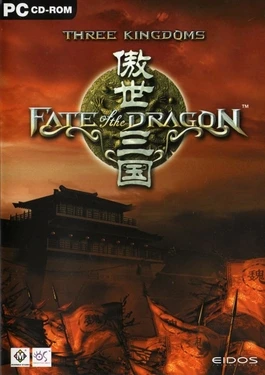
Three Kingdoms: Fate of the Dragon
 PC
PCThree Kingdoms: Fate of the Dragon (released in Asia as 傲世三国 / Aoshi Sanguo) is a real-time strategy (RTS) video game developed by the Chinese studio Object Software (Overmax Studios) and published by Eidos Interactive. Released in March 2001 for Microsoft Windows, the title is heavily based on the historical 14th-century Chinese epic novel Romance of the Three Kingdoms by Luo Guanzhong.
The game is historically significant as one of the first major Chinese-developed video games to receive a widespread, high-profile international release. Mechanically, it takes structural inspiration from the Age of Empires series, but distinguishes itself by introducing deep management layers, including complex raw material processing, dynamic hero deployment, localized taxes, and an unusual multi-layered map system.
Technical Specifications
| Attribute | Details |
| Developer | Object Software / Overmax Studios |
| Publisher | Eidos Interactive |
| Engine | Custom 2D Pseudo-3D Isometric Engine |
| Platform | Microsoft Windows |
| Release Date(s) | • CHN: December 21, 2000 • EU: March 9, 2001 • NA: March 13, 2001 |
| Genre(s) | Real-time strategy (RTS) |
| Modes | Single-player, Multiplayer |
Gameplay Mechanics: The Multi-Layered War
While contemporary strategy games of the early 2000s confined matches to a single flat map grid, Fate of the Dragon features a Dual-Layer Map Matrix.
The Dual-Layer Mapping System
Each scenario partitions the world across localized City Maps and a macro Overworld Map.
- City Maps: Insulated, fortified grid zones where players construct internal infrastructure, manage civilian workforces, and optimize their economies. Each faction initializes behind permanent, towering stone city walls.
- The Overworld Map: Connects all disparate cities together. To launch an offensive against a competitor, armies must march completely out of their city gates, transitioning onto the overworld map to capture neutral resource villages, claim high-altitude passes, and lay siege to hostile fortifications.
Resource Refinement and Logistic Supplies
The game features standard RTS extraction materials—such as Wood, Stone, and Iron.
Civilians do not merely deliver raw wheat or meat to a stockpile to instantly fund military lines. Instead, raw materials must be manually routed through multi-stage processing buildings to create refined items, like Wine and Meat Buns.
Wine is a critical economic driver, spent at temples to appease local deities or served at inns to bolster the population’s happiness metrics. Furthermore, armies cannot simply march infinitely across the map without support; they require Supply Caravans. Units steadily consume food and wine flagons from their inventory while out on campaign; failing to secure these supply lines triggers mass starvation, dropping army efficiency and morale to zero.
The Hero and General System
Combat efficiency centers heavily on unique historical Heroes (such as Guan Yu, Zhang Fei, and Zhao Yun). Heroes are recruited dynamically by constructing Teahouses or Inns.
Once hired, Heroes demand a recurring financial Gold Salary to maintain their loyalty metrics. If a player fails to pay them, or forces them into unfavorable battles, the Hero’s loyalty plummets, eventually causing them to defect to an AI opponent mid-match. Heroes gain personal experience, level up, deploy powerful tactical skills, and can be appointed to bureaucratic government positions to grant massive passive production modifiers to entire cities.
Playable Factions
The single-player campaign mimics the historical dissolution of the Han Dynasty, allowing players to assume the role of one of the three iconic warlords fighting to reunify China:
- The Kingdom of Wei (Cao Cao): Features advanced scientific research speed modifiers and elite heavy cavalry pipelines, representing the industrial and political core of northern China.
- The Kingdom of Shu (Liu Bei): Optimizes high citizen popularity metrics, cheap recruitment costs for standard infantry, and high-tier defensive archer arrays.
- The Kingdom of Wu (Sun Quan): Specializes in high financial tax generation yields and dominant naval warship engineering, dominating river and maritime choke points.
History, Reception, and Modern Status (2026)
Upon its initial 2001 rollout, Three Kingdoms: Fate of the Dragon received mixed to generally favorable reviews from international strategy publications, securing a composite score of 74/100 on Metacritic.
Outlets like IGN and GameSpy highly praised the title for its cultural authenticity, outstanding atmospheric traditional soundtrack, and the strategic depth introduced by the supply wagon mechanics. Conversely, Western reviewers from outlets like PC Gamer criticized the game’s high learning curve and noted that the micro-intensive nature of managing individual factory pipelines and hero salaries could feel tedious during massive multi-front wars.
Current Archival Status
As of 2026, the original 2001 Three Kingdoms: Fate of the Dragon remains a highly sought-after retro classic classified as abandonware. Due to complex, lingering international publishing rights following Eidos Interactive’s absorption into Square Enix, the original game has never received a native digital rollout on platforms like GOG.com or Steam.
However, its direct standalone 2002 sequel, Dragon Throne: Battle of Red Cliffs, was successfully preserved and digitally released on Steam.
To run the original 2001 Fate of the Dragon client on contemporary multi-core Windows 10 and Windows 11 desktop computers, retro gaming communities rely on custom DirectDraw wrappers (such as dgVoodoo2). These community configurations safely redirect legacy graphics calls, letting the beautifully detailed 2D isometric battlefields, ornate Chinese architecture, and massive siege engines scale cleanly into modern widescreen display resolutions without crashing.