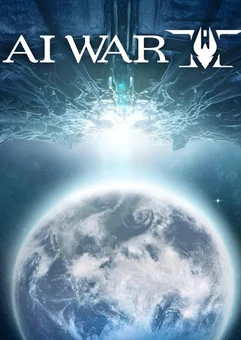
AI War 2
 75
★ /10
75
★ /10
 PC
PC

AI War 2 is a turn-based grand strategy and real-time tactical space strategy hybrid video game developed and published by Arcen Games. Following a successful crowdfunding campaign and an extended Early Access period starting in October 2018, the game officially launched on October 22, 2019, for Microsoft Windows, macOS, and Linux. Serving as the direct sequel to 2009’s AI War: Fleet Command, the game completely overhauls its predecessor’s mechanical architecture by migrating to a modernized, hyper-optimized 3D simulation engine, introducing dynamic minor faction simulation matrices, and completely transforming fleet logistics.
The game maintains the core asymmetrical premise of the original title: humanity has already lost a galactic war against an omnipotent Artificial Intelligence. Starting with a single pocket planet in a vast sea of hostile territory, players must systematically conquer star systems, hack terminal networks, and dismantle AI infrastructures while intentionally managing the AI Progress (AIP) threat indicator. Spiking the AIP draws the direct, overwhelming military gaze of a machine empire that possesses nearly infinite production capabilities.
Technical Specifications
| Attribute | Details |
| Developer | Arcen Games |
| Publisher | Arcen Games |
| Lead Designer | Christopher McElligott Park |
| Composer | Pablo Vega |
| Engine | Unity Engine (Custom multi-threaded 3D simulation framework) |
| Platform(s) | Microsoft Windows, macOS, Linux |
| Release Date | October 22, 2019 |
| Genre(s) | Grand Strategy / RTS Hybrid, Space Simulation, Tower Defense |
| Mode(s) | Single-player, Multiplayer Cooperative |
Mechanical Reinventions over Fleet Command
While AI War 2 preserves the asymmetric grand strategy macro-loops of the original game, it introduces core systemic architectural redesigns to drop late-game micro-management fatigue:
1. The Fleet Centerpiece Pivot
The original game relied on a traditional RTS build queue, forcing players to continuously manufacture thousands of individual starships across scattered planetary shipyards. AI War 2 completely abolishes this system in favor of Fleet Centerpieces.
Players capture and command massive anchor ships (such as mobile Arks, Combat transports, or Citadel flagships). These centerpieces carry dedicated, localized unit slots that automatically build and reinforce their own strike forces up to a set cap limit using pooled national energy grids. If a centerpiece is disabled in combat, it does not permanently explode; instead, it enters an immortal hull phase that can be retreated to friendly territory to undergo full repairs.
2. Localized Hacking vs. Global Tech Pacing
The macro-science progression layer dropped global tier technology levels to implement an active Tactical Hacking System. Players dispatch specialized hacking vessels directly to hostile AI installations to extract valuable ship blueprints, download localized combat data, or sabotage planetary weapon networks. Hacking acts as a short-term, localized crisis trigger—spawning sudden, intense waves of AI responses right on top of the hacking zone—allowing players to secure powerful technological advantages without permanently scaling the universal galactic AIP tracking pool.
Major Expansion Modules
Arcen Games expanded the baseline sandbox through three massive standalone DLC additions, each fundamentally altering faction mechanics:
- The Spire Rises (February 2020): Introduces the massive, non-organic Spire race. It adds an optional, high-stakes game mode where players can actively trigger the Fallen Spire campaign loop. This radically shifts the standard strategy of keeping a low profile into an open, total war map-painting campaign where players erect massive modular Spire cities to survive catastrophic AI counter-exostrikes.
- Zenith Onslaught (May 2021): Injects elite Cruiser hull classes, powerful wandering rogue mercenaries (the Svikari), and terrifying galactic environmental threats—including rogue planet-eating Zenith Miners that physically carve through star systems to consume resource nodes.
- The Neinzul Abyss (April 2022): Introduces a completely transformative secondary player archetype: The Necromancer. Playing as a Necromancer completely removes standard city-building and logistics. Instead, players pilot a modular flagship across space battles to harvest the “Essence” of dead starships, instantly reanimating their wreckage into massive, disposable swarms of undead alien units.
Contemporary Evolution and Status (2026 Perspective)
As of mid-2026, AI War 2 stands as a fully realized, masterfully polished grand strategy platform entering its seventh year of continuous support. Moving far past its baseline retail launch, the software has advanced deep into its v5.8xx lifecycle, with major continuous technical updates deployed in late May and early June 2026 (including version 5.813 Forge of Empires Updates and 5.812 AI Shield Generators).
The game’s engine has undergone a massive structural optimization code sweep overseen by studio founder Chris Park. Dubbed by the community as the “Memory Inferno” and “Neutron Star” overhauls, these mid-2026 engine updates comprehensively re-architected how the software manages memory pressure on complex background calculation threads. By eliminating legacy garbage collection allocation closures, late-game simulation stuttering has been solved:
“The 2026 background optimizations successfully cut memory pressure during dense, end-game galactic engagements involving tens of thousands of simultaneous starships from a staggering 29MB per second down to a pristine 0.7MB to 1.3MB per second, unlocking perfect frame-pacing on modern hardware configurations.”
The complete ecosystem is hosted digitally as the AI War 2: Complete Edition on platforms like Steam and GOG.com. Because Arcen Games thoroughly recompiled their active codebase to ensure modern compatibility profiles, the client executes flawlessly out-of-the-box under modern 64-bit Windows 11 frameworks and carries a solid “Compatible” rating under SteamOS for the Steam Deck, featuring automated vector UI scaling and native touch-screen keyboard integration.