Theocracy
 PC
PC Ubisoft
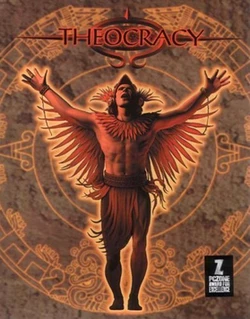
Theocracy is a real-time strategy video game developed by the Hungarian studio Philos Laboratories and published by Ubi Soft in March 2000 for Microsoft Windows and Linux. Set in 15th-century Mesoamerica, the game tasks players with guiding a fictional tribe through regional unification, domestic empire-building, and religious micromanagement to survive the inevitable arrival of the Spanish Conquistadors. Notable for its dark, historically inspired themes, Theocracy was also a pioneer in early PC gaming as one of the few high-profile commercial titles of its era to launch with a native Linux version right on the retail disc.
Technical Specifications
| Attribute | Details |
| Developer | Philos Laboratories |
| Publisher | Ubi Soft (now Ubisoft) |
| Release Date | March 24, 2000 |
| Engine | Proprietary 2D RTS Engine |
| Platform(s) | Microsoft Windows, Linux |
| Genre(s) | Real-time strategy (RTS) |
| Mode(s) | Single-player, Multiplayer |
The Century-Long Countdown: Gameplay & Setting
The core campaign of Theocracy places the player in control of the Atlan tribe, a fictional group that has just escaped tyrannical oppression under a rival faction. The game operates on a strict historical clock: players have exactly 100 years of in-game time to prepare Central America for a devastating external threat.
To survive the endgame apocalypse—the arrival of Spanish Conquistadors—players must expand their borders, establish cross-province trade caravans, forge diplomatic pacts, and raise a formidable military force.
The campaign loop is split cleanly across two distinct operational perspectives:
1. Realm View (The Macro Map)
The strategic layer displays a hand-drawn map of Central America divided into distinct, color-coded provinces. Time only advances while looking at this screen. Players can adjust the time-scale freely; at its slowest setting, a single calendar year takes roughly 10 minutes, while the fastest gear burns through an entire year in approximately 20 seconds. Here, armies are ordered to march across borders, and diplomatic messengers are dispatched to foreign capitals.
2. Province View (The Tactical Grid)
Clicking into a specific territory opens up an isometric 2D view of that province. Here, players manage infrastructure and assign tasks to individual citizens, such as farming, mining, or training soldiers. Crucially, time stands still while editing a province; the player must return to the Realm View for their assigned construction queues and training orders to actively take effect on the global calendar.
The labor system carries real consequences: if you conquer an enemy territory without wiping out its entire army, the remaining survivors are captured and integrated directly into your domestic worker pool.
Asymmetric Tribes & AI Personalities
Central America is populated by five other major rival civilizations alongside the blue-coded Atlans, each possessing a distinct AI behavioral personality and unique military assets:
- The Izhuacans (Red): A hyper-aggressive, warlike religious state that serves as the player’s immediate early-game border threat.
- The Huaputecs (Green): A peaceful, isolationist tribe that will never initiate hostilities unless explicitly attacked or provoked by the player.
- The Yaxuna (Yellow): A faction relying on heavy sword infantry lines supported by spearmen, tamed jaguars, and nature priests.
- The Teotitlans (Cyan): A technologically advanced military power capable of fielding massive, slow-firing siege crossbow units known as Wonderbows.
The Five Spheres of Magic and Human Sacrifice
Religion dictates your true tactical advantage on the battlefield. Players construct massive pyramids dedicated to training Priests across five distinct Spheres of Magic, each focusing on a specific school of utility:
- Sun Magic: Deals massive offensive fire and area-of-effect spells to break enemy ranks.
- Moon Magic: Grants defensive armor buffs, active wards, and protective shields to frontlines.
- Nature Magic: Focused purely on battlefield healing and environmental restoration.
- Star Magic: Specializes in enemy debuffs, sensory distractions, and combat disruption.
- Soul Magic: An elite, versatile school where practitioners are equally skilled across all disciplines.
To cast spells, Priests exhaust a specialized pool of Mana. Unlike traditional fantasy games where mana automatically regenerates over time, Theocracy implements a grim, lore-accurate replenishment system:
“To recharge a Priest’s mana reserves, players must order them to perform human sacrifices at the summit of their pyramids. Players can choose to sacrifice captured enemy prisoners of war or even execute members of their own domestic worker force to immediately fuel their divine magical powers.”
Historical Legacy & Modern Preservation
Theocracy occupies a fascinating milestone in retro PC gaming history. Developed by the defunct Hungarian studio Philos Laboratories, it was a standout early commercial strategy game to launch with native Linux support packaged directly on the retail disc.
In the modern era, the original 2000 client requires significant emulation effort to execute properly. Because it was architected for legacy 16-bit color depths and relied on old OSS Linux audio device structures (/dev/dsp), running the original CD version natively on modern Windows 11 or contemporary Linux distributions requires the use of specialized compatibility layers, virtual environments, or fan-made compatibility wrappers.
However, the game’s core concepts were revitalized in late 2022 when an independent developer released an homage title also called Theocracy on Steam, offering classic 2D top-down turn-based mechanics inspired by the antique maps and religious domination loops of early-2000s strategy design.