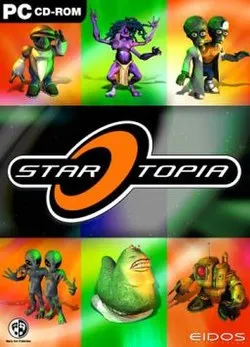
Startopia
 86
★ /10
86
★ /10
 PC
PC
 1C-SoftClub, Eidos Interactive, My Little Planet


Startopia is a space station management and business simulation video game developed by the independent British studio Mucky Foot Productions and published by Eidos Interactive. Released in June 2001 for Microsoft Windows, the title was created by a core team composed largely of ex-Bullfrog Productions employees who had previously worked on seminal genre-defining hits like Dungeon Keeper, Theme Park, and Syndicate.
Set in the immediate aftermath of a devastating, cataclysmic galactic war, the game tasks the player with acting as a digital stationmaster. The objective is to reconstruct and manage a network of giant, derelict, toroidal (donut-shaped) space stations scattered across the cosmos, transforming them into thriving, multi-species hubs of commerce, tourism, and diplomatic cooperation. The game is celebrated for its deep systems, open micro-management, and a highly satirical tone heavily influenced by British science fiction culture.
Technical Specifications
| Attribute | Details |
|---|---|
| Developer | Mucky Foot Productions |
| Publisher | Eidos Interactive |
| Lead Designer | Gary Carr |
| Programmers | Wayne Imlach, Stuart Black, Mike Diskett |
| Engine | Custom 3D Toroidal Engine (Featuring real-time curved horizon scaling) |
| Platform | Microsoft Windows |
| Release Date(s) | • EU: June 15, 2001 • NA: June 19, 2001 |
| Genre(s) | Construction and management simulation, Strategy |
| Modes | Single-player, Multiplayer |
Gameplay Architecture & The Three Decks
The central defining feature of Startopia is the physical geometry of its play space. Every space station is shaped like a giant, rotating hollow torus. This unique framework allows players to look down a continuous, curved indoor horizon where distant structural blocks and walking alien citizens can be seen hanging upside-down directly overhead.
Stations are partitioned into 16 isolated subsections blocked off by heavy security bulkheads. Players expand their territory by spending energy currency to repair, decontaminate, and open adjacent bulkheads. Each subsection is vertically layered across three completely distinct decks, each managing an entirely independent socio-economic simulation loop:
1. The Engineering Deck
The industrial foundation and primary logistical hub of the station. Located at the lowest vertical tier, this is where alien cargo shuttles and trade starships physically dock to unload tourists, immigrants, and wandering merchants.
The player layout centers on essential structural survival mechanisms: Medical Bays to treat toxic interstellar plagues, Recreational Berths for citizen sleep cycles, Research Laboratories to unlock technology tiers, and massive Recycler Plants. The Recycler is critical to the station’s lifecycle; it processes the structural litter and physical trash dropped by sloppy tourists, converting waste directly back into clean energy cubes.
2. The Pleasure Deck
The main economic extraction engine and entertainment center of the station. This middle layer serves as the primary zone where foreign visitors spend their electronic funds.
Players design high-density commercial strips featuring flashing neon Casinos, Space Bars, Luxury Hotels, Brothels (Love Nests), and High-Tech Theme Parks. Maintaining high-end entertainment parameters on this deck elevates global visitor happiness metrics, driving economic prosperity and preventing criminal activity from taking root in the sectors.
3. The Bio-Deck
A fully adjustable, enclosed artificial biosphere located at the uppermost tier under a massive, transparent glass dome. The Bio-deck satisfies the spiritual, psychological, and environmental needs of nature-loving alien races.
Instead of traditional building construction, players interact with this layer through direct Real-Time Terraforming. Using a specialized landscape brush tool, players can dynamically raise mountain topography, dig out deep water lakes, and modify moisture, humidity, and temperature parameters across individual segments.
Altering these variables enables the cultivation of wildly diverse biomes—ranging from arid desert sands to humid tropical jungles or frozen arctic tundras. These biomes naturally grow specialized alien flora and fauna that can be harvested by workers to secure raw commodities for the industrial factories downstairs.
The Alien Demographic Matrix
The player does not exercise direct RTS control over the station’s organic population. Instead, aliens act completely autonomously based on their internal behavioral drives and career traits. To maintain structural efficiency, the player must hire specific individuals from the visitor pool to staff designated rooms.
The global workforce is composed of 9 distinct, asymmetric alien species, each hardcoded to a precise professional role based on their unique biology:
- Groulien Salt Hogs: The blue-collar backbone of the station. These robust, short humanoids handle the dirtiest manual labor, operating the Recycler plants and staffing the manufacturing lines inside heavy Factories.
- Turakken: Highly intelligent, four-armed scientists. They possess exceptional logical statistics and are exclusively required to staff the Research Labs to discover advanced blueprint tiers and upgrade machine efficiencies.
- Targariens: Giant, noble, bird-like humanoids who excel at specialized diagnostics, making them the premier doctors and surgeons needed to operate advanced Medical Bays.
- Zedem Monks: Highly spiritual, robed ascetics who walk the Bio-deck to pray at shrines. They specialize in fulfilling the religious and psychological needs of visitors, converting cynical aliens into tranquil, productive citizens.
- Karmaran: Shaggy, multi-limbed creatures that function as high-end service professionals, running luxury hotels and operating relaxation therapy tables.
- Dahut: Extravagant, hyper-hedonistic party-goers who are hired to manage entertainment utilities, space bars, and dance clubs on the Pleasure Deck.
The Automated Scuzzer Droids
To support the organic workforce, players deploy two variations of automated, spherical robotic droids known as Scuzzers:
- Standard Scuzzers: Small, non-combat maintenance drones that handle structural base construction, execute room repairs, clean up stray litter, and carry heavy freight boxes across decks.
- Security Scuzzers: Heavily armed, militarized variants equipped with stun batons and shields. They police the corridors, detain local criminals, neutralize cloaked enemy saboteurs, and are deployed to actively hack the bulkhead control boxes of competing station managers during territorial annexations.
Setting & Sci-Fi Satire
Startopia features a deeply woven, cynical corporate comedy layer that acts as a continuous parody of classic 20th-century science fiction. The single-player campaign guides the player through a series of increasingly complex regional assignments overseen by a roster of bizarre corporate executives and demanding employers.
The player’s primary interface helper is VAL, the station’s centralized artificial intelligence assistant. VAL serves as an direct parodic homage to HAL 9000 from 2001: A Space Odyssey, presenting critical information, structural disaster warnings, and economic updates with a dry, intensely passive-aggressive, and passive snarky wit.
The narrative and structural writing frequently integrate direct jokes and pop-culture references targeting mainstream science fiction properties, including Star Trek, Red Dwarf, and Doctor Who.
Dedication: The game is officially dedicated to the memory of celebrated comedic science fiction author Douglas Adams (The Hitchhiker’s Guide to the Galaxy), who tragically passed away in May 2001 during the final active weeks of the game’s production cycle.
History and Modern Status (2026)
Cult Classic Status
Upon its initial commercial rollout in the summer of 2001, Startopia garnered widespread “generally positive” reviews from mainstream strategy and simulation critics. Outlets like PC Gamer and GameSpot highly lauded the title for its beautiful, detailed 3D asset animations, praised the innovative depth of the terraformable Bio-deck, and commended its brilliant, sharp-witted humor.
However, despite severe critical acclaim, the title suffered from soft retail sales numbers due to competing against high-profile mainstream marketing releases that summer. Following the commercial shortfall, Mucky Foot Productions encountered extreme financial stress and formally dissolved in 2003, making Startopia a beloved cult classic among strategy historians.
The 2021 Spiritual Successor
In March 2021, publisher Kalypso Media and developer Realmforge Studios attempted to revive the brand by releasing Spacebase Startopia for modern PC and console platforms.
While the remake successfully translated the three-deck toroidal architecture into modern high-definition 3D graphics and added cooperative multiplayer layers, it faced mixed reviews from legacy fans. Retro simulation purists noted that the 2021 iteration lacked the gritty architectural personality, system depth, and subtle, dry writing charm that defined the 2001 original, resulting in players frequently returning to the classic title.
Modern Digital Preservation (2026)
As of May 2026, the original 2001 Startopia remains fully preserved, active, and commercially distributed on digital distribution storefronts including Steam and GOG.com under the legacy management of Square Enix and specialized preservation licenses.
The digital installer packages the game’s final official v1.01 system update, which remedies several archaic engine startup crashes out-of-the-box. Because the game’s legacy 2001 code structure is built around DirectX 7 architectures, executing the application on contemporary multi-core Windows 10 and Windows 11 rigs can trigger direct desktop crashes or black screen display exceptions.
To bypass these architectural limitations, modern retro PC gamers rely on community-maintained optimization scripts and the v1.02 unofficial fan patch. Applying these wrappers lets players force the game to run on a single CPU core via custom launch parameters while safely re-routing graphics calls. This allows the curved indoor horizons and whimsical alien societies of Startopia to scale into modern widescreen formats—supporting native 1080p and 1440p resolution display monitors with fluid performance.