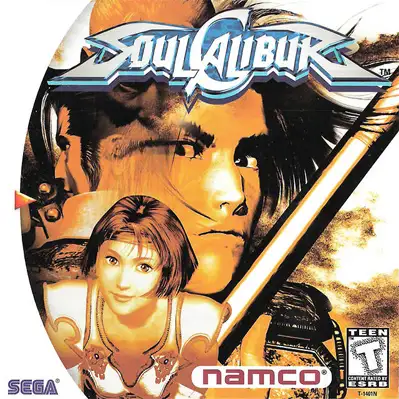
SoulCalibur
 98
★ /10
98
★ /10
 Android,
  Dreamcast,
  iOS (iPhone/iPad),
  Xbox 360
 Bandai Namco Entertainment
SoulCalibur is a 1998 3D weapon-based fighting game developed and published by Namco (now Bandai Namco). Originally released in the arcades, it was ported to the Sega Dreamcast in September 1999 as a launch title. Serving as the sequel to 1995’s Soul Edge (known as Soul Blade on consoles), SoulCalibur is universally hailed not just as one of the greatest fighting games of all time, but as one of the most critically acclaimed and technologically revolutionary video games ever created.
Core Concept and Story
Set in the late 16th century, the game’s sweeping, historical-fantasy narrative is famously introduced by the legendary announcer line: “A tale of souls and swords, eternally retold.” The plot revolves around Soul Edge, a legendary, cursed, demonic sword that feeds on the souls of its victims. The sword has corrupted a young knight named Siegfried, turning him into the Azure Knight, Nightmare, who serves as the game’s primary antagonist. A highly diverse cast of warriors from all across the globe are drawn to the sword’s dark energy—some seek to destroy it, some want to claim its absolute power, and others seek the holy sword designed to counter it, the titular Soul Calibur.
The roster is iconic, featuring characters whose fighting styles perfectly match their weapons, including the wandering samurai Mitsurugi, the acrobatic ninja Taki, the bo-staff-wielding monk Kilik, the snake-sword-wielding alchemist Ivy, and the deeply unsettling, contortionist assassin Voldo.
Gameplay and Features
SoulCalibur fundamentally changed the 3D fighting game genre by prioritizing fluid movement, spacing, and weapon physics over the stiff, rigid combat of its contemporaries:
- The 8-Way Run: This was the game’s ultimate mechanical triumph. In games like Tekken or Virtua Fighter, movement was largely restricted to a 2D plane with clunky, dedicated “sidestep” buttons. SoulCalibur allowed players to simply hold the directional pad to run completely freely in 360 degrees around the arena, making the combat feel incredibly fast, dynamic, and genuinely three-dimensional.
- Weapon-Based Combat: Because every character used a distinct weapon, understanding spacing (or “footsies”) was vital. You had to learn how to close the gap against a long-range spear user like Seong Mi-na using a short-range, rapid-striking character like Maxi with his nunchaku.
- Guard Impacts: Instead of just holding down the block button, high-level players could time their blocks perfectly with a directional input to execute a “Guard Impact.” This parried the enemy’s weapon away, leaving them momentarily defenseless and creating massive momentum shifts in fights.
- Ring Outs: Health bars weren’t the only way to win. If you spatially outmaneuvered your opponent or hit them with a heavy enough knockback attack, you could physically launch them off the edge of the floating arenas for an instant “Ring Out” victory.
The Dreamcast Port and Legacy
The 1999 Sega Dreamcast port of SoulCalibur is legendary in the gaming industry. At the time, the gold standard for home consoles was simply achieving an “arcade-perfect” port. Namco shattered expectations by delivering a console port that was vastly superior to the arcade original, featuring drastically improved, breathtakingly smooth 60fps graphics and highly detailed character models.
Furthermore, the Dreamcast version introduced the Mission Battle mode, a sprawling single-player campaign where players fought through specific conditions (e.g., enemies regenerating health, or invisible enemies) to unlock a massive gallery of concept art and alternate costumes. It set a completely new standard for the amount of single-player content a fighting game should have.
SoulCalibur was awarded perfect 10/10 scores from almost every major gaming publication (including being the second game ever to receive a perfect 40/40 from Japan’s Famitsu magazine). To this day, it holds a staggering 98/100 on Metacritic, cementing its status as a flawless masterpiece.
Quick Note
SoulCalibur is the absolute pinnacle of the 1990s arcade-to-home-console translation era.
In short: With its revolutionary 8-Way Run movement system, perfectly balanced weapon combat, and a Sega Dreamcast port that visually defied what people thought home consoles were capable of, it remains the defining blueprint for the 3D weapon-fighter genre.