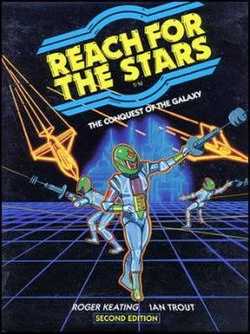
Reach for the Stars: The Conquest of the Galaxy
 Apple II,
  Commodore 64,
  PC
PC
Reach for the Stars: The Conquest of the Galaxy (commonly abbreviated as RFTS) is a landmark turn-based science-fiction strategy video game developed and published by the Australian studio Strategic Studies Group (SSG). Originally released in 1983 for the Commodore 64, it holds a monumental position in video game history as the earliest commercially published example of the space 4X genre (eXplore, eXpand, eXploit, and eXterminate).
Designed by SSG co-founders Roger Keating and Ian Trout, Reach for the Stars served as a direct mechanical bridge translating the rules of tabletop board-and-counter wargames—specifically Howard Thompson’s 1974 classic Stellar Conquest—into a digital environment.
The game eschewed complex graphics in favor of dense macroeconomic systems, technological evolution, and deep strategic simulation, laying the fundamental gameplay blueprint that would later inspire genre titans like Master of Orion.
Technical Specifications
| Attribute | Details |
| Developer | Strategic Studies Group (SSG) |
| Publisher | Strategic Studies Group (SSG) |
| Designers | Roger Keating, Ian Trout |
| Engine | Text-and-Symbol Grid Layout (Minimalist 2D Interface) |
| Platform(s) | Commodore 64 (1983), Apple II (1985), MS-DOS (1986), Amiga (1988), Apple IIGS (1988), Macintosh (1988) |
| Genre(s) | Turn-based strategy, Space Grand Strategy, 4X |
| Mode(s) | Single-player (vs. CPU), Local Multiplayer (up to 4 players) |
The Genesis of Digital 4X Space Strategy
Before Reach for the Stars hit floppy disks in 1983, early digital “space empire” games were largely simple, text-based combat maps or strictly tactical simulations. SSG revolutionized this landscape by giving players control over an entire spacefaring civilization’s macroscopic development loop.
Matches initialize with up to four factions commanding a single home star system. The entire surrounding galaxy is covered by a total Fog of War.
To win, an empire must navigate a complex web of exploration, economic bootstrapping, planetary colonization, and total military dominance. Due to the sheer depth of the calculations and customization options available for each match, single-player campaigns could comfortably last over 12 hours, while multiplayer sessions regularly surpassed 24 hours of real-world time.
Turn Mechanics & The Three Ship Classes
The game engine breaks down every turn into two distinct, highly strategic gameplay phases: The Development Phase and The Movement Phase.
During the Development Phase, players allocate planetary production budgets to manage industries. During the Movement Phase, tasks shift to logistics, giving players the option to manually route starship fleets across galactic grid lines to colonize uncharted territories or engage enemy fleets.
To keep early 8-bit memory limitations from bottlenecking the AI, combat and exploration are streamlined into three highly specialized ship classifications:
- Scouts: Incredibly cheap, completely unarmed vessels. Capable of fast navigation, they are deployed as a low-risk, expendable tool to push back the fog of war, assess planetary compositions, or unmask hidden enemy armada movements.
- Transports: Heavy, slow-moving vessels entirely incapable of ship-to-ship combat. Their sole structural utility is carrying raw population pools (colonists) across space lanes to establish fresh footholds on un-colonized systems.
- Warships: Armor-plated, weapon-toting capital vessels built exclusively to engage hostile fleets and safeguard interstellar shipping paths. Warships are entirely incapable of carrying civilian colonists.
Balanced Budgets & The Overpopulation Trap
The true strategic challenge of Reach for the Stars is balancing limited liquid funds across three core imperial pillars: Technology Upgrades, Fleet Construction, and Environmental Engineering.
The Technology vs. Swarm Dilemma
Players can aggressively funnel their income into global Technology Levels. Advancing your military tier allows your factories to construct far more powerful warships.
This presents a high-stakes tactical gamble: a player can attempt to win early by spamming thousands of primitive, low-tech ships to catch an opponent off guard before they expand; however, if the opponent successfully holds the line long enough to upgrade their tech tier, their advanced capital warships will easily obliterate the incoming lower-tier swarms.
The Overpopulation Trap
To increase a colony’s baseline industrial output, players can invest directly in Environmental Upgrades. Upgrading the planet’s ecosystem accelerates organic population growth.
However, the game features a brutal economic penalty for poor planning: if a world’s population expands past the maximum capacity allowed by its current environment tier, the planet faces a severe resource crisis. The financial overhead required to feed and sustain the excess population skyed, permanently draining the imperial treasury until the player can fund further environmental upgrades or forcefully move the population onto transport ships.
The 2000 Remake & Matrix 2005 Re-Release
“The original Reach for the Stars was a hit because it contained great gameplay, excellent balance, tough AI, and great replayability—qualities sadly lacking from many contemporary games.”
Recognizing the game’s timeless legacy, Strategic Studies Group completely rewrote the game from the ground up for the modern Microsoft Windows platform, releasing a graphical sequel/remake titled Reach for the Stars (2000), published by Strategic Simulations, Inc. (SSI). The 2000 edition preserved the core turn-based rules, ship classes, and population constraints of the original, while adapting the experience with a 2D isometric graphical overhaul and fully rendered control panels.
In April 2005, publisher Matrix Games partnered with SSG to deploy the final, definitive digital iteration of the title: Reach for the Stars (2000) Updated Re-Release.
This release functioned as a dedicated preservation effort, bundling the 2000 remake with critical software patches that completely eliminated lingering compatibility bugs, streamlined multi-user network latency, and optimized the computer’s artificial intelligence scripts to ensure the legendary 1983 grand strategy blueprint executed flawlessly on contemporary operating systems.