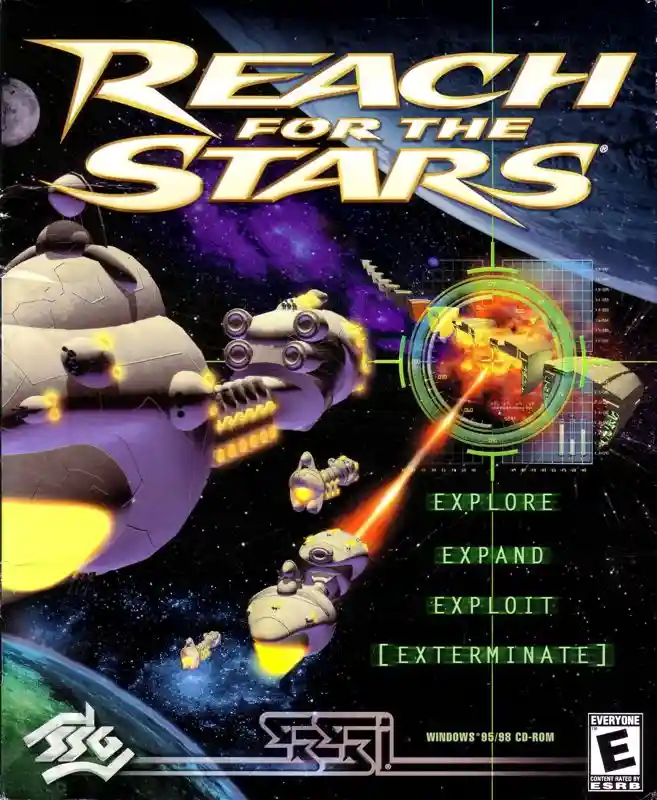
Reach for the Stars (2000)
Remaster of Reach for the Stars: The Conquest of the Galaxy PC
PC
 Strategic Simulations, Inc.
Reach for the Stars is a turn-based science-fiction space grand strategy 4X video game developed by the Australian studio Strategic Studies Group (SSG) and published by Strategic Simulations, Inc. (SSI). Released on September 14, 2000, for Microsoft Windows, the title is a complete, modernized ground-up remake of SSG’s seminal 1983 classic of the same name—the game universally recognized as the commercial genesis of the 4X genre.
While the 1983 original relied on minimalist text commands and abstract board-game logic, the 2000 edition sought to capture the booming turn-of-the-century strategy market.
Produced by Terry Coleman, the remake paired the core gameplay blueprint with a 16-bit visual interface, fully asymmetrical alien species, a automated technology queue, and simplified macro-economic management. The goal was to preserve the series’ legendary artificial intelligence and meticulous balance while stripping away the dense mechanical micro-management seen in competitor titles.
Technical Specifications
| Attribute | Details |
| Developer | Strategic Studies Group (SSG) |
| Publisher | Strategic Simulations, Inc. (SSI) / Mattel Interactive |
| Producer | Terry Coleman |
| Designers | Ian Trout, Roger Keating |
| Engine | Proprietary 16-bit 2D/3D Graphic Interface |
| Platform | Microsoft Windows (95 / 98 / Me / 2000 / XP) |
| Release Date | September 14, 2000 |
| Genre(s) | Turn-based strategy, Space Grand Strategy, 4X |
| Mode(s) | Single-player, Multiplayer (LAN, Internet, Modem with simultaneous turns) |
A Modernized Interface & Faction Diversity
The primary hurdle for the 2000 remake was transitioning the abstract data tracking of the 1980s into a coherent, visual ecosystem. SSG wrapped the map inside a futuristic, console-like 16-bit control interface.
While some contemporary critics noted that the stylized panel “wings” took up substantial monitor real estate, the layout streamlined data tracking, allowing players to quickly access empire-wide supply queues without cycling through endless sub-menus.
Asymmetric Biology
Moving away from the uniform faction templates of the 1983 original, the remake features 18 playable races spanning 16 highly distinct alien species. Factions vary across trading margins, defensive capabilities, population caps, and biological requirements:
- The Human Sub-Factions: Factions like the peaceful Cambri are highly charismatic and excel at corporate trade, but are biologically restricted to colonizing worlds with strict oxygen-rich atmospheres.
- The Hive Factions: A collection of highly aggressive, bellicose insectoid entities. They possess a unique atmospheric tolerance, allowing them to breathe nearly any toxic gas blend. This biological perk enables them to comfortably expand onto otherwise lethal worlds without waiting for terraforming tech.
- The Trogarchs: A ruthless, warlike empire heavily optimized for raw production, orbital siege operations, and rapid fleet manufacturing.
Simplified Macro-Economics & Technology Queues
True to the minimalist philosophy of the original, Reach for the Stars (2000) consciously rejects complex building management. Players do not manually position individual structures or factories on planetary tiles. Instead, the macro-economy is driven by leveling up six core categories of planetary facilities via simple allocation investment:
                     [Planetary Facility Grid]
                                 |
       +-------------------------+-------------------------+
       |                         |                         |
 [Industrial Tracks]     [Defense & Security]     [Logistics & Invasion]
 • Industry: Output      • Defense: Produces      • Colonist Recruitment:
 • Research: Tech speed    orbital satellites       Spawns colony ships
 • Shipbuilding: Docks   • Marine Training:       • Multiplies population
   speed multipliers       Builds troop transports  growth limits
Pure Military Technology Trees
The research matrix undergoes a similar streamlining. The tech tree is stripped entirely of sociological, political, or economic breakthrough fields, focusing 100% on naval warfare.
Factions progress through roughly ten distinct eras across six specific technology tracks: Shields, Propulsion Systems, Electronic Countermeasures, Offensive Projectiles, Defensive Projectiles, and Beam Weapons.
To minimize interface fatigue, SSG integrated a robust Research Queue Terminal. Players blueprint their long-term scientific strategy by dragging and dropping multiple technologies into a unified track. The engine automatically routes excess research points into the next project upon completion, allowing you to keep your focus on frontline logistics.
Formation-Driven Tactical Combat
Interstellar warfare in the 2000 version moves away from micro-managing individual starships on a hex grid, operating instead as a macro-level tactical simulation.
When opposing fleets clash, the game transitions to a dedicated combat screen. The player’s tactical agency is restricted entirely to the deployment phase: you select your fleet’s overall tactical formation and set default engagement distances.
Different weapon classes perform according to spatial constraints: raw energy beam weapons require close-quarters brawling, while offensive projectile missiles require deep, long-range spacing to bypass an enemy’s automated point-defenses. Once your parameters are locked, you hit the execute button and watch as the game’s AI automatically simulates the laser fire, shield drops, and fleet maneuvering in real-time.
The game shipped with substantial content out of the box, offering 21 standalone single-player scenarios (ranging from minor two-player skirmishes to massive 8-player galactic wars), a curated 10-mission narrative campaign, and the identical race and map editors utilized by the core development team.
The 2005 Matrix Update & Modern Preservation (2026 Status)
“Matrix Games’ 2005 re-release serves as a definitive milestone in digital preservation, packaging SSG’s unreleased final build into a clean, modern framework.”
Upon its initial release in 2000, the game received a highly polarized reception from strategy veterans. While purists celebrated its competitive AI and tight structural balance, mainstream reviewers critiqued the interface as archaic and complained about multiplayer instability bugs.
To salvage the title’s legacy, publisher Matrix Games (in coordination with Slitherine) officially partnered with SSG in April 2005 to deploy the definitive version: Reach for the Stars (2000) Updated Re-Release.
This 2005 release was not a remake, but a dedicated cleanup effort. It incorporated the final, previously unreleased internal software patch directly from Ian Trout and Roger Keating. The update completely ironed out old registry bugs, stabilized multiplayer netcode to support zero-waiting simultaneous turns, and adjusted memory pools to ensure execution under Windows XP architectures.
As of May 2026, the 2000/2005 version of Reach for the Stars is preserved as a fascinating, highly focused mechanical artifact from the transition era of PC strategy gaming. The game is currently discontinued from active commercial distribution on mainstream storefronts like Steam or GOG, though it is highly sought after across GOG’s community “Dreamlists.”
For retro strategy purists who own the original Slitherine or Matrix digital installer files, the game remains fully operational. Because the codebase relies on early DirectX frameworks, executing the client on modern 64-bit Windows 11 environments typically requires wrapping the directory with lightweight graphic translation utilities like dgVoodoo2. This fixes legacy resolution-switching errors and allows the high-yield planetary upgrades, automated research queues, and asymmetric alien fleets of the 2000 remake to render flawlessly on contemporary high-definition widescreen setups.