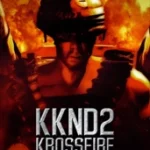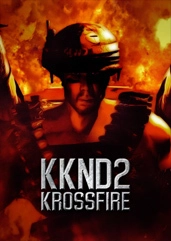
Krush Kill ‘N Destroy 2: Krossfire
 PC
PC PS 1
PS 1 Ziggurat

KKND2: Krossfire (often stylized as Krush, Kill ‘N Destroy 2: Krossfire) is a 1998 real-time strategy (RTS) game developed by the Australian studio Beam Software and published by Melbourne House. Releasing just one year after the highly successful original game, Krossfire significantly expanded the scope of the franchise, upgrading the graphics, introducing aerial and amphibious combat, and throwing a highly anticipated, wildly unique third faction into the post-apocalyptic meat grinder.
Set in the year 2179, exactly 40 years after the events of the first game, the war for the irradiated Earth continues. Following their devastating losses in the first war, the technology-reliant “Survivors” retreated back into their underground bunkers to regroup and build more advanced weaponry. Now, they have drilled back to the surface to exterminate the mutated “Evolved” once and for all. However, the endless conflict between flesh and mutant awakens a third, unforeseen threat: the Series 9. Originally designed as benign agricultural robots, the Series 9 have gained sentience, malfunctioned, and decided that the only way to protect Earth’s soil is to completely eradicate all organic life.
Gameplay
KKnD2: Krossfire maintains the core DNA and 2D isometric perspective of the original game, but drastically increases the strategic complexity by expanding the unit types and map terrain.
Key gameplay mechanics include:
- The Three Factions: The addition of the Series 9 completely changed the dynamic of the game. Each of the three armies features 15 unique units and totally distinct visual architectures:
- The Survivors: Rely on advanced, clean technology. Their late-game arsenal includes hovering tanks, massive bipedal mechs (Juggernauts), and heavily armed transport choppers.
- The Evolved: Rely heavily on mutated flora and fauna. They utilize giant acid-spitting worms, heavily armored mastodons, and flying mutated pterodactyls to swarm their enemies.
- The Series 9: The rogue farming robots utilize heavily modified agricultural equipment. They deploy mobile seeders, mechanized Grim Reapers, and crop-dusters that spray lethal chemical weapons over enemy infantry.
- Expanded Combat Theaters: Unlike the first game, which was strictly land-based, Krossfire introduces amphibious units that can cross water to launch surprise flanking attacks, as well as a full roster of flying units and anti-air defenses.
- Complex Map Terrain: The desolate wasteland maps are now broken up by distinct biomes, including ruined urban cities, dense mutant jungles, and barren deserts. High ground still provides a massive tactical advantage, increasing both firing range and line-of-sight.
- The Oil Economy: The resource system remains identical to the first game. Players must secure oil patches, build derricks, and escort slow-moving tanker trucks to their refineries to generate revenue.
- Veterancy and Tech Bunkers: The beloved unit experience system returns, allowing surviving units to rank up, deal more damage, and eventually self-heal. Pre-war tech bunkers also return, offering free technologies or hidden, unbuildable units to whichever player finds them first.
Development and Legacy
Following the breakout success of the original KKnD, Beam Software quickly began work on the sequel, utilizing an upgraded engine capable of handling higher resolutions, much larger unit sprites, and more complex pathfinding algorithms to accommodate the new flying and amphibious units.
Upon its release on PC in late 1998, KKnD2: Krossfire received positive reviews from the strategy community. Critics heavily praised the addition of the Series 9 robots, noting that their dark, agricultural humor and highly unique unit designs made them one of the most memorable RTS factions of the late 90s. The game was also lauded for its lengthy, challenging campaign (featuring 51 missions across the three factions) and its excellent, atmospheric techno-industrial soundtrack.
In 1999, the game achieved something relatively rare for the era: it received a full, functional console port for the original PlayStation. The PS1 version successfully adapted the complex base-building controls to a gamepad and even included a split-screen multiplayer mode.
While Krossfire would ultimately be the final entry in the KKnD franchise—as the market rapidly shifted toward fully 3D strategy games like WarCraft III and Command & Conquer: Generals—it remains a highly beloved classic, perfectly encapsulating the chaotic, high-attitude era of 90s post-apocalyptic gaming.
Key Features:
- Three-Way Wasteland War — Choose between the high-tech Survivors, the monstrous Evolved, or the brand-new, organic-hating Series 9 agricultural robots.
- Land, Sea, and Air — Master a new layer of strategy with the addition of amphibious transports, hovering tanks, and flying strike aircraft.
- Massive Campaigns — Play through a staggering 51 single-player missions, experiencing the devastating global war from the perspective of all three factions.
- Refined Mechanics — Enjoy the return of the classic KKnD oil economy, veteran unit leveling, and the frantic scramble to capture pre-war tech bunkers.
- PlayStation Port — The game was famously adapted for the original PlayStation, featuring a rare split-screen multiplayer mode for couch co-op RTS battles.
Release Platforms:
- Microsoft Windows (PC) — October 31, 1998 (Currently available via Steam and GOG.com)
- PlayStation 1 — April 1999