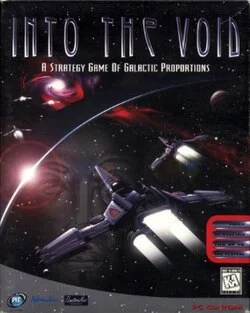
Into the Void
 PC
PCInto the Void is a science-fiction turn-based 4X space strategy video game developed by American studio Adrenalin Entertainment and published by Playmates Interactive Entertainment. Released in April 1997 for MS-DOS, it stands as a lesser-known but highly dedicated entry from the twilight era of classic DOS grand strategy.
Arriving on the heels of genre giants like Master of Orion II, Into the Void channels the traditional pillars of the 4X genre—empire expansion, resource exploitation, planetary colonization, and total tactical elimination of rival species. While it covers familiar mechanical territory, it is historically noted by retro strategy purists for its distinct, polarizing galactic navigation architecture and a steep, uncompromising learning curve.
Core Mechanics and Galactic Infrastructure
The gameplay loop of Into the Void casts the player as the absolute sovereign of an interstellar faction tasking themselves with transforming a modest starting fleet into a sprawling star empire. The structural layers of the game are managed through several interrelated disciplines:
Faction Management and Resource Balancing
Unlike standard 4X titles that rely on extensive lists of luxury assets, the game consolidates its economy into a handful of foundational resource pools—specifically tracking raw ores, exotic crystals, antimatter deposits, and global research metrics. Factions must systematically scout planetary anomalies, establishing mining outposts and managing cargo networks to continuously siphon these materials back to their planetary hubs to fund heavy space industrialization.
Tech Branching and Fleet Crafting
Scientific development is partitioned across multiple independent technological trees. Players spend accrued research points to unlock advanced structural blueprints rather than generic passive buffs. These blueprints must be manually ferried over to the engineering docks, where players utilize collected resources to forge custom weapons, hyper-drives, heavy armoring plates, and custom ship hulls, creating tailored military fleets to counter the specific technologies deployed by opposing civilizations.
The Navigation and Sector Movement Matrix
The element that most sharply distinguishes Into the Void from its contemporary peers—and the design pillar that generated the most division among critics at launch—is its highly unconventional overworld navigation interface.
The space map eschews free-form coordinates or standardized linear starlane nodes. Instead, the game engine models space travel through a restrictive, localized system of orbital lines and vector-trajectories. Moving a task force requires calculating precise distance tolerances and transit durations. Players drop target destination markers and specify ship speeds, forcing them to balance quick travel times against high fuel consumption rules.
Because fleets can easily run completely out of fuel and become permanently stranded in the pitch-black neutral zones between star clusters, macro-exploration requires meticulous forward-planning, defensive fuel-dump positioning, and tight coordination of logistics lines.
Alternative Context: The 2015 Indie Reboot
Within modern digital databases, the name Into the Void frequently pulls up a completely separate but thematic space strategy game. In December 2015, indie developer Mozg Labs released a standalone title titled Into the Void on platforms like Steam.
Functioning as a hybrid between turn-based space strategy and role-playing exploration, the 2015 indie game tasks players with commanding a localized faction wandering through procedurally generated galaxies to track down an ancient cosmic threat that annihilated Earth centuries prior.
While it lacks the massive, multiplayer-focused scale of the 1997 DOS original, the 2015 title preserves the series’ thematic spiritual focus on brutal resource scarcity, modular fleet customization across four technology branches, and unforgiving, tactical turn-based grid combat encounters.
Modern Preservation and 2026 Status
As of May 2026, the original 1997 Into the Void occupies a highly secure, well-documented position as an obscure cult classic within vintage PC abandonware repositories. Because Playmates Interactive’s original 16-bit DOS codebase is hardcoded around turn-of-the-century memory allocation protocols, executing the original software natively under modern 64-bit multi-core Windows 11 architectures is entirely impossible.
To safely preserve the title for modern 4X historians, retro strategy communities rely on open-source emulation packages. The game is easily executed today utilizing advanced builds of DOSBox (such as DOSBox-Staging).
When properly loaded inside an emulation container, players can apply graphic interpolation scaling and lock original pixel aspect ratios, allowing the classic isometric fleet battles, dense resource sliders, and unforgiving, high-stakes navigation mechanics of Into the Void to run with absolute, performance stability on modern high-resolution displays.