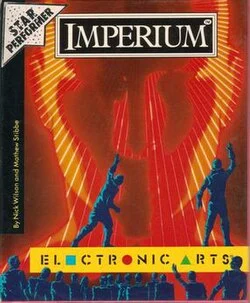
Imperium
 Amiga
Amiga Atari ST
 PC
PC Electronic Arts
Imperium is a landmark 1990 turn-based science-fiction grand strategy 4X video game developed by Intelligent Games and published by Electronic Arts (EA). Released for MS-DOS, Commodore Amiga, and Atari ST, the title occupies a pivotal, highly visionary position in the evolution of space-based grand strategy.
Arriving at the dawn of the 1990s, Imperium was designed by Matthew Stibbe and produced by Joss Ellis. While its contemporaries relied on minimalist, abstract text displays or flat 2D grid boards, Imperium boldly introduced the genre to a highly sophisticated, desktop-like windowed user interface, an interactive 3D-rotatable star map, and deeply layered socio-political systems.
By forcing players to manage internal political dissent, character loyalty, and non-linear economic inflation, it served as a direct conceptual bridge to the modern mechanical complexity seen in space operas today.
Technical Specifications
| Attribute | Details |
| Developer | Intelligent Games (IG) |
| Publisher | Electronic Arts (EA) |
| Designer | Matthew Stibbe |
| Producer | Joss Ellis |
| Engine | Proprietary 16-bit Windowing & Vector Map Engine |
| Platform(s) | MS-DOS, Commodore Amiga, Atari ST |
| Release Date | 1990 |
| Genre(s) | Turn-based strategy, Grand Strategy, 4X Space Simulation |
| Mode | Single-player |
The Millennium Objective & The Nostrum Quest
The campaign initializes in the year 2020 with the player freshly elected as the high sovereign leader of Earth’s infant star empire. Imperium offers two completely distinct, gameplay-altering pathways to claim absolute victory over the galaxy:
1. Total Galactic Conquest
The classic militaristic path. The player must systematically expand their borders, construct massive space armadas, bombard enemy surface fortifications, and forcefully eliminate or subjugate all four competing rival alien empires across the star grid.
2. The 1,000-Year Survival Exception
An exceptionally original victory parameter. Players can choose to win purely through structural, political endurance by successfully surviving at the helm of state for 1,000 game years.
However, executing a millennium-long reign introduces a deliberate, high-stakes biological bottleneck: The Nostrum Crisis. Human characters naturally age and decay over time. To achieve functional immortality, empires must scout deep space to locate incredibly rare planets containing Nostrum—a fabled, life-extending sci-fi drug asset.
Accumulating exactly 50 units of Nostrum allows the player or their chosen inner circle of henchmen to live forever. Because every competing AI empire is aggressively hunting for these exact same Nostrum-rich worlds, the quest for immortality triggers brutal, cutthroat territorial wars across the cosmos.
The Windowing Interface & 3D Galaxy Map
On a visual and technical front, Imperium was hailed by 4X historians as a massive UI breakthrough. Moving away from rigid, full-screen menu shifts, the game developed a custom-designed, fully interactive Overlapping Windowing Interface that functioned like a modern desktop environment.
Players interact with a row of sixteen specialized operational icons anchoring the top of the viewport. Clicking these icons opens independent, modular data windows tracking fields like Taxation, Diplomacy, Embargoes, and Faction Politics.
The engine allows players to open several text and slider windows simultaneously, dragging them across the screen workspace, tiling them side-by-side to parse raw financial data, or collapsing them down into compact title bars to keep the workspace clean. Aside from the vibrant tactical radar charts, the majority of these information windows are rendered in a sleek, utilitarian monochrome layout.
Concurrently, the primary navigational terminal features a highly advanced 3D Vector Galaxy Map. Instead of plotting courses on flat coordinates, players can physically grab and rotate the celestial sphere map across three dimensions.
This 3D modeling allows players to map hidden fleet movements above or below the galactic plane. To simulate the authentic friction of interstellar intelligence operations, the map incorporates a specialized distortion factor: as distances grow from your home sensors, the accuracy of enemy fleet numbers degrades into vague estimates, forcing you to deploy scouting probes to safely unmask foreign borders.
Internal Threat Matrix: Subordinates & Elections
Imperium stands out for its deep focus on internal politics and the fragility of absolute leadership. Recognizing that a single emperor cannot physically micromanage a sprawling interstellar empire, the gameplay loop forces you to delegate administrative authority to a roster of distinct Subordinate Characters.
Character Attribute Mechanics
Subordinates are recruited and assigned to act as Faction Ambassadors, Planet Governors, or Starfleet Commanders. Characters are modeled across three primary statistical metrics:
- Competence: Dictates their administrative efficiency, shipyard production speeds, or tactical combat modifiers.
- Charisma: Governs their ability to sway planet populations, lowering local crime and pacifying unrest.
- Loyalty: The most dangerous attribute. Disloyal subordinates are a threat; if a commander accumulates too much personal fame or planetary control, their loyalty drops, prompting them to turn on you to stage a violent military coup or instigate regional political revolutions.
Players must actively manage character loyalty by buying off their henchmen using liquid cash bribes, granting decorative imperial titles, or sharing precious units of the life-extending Nostrum drug to secure their compliance.
The 50-Year Democracy Check
Adding a final layer of systemic pressure, the player’s sovereign mandate is challenged by Elections every 50 game years. Your popularity is tracked as a rolling percentage metric reflecting your economic performance, trade margins, and military casualties.
If public approval slips below a critical 60% threshold as the election turn approaches, players must aggressively dump massive portions of their state treasury straight into a localized Election Campaign Fund to politically bribe and influence the media, avoiding an immediate “Game Over” by being democratically ousted from power.
Macroeconomics & Deep-Space Fleet Actions
The domestic economy handles structural management across 20 distinct, raw-to-processed commodities. Factions do not simply log infrastructure upgrades; they must actively balance supply chains.
Certain mined resources are mandatory components required to physically build advanced starship hulls; if your local governors accidentally sell off these vital materials on the global free market to curb domestic economic inflation, your orbital shipyards will completely stall out.
Players tweak import and export tax scales, distribute planet-side industrial subsidies to advance regional tech tiers, and coordinate harsh trade embargoes to choke out the economies of hostile neighbors.
“For players who find the immense weight of checking macroeconomic data, handling election funds, and running character counter-espionage exhausting, Imperium provides a built-in salvation: Intelligent Advisors.”
The software includes highly flexible AI Macroautomation Options. At any moment during gameplay, you can check optional boxes to hand over complete, automated control of the Military, Economy, or Diplomacy grids to dedicated computer advisors. This allows players to freely offload administrative bottlenecks to focus entirely on piloting specific strategic initiatives.
Tactical Fleet Interceptions
When space warfare breaks out, Imperium breaks from traditional design limits by allowing Engagements in Deep Space Void Coordinates, rather than restricting fleet battles exclusively to planetary orbit zones.
Invading a world requires an operational multi-tier strategy: your capital assault vessels must first execute long-range orbital bombardments to systematically chip away at a planet’s surface infrastructure and knock out protective defensive shields. Once the planetary grid is soft, players deploy heavy Ark Ships filled with thousands of ground divisions to launch surface invasions to claim the planet center.
Modern Preservation Status (2026 Perspective)
As of May 2026, Imperium is fondly preserved and deeply studied by retro space-strategy historians as an incredibly visionary, ahead-of-its-time masterpiece. While it quickly vanished from mainstream retail shelves in the early 1990s due to its crushing data complexity and a steep learning curve, its implementation of scalable user windows and deep character tracking laid the vital blueprints for the future of grand strategy.
The complete, original 1990 MS-DOS client is immaculately preserved across classic abandonware distribution hubs. Because the vintage 16-bit executable file cannot boot natively under modern 64-bit multi-core Windows 11 environments, contemporary players safely execute the software utilizing DOSBox emulation containers.
By mounting the game directories alongside the original 97KB digital reference manual text file, retro gaming purists can experience the pioneering 3D vector map rotations, complex political campaign fund controls, and high-stakes Nostrum immortality hunts with flawless, stable performance.