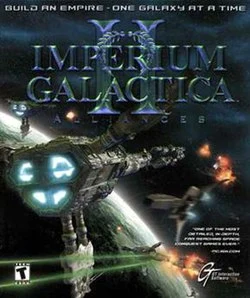
Imperium Galactica II: Alliances
 Android,
  iOS (iPhone/iPad), Macintosh,
  PC
PC
 THQ Nordic


Imperium Galactica II: Alliances is a landmark turn-based and real-time hybrid space grand strategy 4X video game developed by the acclaimed Hungarian studio Digital Reality and published by GT Interactive (with Infogrames handling subsequent localized waves). Released between December 1999 and April 2000 for Microsoft Windows, the title stands as one of the most mechanically sophisticated and highly praised space operas of its era, widely considered by strategy historians to be the absolute pinnacle of the Imperium Galactica franchise.
While the 1997 original restricted players to a rigid, highly linear cinematic plot tracking a lone human protagonist, Alliances completely opened up the sandbox. By offering three wildly asymmetric narrative campaigns, granting full sandbox empire customization from the first turn, expanding the modular starship designer, and refining real-time ground and orbital fleet tactical grids, the title successfully bridged the narrative drama of a space opera with the endless replayability of titles like Master of Orion II.
Technical Specifications
| Attribute | Details |
| Developer | Digital Reality (Remaster: Gyroscope Games) |
| Publisher | GT Interactive / Infogrames (Modern digital rights: THQ Nordic) |
| Lead Composers | Tamás Kreiner, Gábor Pallos |
| Engine | Proprietary 3D Real-Time Cinematic Strategy Engine |
| Platform(s) | Microsoft Windows, Mac OS, Linux, iOS/iPadOS (Mobile Port) |
| Release Date | • EU: December 1, 1999 • NA: April 10, 2000 |
| Genre(s) | Real-time strategy (RTS), Real-time tactics (RTT), 4X Space Grand Strategy |
| Mode(s) | Single-player, Multiplayer (Up to 8 players via LAN or internet lobby) |
The Asymmetric Triad: The Three Main Campaigns
The definitive structural upgrade in Imperium Galactica II is its implementation of three completely unique mainline campaigns. Rather than featuring uniform factions with minor statistical balance tweaks, choosing an empire fundamentally alters your narrative victory conditions, technological research limitations, and baseline mechanics:
1. The Solarian Federation (The Humans)
- Playstyle Archetype: Balanced Diplomacy, Exploration, and Trading.
- Campaign Objectives: Representing the far-future human race, the Solarians must navigate complex cross-border alliances and deep system colonization to locate four fabled, highly ancient data crystals known as “The Tears.” According to historical legend, recovering these data crystals will grant the human race permanent invincibility and unlock the scientific capacity to resurrect their dead emperor.
2. The Kra’hen Empire (The Conquerors)
- Playstyle Archetype: Pure Militarism and Absolute Aggression.
- Campaign Objectives: The Kra’hen are a terrifying, bloodthirsty bio-mechanical race that rejects the entire concept of diplomacy, trade, or peace treaties—making them completely incapable of communicating or negotiating with any other species on the map. Acting as the brutal Imperator, your lone operational goal is to appease the God-Emperor by physically conquering every star system and collecting the severed heads of your cosmic enemies.
3. The Shinari Republic (The Subversives)
- Playstyle Archetype: Deep Espionage, Political Blackmail, and Economic Theft.
- Campaign Objectives: Possessing exceptionally weak starship structures and fragile ground forces out-of-the-box, the Shinari are completely incapable of winning a traditional, direct military war. Instead, they exploit a massive passive bonus to finance and intelligence gathering. The Shinari must bribe neighbors, manipulate trade loops, and execute deep-cover spy programs to trick the other major powers into destroying each other.
The Triple-Layer Real-Time Systems
Alliances successfully managed a highly chaotic layout where everything inside the galaxy operates concurrently on an active, adjustable real-time global clock. Players navigate through three independent, fully interactive tactical layers:
Granular Isometric Colony Design
Clicking on a colonized system drops the camera down to an active, top-down isometric planet surface view. To grow your citizen demographics and generate tax revenue, you manually zone and build functional infrastructure grid-by-grid. Factions manage power allocation, healthcare, and planetary morale by dropping down structures from a massive list of over 100 buildings—including specialized orbital ship docks, medical bays, research labs, high-energy factories, and anti-orbital energy fortresses.
Fully 3D Real-Time Space Fleets
Moving away from the legacy 2D sprites of the first game, Imperium Galactica II integrated a cutting-edge, fully 3D tactical fleet engine. Space battles are cinematic encounters where admirals issue immediate speed, target prioritization, and vector routing commands to up to 28 capital starships and 180 independent starfighter wings simultaneously, tracking localized shield drops and armor damage loops in real-time.
Vehicle-Driven Surface Wars
If your orbital defense bases fall to an enemy blockade, the host world triggers a full-scale ground invasion. The planet surface transforms into a tactical battlefield where players manually command custom armies of wheeled, tracked, or heavy anti-gravity hover tanks to physically defend your municipal buildings or forcefully crush the enemy’s civilian infrastructure.
Modular Ship Workshops and Weapon Configurations
Interstellar warfare entirely abandons rigid, factory-preset spaceships. Instead, the Fleet Automation Terminal grants players total, granular agency to design and customize their own military task forces from scratch across four core capital hull frames: Destroyers, Corvettes, Cruisers, and massive Flagships.
Advanced, high-tier chassis options expand your structural capacity slots, allowing you to mount multiple weapon classes concurrently. Players must strategically balance a vessel’s weapon weight and power grid draw against its factory production costs before deploying the blueprints to their orbital colonies to begin automated fleet assembly.
The Remaster and Modern Preservation Status
The long-term digital survival of Imperium Galactica II: Alliances stands as a legendary triumph of community dedication and publisher care. Following the bankruptcy of original distributor GT Interactive, the intellectual property was safely rescued by THQ Nordic. In late 2016, THQ Nordic partnered with independent developer Gyroscope Games to deploy an official, highly optimized Digital Remaster onto modern storefronts including Steam and GOG.com for a standard retail price of $9.99.
The modern remaster completely bypassed archaic DOSBox emulators to rebuild the underlying code natively for modern operating systems, ensuring flawless compatibility out-of-the-box for 64-bit Windows 11, macOS, and Linux architectures. The remastered engine introduced powerful visual upgrades, including:
- High-Resolution UI Resynchronization: Completely overhauled legacy, pixelated UI textures with crisp, high-definition text renderings that scale smoothly onto modern high-resolution displays and widescreen monitors.
- Updated Renderer: Added arbitrary resolution and aspect ratio support, alongside upgraded lighting and real-time shadow casting metrics on all planetary surface maps.
- Integrated Multiplayer Browser: Replaced legacy, broken port connections with a native server browser script, keeping online skirmishes fully stable and easily accessible for modern strategy enthusiasts.