Imperialism
 PC
PC
 Strategic Simulations, Inc.
Where to buy

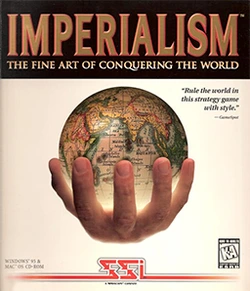
Imperialism is a critically acclaimed turn-based 4X and grand strategy video game developed by Frog City Software and published by Strategic Simulations, Inc. (SSI). Released in September 1997 for Microsoft Windows and Apple Macintosh, the game plunges players into the cutthroat geopolitical landscape of the 19th-century Industrial Revolution.
Unlike standard 4X titles of its era that focused on sweeping military conquests or space colonization, Imperialism structures its gameplay loop entirely around the economic realities of mercantilism, industrial manufacturing networks, raw resource supply lines, and trade dependencies. The title is widely praised by strategy historians for its design, which elegantly models how economic dominance dictates global political power.
Technical Specifications
| Attribute | Details |
| Developer | Frog City Software |
| Publisher | Strategic Simulations, Inc. (SSI) / Mindscape |
| Designers | William Spieth, Ted Spieth |
| Platform(s) | Microsoft Windows, Classic Mac OS |
| Release Date | September 3, 1997 |
| Genre(s) | Turn-based strategy, Grand strategy, 4X |
| Mode(s) | Single-player, Multiplayer (up to 7 players) |
The Path to Global Governance
Imperialism can be played either on a historically mapped European theater or within a procedurally generated fictional world. The match initializes in 1815—the historical conclusion of the Napoleonic Wars and the dawn of the modern industrial era. Players select one of seven industrial “Great Powers” (such as Great Britain, France, Russia, or Prussia), which are surrounded by dozens of resource-rich, non-aggressive Minor Nations.
The ultimate path to victory is entirely political rather than strictly militaristic. Once every decade, the global Council of Governors convenes. Every single conquered or sovereign province across the planet holds a designated vote.
To win the match, a candidate must secure a strict two-thirds absolute majority vote to be crowned the Supreme World Ruler. If an empire fails to achieve democratic consensus by the hard endgame limit of 1915, the match shifts parameters, automatically awarding victory to whichever Great Power commands the largest standing military and domestic workforce infrastructure.
The Industrial Economy & Supply Lines
The engine of Imperialism is built on a tight, unforgiving raw-to-processed manufacturing matrix centered entirely inside your national capital city. Every hex on the overworld map contains distinct terrain yields (such as timber from forests, grain from fields, iron from mountains, or wool from livestock).
To exploit these tiles, players deploy specialized overworld civilian workers:
- Prospectors: Dispatched to climb mountains and comb wilderness hexes to actively discover hidden deposits of coal, iron ore, diamonds, or oil.
- Engineers: Manually construct extraction facilities (mines, orchards, ranches) and lay down a centralized Railway Network to link the tile back to the capital.
The Logistics Bottleneck
Harvesting a resource does not automatically add it to your treasury. The absolute bottleneck of the game is your Transport Capacity, abstractly represented as a pool of physical rail Wagons and maritime Merchant Ships.
Every turn, raw components must be physically hauled back to your capital’s central warehouses via your transport allocation screen. If your factories demand 50 iron nodes but your wagon fleet can only transport 30, the surplus iron sits idle on the map hexes, entirely stalling your industrial expansion.
Factory Refining and Capital Labor
Once raw goods safely enter the capital, they are manually refined into secondary commodities via the industry terminal:
- Timber is processed into Lumber, which is spent to expand rail networks or build warships.
- Iron ore and Coal are combined to manufacture Steel, which is consumed to build high-tier factories and modern heavy weapons.
- Wool and Cotton are spun into Cloth, which acts as the core currency spent to train and feed your civilian workforce.
Workforce management is highly granular. Players systematically train basic laborers into specialized Craftsmen or Master Engineers. Advanced specialists exponentially multiply the factory refining velocity of your capital, turning your empire into a manufacturing monopoly.
Foreign Diplomacy & Minor Nations
Because no starting empire possesses every single raw resource node mandatory to fuel a late-game economy, players must aggressively court resource-rich independent Minor Nations. This dynamic creates a cutthroat global bidding war driven by economic leverage rather than gunboat diplomacy:
- Trade Subsidies & Market Penetration: Great Powers use the Trade Screen to bid for raw goods from minor nations or sell their refined, high-value industrial products back to them. Offering favorable pricing structures builds continuous diplomatic favor.
- Sphere of Influence Tracking: As a minor nation becomes economically dependent on your refined machinery and cloth exports, they steadily transition into your exclusive Sphere of Influence.
- Imperial Annexation: Once a minor nation’s diplomatic favor meter hits maximum thresholds through financial grants and non-aggression pacts, they will voluntarily open their palace terminals to sign a Request to Join an Empire. The minor nation permanently dissolves its sovereignty, safely merging its entire geographic territory, resource nodes, and council voting blocks directly into your empire without a single shot being fired.
Tactical Combat
When macro-diplomacy collapses and an official Declaration of War is validated on the political screen, Imperialism transitions away from the overworld map to open an independent, turn-based Tactical Combat Grid.
Battlefields are rendered as detailed hexagonal maps where terrain elevation, fortresses, and line-of-sight tracking heavily dictate unit performance. Military units directly mirror 19th-century warfare evolution.
Matches initialize with primitive, smoothbore Musket infantries and slow Cavalry divisions, but progressively scale along the technology tree to deploy devastating modern warmachines—including long-range rifled Artillery batteries, rapid-fire Gatling gun placements, and early ironclad battleships.
Because units are intensely expensive to train and maintain, combat prioritizes careful tactical positioning, flanking maneuvers, and defensive fortification over thoughtless mass-unit swarming.
Sequel: Imperialism II: Age of Exploration
Following the massive critical and commercial success of the 1997 client, Frog City Software developed a highly successful sequel titled Imperialism II: Age of Exploration, released by Learning Company (SSI) in 1999.
The sequel systematically shifts the chronological lens backward in time, launching its campaigns in 1492 during the historical dawn of the Age of Discovery.
The game engine expands the overworld infrastructure by splitting maps into two distinct horizontal spheres: the Old World (where European powers engage in high-intensity diplomatic maneuvering) and the New World (an unmapped, resource-scarce frontier blanketed in dense fog of war).
Players deploy conquistadors and explorers to seek out gold deposits, establish overseas colonial shipping loops, and exploit exotic luxury resources like diamonds and spices, delivering an exceptionally deep mechanical twist to the series’ iconic manufacturing formulas.
Legacy & Modern Preservation (2026 Status)
As of May 2026, Imperialism is universally preserved and deeply revered by 4X strategy purists as an absolute pinnacle of economic strategy design. Its highly original approach—viewing global military conflict strictly as an extension of industrial manufacturing and logistical supply lines—has heavily inspired modern grand strategy mechanics across contemporary titles like Paradox Interactive’s Victoria series.
The complete vintage masterpiece is fully active and legally distributed on GOG.com for a standard baseline retail price of $5.99.
The digital GOG edition comes pre-wrapped with lightweight, community-vetted compatibility adjustments, enabling the 1997 Windows 95 application codebase to execute flawlessly out-of-the-box under modern 64-bit multi-core Windows 10 and Windows 11 architectures.
Strategy enthusiasts running the software on modern setups can cleanly scale the original desktop view or execute the client inside native display windows, allowing the deep industrial processing chains, cutthroat trade bidding wars, and historic Council of Governors elections of Imperialism to perform with flawless stability.