Imperialism II: Age of Exploration
 PC
PC
 Strategic Simulations, Inc.
Where to buy

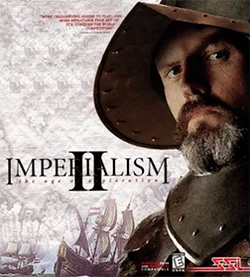
Imperialism II: Age of Exploration is a critically acclaimed turn-based 4X grand strategy video game developed by Frog City Software and published by Strategic Simulations, Inc. (SSI). Released in March 1999 for Microsoft Windows and Macintosh, the game is the direct standalone sequel to the 1997 classic Imperialism.
Shifting the chronological focus backward from the first game’s 19th-century Industrial Revolution, Imperialism II launches players into the high-stakes geopolitical landscape of the 15th and 16th centuries. The game models the symbiotic loop of maritime exploration, economic bootstrapping, mercantilism, and industrial warfare that defined European colonial expansion.
Technical Specifications
| Attribute | Details |
| Developer | Frog City Software |
| Publisher | Strategic Simulations, Inc. (SSI) |
| Designers | Ben Polk, Bill Spieth, Ted Spieth |
| Platform(s) | Microsoft Windows, Mac OS |
| Release Date | March 31, 1999 |
| Genre(s) | Turn-based strategy, Grand strategy, 4X |
| Mode(s) | Single-player, Multiplayer |
The Great Split: Old World vs. New World
The definitive mechanical innovation of Imperialism II is the structural bifurcation of the global map screen. Unlike its predecessor—where the entire map grid was visible from turn one—this engine splits the world into two distinct geographic zones:
1. The Old World
Fully visible and pre-mapped at the start of a match, this zone contains the six playable European Great Powers (England, France, Spain, Portugal, Holland, and Sweden) and a network of sovereign Minor Nations (such as Scotland, Ireland, Denmark, and Switzerland). The Old World features standard resource configurations (iron, coal, timber) and is heavily fortified with defensive forts, making early European wars intensely expensive and logistically grueling.
2. The New World
Entirely shrouded in a pitch-black fog of war, the New World occupies the opposite half of the map. Players must build naval vessels (Carracks) and deploy civilian Explorers to cross ocean coordinates to map out these foreign frontiers. The New World is populated by independent native tribes (such as the Aztec, Inca, Iroquois, and Huron) and holds exclusive, high-value raw assets entirely absent from Europe.
Importantly, the game engine relaxes geopolitical penalties in this theater: players can launch unprovoked military invasions against New World tribes to forcefully capture their resource-rich capitals without ever needing to log a formal declaration of war.
The Bootstrapping Economy & Labor Matrix
The economy of Imperialism II is built on a tight, unforgiving resource-processing loop centered directly in your home capital city. Resources must be physically hooked up via a continuous road network back to a domestic port before they can enter your central inventory.
Unlike the first game, raw terrain hexes must be systematically developed by Engineers (e.g., grading fields, digging mines, cutting forests) before they yield any output.
Labor Productivity Tiers
To bypass the need to endlessly mass thousands of individual workers, the game features an innovative Labor Evolution System. Factions do not simply add more raw population units; instead, they spend liquid currency and specific New World commodities to train existing workers into higher tiers of technical mastery:
| Labor Tier | Productivity Multiplier | Required New World Luxury Upgrade |
| Peasant | 1x baseline | None |
| Apprentice | 4x multiplier | Refined Sugar |
| Journeyman | 6x multiplier | Hand-rolled Cigars |
| Master | 8x multiplier | Premium Fur Hats |
Upgrading a handful of citizens into Masters allows your capital’s factories to refine steel, lumber, and fabric at staggering velocities, enabling compact, high-efficiency economic growth.
The Food Supply Constraint
Every single civilian specialist, standing army regiment, and active merchant ship consumes exactly one unit of Food every single turn. This food balance must be met using a strict 1:1 ratio composed of Grain (harvested from farms) and Meat (harvested from ranches or fished from ocean tiles within a port’s radius). If your food metrics drop below zero for even a single turn, your workforce faces immediate starvation, instantly halting factory lines across the entire empire.
Naval Warfare & Port Blockades
Because the economy is entirely dependent on hauling high-value luxuries (spices, gold, silver, gems) and food from the New World back to Europe, Naval Supremacy serves as the primary strategic weapon of the mid-to-late game.
The transport logistics were heavily rebalanced from the original title: overworld land roads have completely infinite capacity, entirely eliminating the need to micromanage individual freight railcars, but all maritime transit requires physical cargo holds inside your merchant fleet.
“He who rules the waves rules the economy. A tiny, aggressive navy can comfortably bring an industrial superpower to its knees without ever fighting a land battle.”
Players can organize specialized naval task forces to actively target and Blockade a competitor’s home capital port. Successfully locking down an opponent’s port coordinates instantly severs their entire maritime cargo network.
Their merchant fleets cannot haul commodities, their New World supply lines are completely frozen, and their domestic factories run out of raw materials within turns, forcing their economy into a catastrophic tailspin until they can build heavy war vessels—culminating in the discovery of unassailable, armor-plated Ironclads—to break the siege.
The Path to Victory
To win a match of Imperialism II, an empire must focus entirely on a single, uncompromising metric: controlling more than one-half of the Old World.
Conquering the entirety of the New World, looting tribal treasuries, and stripping native continents of diamonds or fur will not trigger a victory exception. The New World exists strictly as an economic fueling tank; its sole purpose is to provide the liquid gold, advanced tech-theft spikes via Spies, and processed weapons needed to physically crush or diplomatically absorb your European neighbors.
Sovereignty over the Old World can be achieved through total military annihilation of competing capitals, or through sophisticated Macro-Diplomacy. By offering lucrative trade subsidies, extending massive financial grants, and maintaining continuous defensive pacts, Great Powers can steadily influence Minor Nations until they voluntarily sign an official Request to Join an Empire, permanently merging their voting blocks and land hexes into your territory without firing a single shot.
Modern Preservation Status (2026 Perspective)
As of May 2026, Imperialism II: Age of Exploration is preserved by strategy historians as an absolute masterpiece of economic grand design. By shifting the macroscopic focus away from thoughtless land-grabs to center entirely on transport logistics, labor efficiency, and capital resource bottlenecks, the title achieved a mechanical depth that remains highly unique within the 4X landscape.
The entire vintage classic is fully active, preserved, and legally distributed on GOG.com for a standard baseline retail price of $5.99. The digital GOG edition comes natively wrapped with pre-configured modern compatibility adjustments, enabling the 1999 Windows 95 executable file to boot and execute flawlessly out-of-the-box under modern 64-bit multi-core Windows 10 and Windows 11 architectures.
The software runs with absolute performance stability, allowing retro PC gaming purists to scale the crisp 2D isometric map layouts, manage their modular labor matrices, and orchestrate cutthroat naval blockades with flawless historical fidelity.