Grey Goo
 77
★ /10
77
★ /10
 PC
PC
 1C-SoftClub, Grey Box, Six Foot
Where to buy

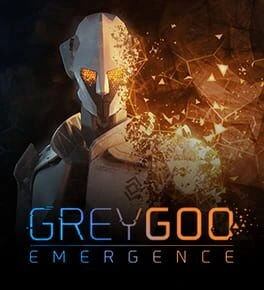
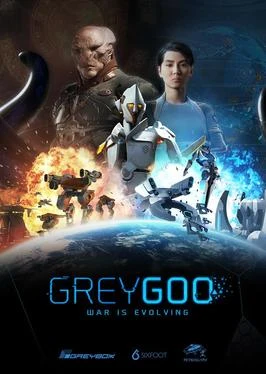
Grey Goo is a 2015 real-time strategy (RTS) game developed by Petroglyph Games and published by Grey Box. Created by a studio founded by former Westwood Studios veterans (the legendary team behind the original Command & Conquer franchise), the game was explicitly designed to be a massive return to the “golden age” of 1990s macro-heavy strategy games, pushing back against the hyper-fast, micro-management-intensive style popularized by StarCraft II.
Set centuries in the future on the lush, uncharted planet of Ecosystem 9, the narrative details a massive, three-way war for survival. The Beta, a pragmatic, nomadic alien race fleeing from a mysterious cosmic threat, have settled on the planet to rebuild. They are suddenly confronted by the Humans, who have abandoned their physical bodies for highly advanced, defensive mechs to explore the galaxy. However, the true threat arrives in the form of the titular “Goo”—a highly adaptive, self-replicating swarm of nanobots originally created by humanity to map the universe, which has now gone rogue and seeks to consume all matter in its path.
Gameplay
Grey Goo heavily emphasizes macro-management—focusing on base building, resource control, and overarching army composition rather than requiring the player to perform hundreds of actions per minute (APM) to micromanage individual units in combat.
Key gameplay mechanics include:
- Asymmetric Factions: The game’s biggest draw is how wildly different its three core factions play:
- The Beta: The most traditional RTS faction. They rely on placing central “hubs” and attaching specific factories and tech structures to them. They can easily pack up their hubs and relocate, making them highly adaptable and mobile.
- The Humans: Highly defensive and reliant on a power grid. Human structures must be connected via energy conduits to a central headquarters. Their units are highly specialized, and their bases can eventually utilize teleportation to instantly move units across the map.
- The Goo: A totally unique approach to the RTS genre. The Goo has absolutely no base or structures. You start with a single, massive “Mother Goo.” To gather resources, you physically move the Mother Goo directly on top of a resource geyser. Once it grows large enough, you split it into smaller Goos, which then morph directly into offensive units or more Mother Goos. They can traverse over mountains and ignore terrain that blocks the other two factions.
- Catalyst Resource: The game features only one resource: Catalyst. This glowing liquid erupts from geysers on the map, meaning map control and holding specific chokepoints around these geysers is critical for victory.
- Epic Units: Deep into the tech tree, each faction can construct an “Epic Unit”—a massive, incredibly expensive, screen-filling titan capable of devastating entire enemy bases on its own (such as the Human Alpha, a colossal walking mech).
- The Shroud: In 2016, the game received a massive expansion titled Descent of the Shroud, which introduced a fully playable fourth faction. The Shroud is an aggressive, energy-based alien race that relies on evolving structures and overwhelming early-game pressure.
Development and Legacy
To bring their sci-fi universe to life, Petroglyph Games partnered with Weta Workshop (the legendary special effects company behind The Lord of the Rings films) to design the factions and create the game’s stunning, high-budget CGI cinematic cutscenes. To further cement its Command & Conquer pedigree, Petroglyph brought in industry legend Frank Klepacki to compose the game’s heavy, industrial, and sweeping orchestral soundtrack.
Upon its release in January 2015, Grey Goo received generally positive reviews. Old-school RTS fans heavily praised the slower, more deliberate pacing, the incredibly unique mechanics of the Goo faction, and the phenomenal production values of the campaign.
However, despite its strong critical reception, the game struggled to maintain a lasting multiplayer community. In 2015, the competitive RTS scene was heavily monopolized by StarCraft II, and Grey Goo‘s deliberate pacing didn’t translate as well to the fast-paced esports and streaming environment. Today, while the multiplayer scene is quiet, Grey Goo stands as a highly polished, incredibly unique single-player RTS experience that successfully captured the spirit of the late-90s strategy boom.
Key Features:
- Macro Over Micro — Step away from frantic clicking and focus on overarching strategy, base building, and massive army composition.
- Play as the Swarm — Command the titular Goo, an amorphous, base-less faction that moves fluidly across the map to consume resources and engulf enemies.
- Weta Workshop Cinematics — Experience a rich, cinematic sci-fi campaign featuring spectacular CGI cutscenes crafted by an Academy Award-winning effects studio.
- Klepacki Soundtrack — Wage war to an epic, thumping soundtrack composed by the legendary musician behind the Command & Conquer franchise.
- The Definitive Edition — Access the complete package on PC, which includes the base campaign, all DLC, and the aggressive fourth faction, the Shroud.
Release Platforms:
- Microsoft Windows (PC) — January 23, 2015 (Currently available via Steam)