Supreme Commander
 86
★ /10
86
★ /10
 PC
PC Xbox 360
 Gas Powered Games
 Aspyr Media,
  Buka,
Buka,  Square Enix,
  THQ
THQ


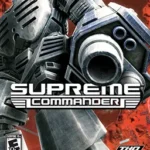
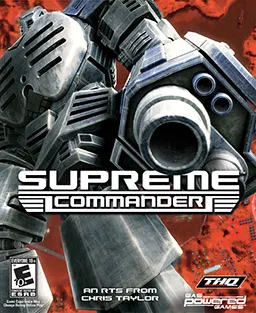
Supreme Commander is a 2007 real-time strategy (RTS) game developed by Gas Powered Games and published by THQ. Created by industry veteran Chris Taylor, the game was designed from its inception as the true “spiritual successor” to Taylor’s 1997 masterpiece, Total Annihilation. It remains one of the most ambitious RTS titles ever produced, defined by a sense of scale that effectively dwarfed every other strategy game on the market.
While other RTS games of the era were zooming in on small-scale squad combat, Supreme Commander went in the opposite direction. It moved the camera miles into the sky, allowing players to command theater-wide wars involving thousands of land, sea, and air units across maps that could span over 80 square kilometers. It didn’t just ask you to be a battlefield tactician; it forced you to be a theater commander.
The narrative premise is set in the 39th century, during the twilight of the Infinite War—a thousand-year conflict that has torn humanity into three distinct, warring ideologies. As the resources of the galaxy dwindle and the combatants reach a stalemate, each faction prepares a final, desperate gambit to end the war once and for all.
Gameplay
Because of its immense scale, Supreme Commander introduced a series of revolutionary interface and economic systems to help players manage the chaos of total war.
Key gameplay mechanics and features include:
- The Strategic Zoom: This was the game’s “killer app.” Instead of a traditional minimap, players could seamlessly zoom out from a single engineer on the ground to a full orbital view of the entire theater. Units would transform into strategic icons, allowing for perfect situational awareness and the ability to issue commands across multiple fronts simultaneously.
- The Stream-Based Economy: Moving away from “stockpile” economics, Supreme Commander utilized a flow-based system of Mass and Energy. Resources are consumed as they are gathered; if your construction projects demand more than your income, your entire economy slows down. Balancing this “inflow vs. outflow” created a high-stakes economic game where stalling an opponent’s mass extractors was often more lethal than destroying their army.
- Armored Command Units (ACUs): The player is physically present on the field as a “Supreme Commander” inside a massive, bipedal mech. This unit is your most powerful builder and your greatest liability—if your ACU is destroyed, it detonates in a localized nuclear blast, resulting in an immediate game over.
- Experimentals: The crown jewels of the game’s tech tree. These are gargantuan units that take massive amounts of time and resources to build, such as the Monkeylord (a stealthy, laser-firing spider bot) or the Fatboy (a mobile, amphibious fortress). Landing an experimental on an enemy base is often the definitive “checkmate” of a match.
The Factions
The three factions in Supreme Commander feature highly asymmetrical tech trees, each with a specific visual language and tactical doctrine:
- United Earth Federation (UEF): The remnants of the old Earth Empire. Their design is grounded in “traditional” military aesthetics, utilizing heavy armor, treads, and ballistic weaponry. They excel in defensive warfare, utilizing powerful shields and the Fatboy mobile factory to slowly grind down opponents through superior attrition.
- Cybran Nation: A race of cybernetically enhanced humans seeking independence. Their units are jagged, insect-like, and highly mobile. They rely on stealth, electronic warfare, and “glass cannon” weaponry. Their signature unit, the Monkeylord, remains one of the most iconic units in RTS history, capable of wiping out entire bases with its microwave laser.
- Aeon Illuminate: A faction of religious zealots who follow the teachings of a peaceful alien race known as the Seraphim. Their units are sleek, elegant, and highly specialized. They emphasize “quality over quantity” and possess the most powerful naval units in the game, including submersible battleships and the Galactic Colossus, a towering, laser-eyed tripod.
Development and Legacy
Supreme Commander was a technical powerhouse that famously required high-end hardware to run at its release in 2007. It was one of the first games to truly utilize dual-monitor support, allowing players to have a full-screen tactical map on one screen while managing combat on the other. This focus on “Information Supremacy” made it a favorite for hardcore strategy fans.
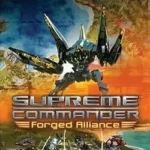
The game was followed by a standalone expansion in late 2007, Supreme Commander: Forged Alliance, which added the alien Seraphim faction and significantly polished the unit balance and UI. To many fans, Forged Alliance is considered the “perfect” version of the game.
As of May 2026, the legacy of Supreme Commander is stronger than ever. While the official servers are long gone, the community-led Forged Alliance Forever (FAF) project has kept the game alive for nearly two decades. FAF provides custom matchmaking, a modern ladder system, constant balance updates, and even new campaign missions. In 2026, the competitive scene remains highly active, with FAF standing as a gold standard for how community-driven preservation can sustain a legendary RTS far beyond its commercial lifespan.
Key Features:
- Unrivaled Scale — Command thousands of units across massive 81km x 81km maps in land, air, and sea combat.
- Revolutionary Strategic Zoom — Seamlessly transition from a micro-view of a single unit to a macro-view of the entire theater of war.
- The ACU Mechanic — Lead from the front in your Armored Command Unit, balancing the risk of your own destruction with your incredible building power.
- Coordinated Attacks — Utilize sophisticated UI tools to synchronize strikes from multiple directions, ensuring your bombers and tanks arrive at the target at the exact same second.
- Infinite War Narrative — Experience a deep, cinematic story told through three distinct perspectives as the galaxy’s last empires clash for survival.
Release Platforms:
- Microsoft Windows (PC) — February 16, 2007.
- Xbox 360 — June 2008 (A significantly modified port with a radial UI and reduced unit caps).
- Steam Digital Version — Currently available and serves as the base for the Forged Alliance Forever community client.