Stellar Crusade
 Amiga
Amiga Atari ST
 PC
PC Strategic Simulations, Inc.
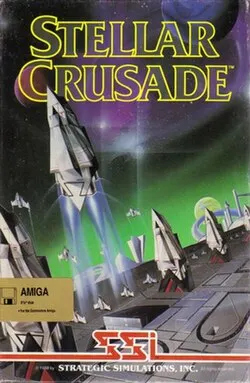
Stellar Crusade is a turn-based sci-fi grand strategy 4X video game designed by Norm Koger and published by Strategic Simulations, Inc. (SSI). Released in 1988 initially for the Atari ST and rapidly ported to MS-DOS, with an Amiga version following in 1990, the title occupies a fascinating historical niche.
Stellar Crusade is celebrated as Norm Koger’s first professionally published video game, serving as a radical, hyper-complex experiment in macro-logistics that pushed the mathematical boundaries of early 4X space strategy.
Set within a 25-light-year radius open star cluster in the 24th century, the game simulates an all-out, decades-long ideological and material war. Long before the genre standardized streamlined build queues, Stellar Crusade required players to coordinate three-dimensional star maps, balance non-linear supply chains of raw and refined commodities, engineer modular starships, and manage structural mechanical decay across active combat fleets.
Technical Specifications
| Attribute | Details |
| Developer | Norm Koger |
| Publisher | Strategic Simulations, Inc. (SSI) |
| Designer / Programmer | Norm Koger |
| Platform(s) | Atari ST, MS-DOS, Amiga |
| Release Date | • Atari ST / MS-DOS: 1988 • Amiga: January 1990 |
| Genre(s) | Turn-based strategy, Grand Strategy, 4X Space Simulation |
| Mode(s) | Single-player (vs. CPU), Local Multi-player (2 players) |
The Intergalactic Jihad: Asymmetric Factions
The underlying narrative framework of Stellar Crusade frames space colonization as a bitter, zero-sum ideological crusade. The game sets up a conflict between two deeply opposed sociopolitical super-factions competing for a resource-rich galactic cluster:
- The Corporate League: A hyper-capitalist consortium of trade syndicates and industrial monopolies. In single-player campaigns, the human player is permanently locked into commanding this faction. The League features highly optimized industrial refining traits and economic data tracking loops.
- The People’s Holy Republic (PHR): A zealous, spacefaring empire fueled by absolute religious fundamentalism and galactic Jihad. Controlled either by a second human player or a ruthless computer AI script, the PHR excels at psychological subversion, covert operations, and mobilizing massive civilian insurgencies behind enemy lines.
The turn structure is strictly divided across three distinct iterative phases per three-month game cycle: an Economic Phase (zoning planetary assets and funding production queues), a Movement Phase (routing shipping lines, deploying spies, and positioning space armadas), and a simultaneous computer-calculated Resolution Phase where all conflicts and material updates are executed.
Hyper-Complex Macroeconomics & Supply Bottlenecks
At the heart of Stellar Crusade lies an incredibly advanced, punishingly realistic simulation of a multi-tiered interstellar economy that stood entirely unmatched in late-1980s strategy software. Planets are not uniform asset dumps; scanning uncharted star systems reveals randomized worlds tracking varying base compositions of raw metals, organic elements, and local native populations.
Instead of accumulating a magical, global empire-wide treasury pool, materials must be physically, step-by-step transported across three-dimensional coordinates to fulfill complex engineering.
A player might capture an agrarian world producing raw organics. Those organics must be physically loaded onto transport pools and shipped across coordinates to a completely separate refinery star system to be processed into specialized intermediate goods.
From there, the refined cargo must be ferried down a third route to a dedicated orbital shipyard system where a custom, player-designed class of starship is currently under construction.
If enemy saboteurs or covert raiders successfully target your transport pools or induce labor strikes on your colony worlds, the entire production line instantly experiences severe cost overruns and grinding construction delays, stalling your military expansion.
Fleet Commands & The Breakdown Penalty
Interstellar warfare in Stellar Crusade rejects the arcade trope of keeping a massive, permanent standing navy idling in deep space. Maintaining active warships is an intensely expensive proposition that can quickly bankrupt an empire. To model realistic military readiness, ships are assigned to distinct command states:
The Training vs. Active Duty Loop
Newly manufactured starships are automatically placed into a global Training Command. While in training status, ships undergo readiness maneuvers to prepare for active deployment while drawing minimal operational funding from the treasury.
The Mechanical Breakdown Penalty
When an enemy fleet approaches a border coordinate, players must draw ships out of training and organize them into an active-duty Task Force. This must be timed with precision. Active Task Forces instantly burn massive resource overhead and begin to suffer from an uncompromising Mechanical Breakdown Penalty.
Unless a task force is actively stationed directly inside a highly expensive, fully supplied home Naval Installation, ships will experience structural and systemic equipment failures turn-by-turn purely from being kept on active duty alert.
Admirals are forced to assemble their forces at the absolute last minute, execute their offensive campaigns with maximum velocity, and immediately disband the task force back into training commands before their own capital engines decay into scrap metal.
The Human Element
Adding a final layer of hard sci-fi unpredictability, fleets are helmed by distinct, simulated historical commanders tracking variable leadership metrics. In a legendary mechanic, these commanders actively age as the decades-long campaign marches forward. It is entirely common for an elite, highly decorated five-star admiral you were actively relying on to orchestrate a high-stakes stellar siege to suddenly die of old age mid-transit, throwing your task force into organizational disarray.
The Incomplete Manual Controversy & Legacy
Upon its initial commercial release in 1988, Stellar Crusade was met with intense frustration and mixed reviews from strategy critics, completely centering on a notorious publishing blunder by SSI.
The game’s underlying software logic was so remarkably dense and intricate that it required an exhaustive, textbook-length manual to teach players how to safely navigate the economic sliders and fleet command interfaces.
However, Computer Gaming World editor Russell Sipe exposed that SSI’s editing department manually removed roughly 11 to 12 critical pages from Norm Koger’s original instruction manual prior to printing.
SSI enacted this edit under the flawed assumption that a shorter booklet would make the game look “less imposing” to mainstream buyers.
“SSI’s decision to shred a dozen pages from Norm Koger’s manual effectively rendered the retail release of Stellar Crusade unplayable, transforming a brilliant economic simulator into a cryptographic puzzle for consumers.”
This corporate editing blunder left the retail software box packaging a vague, borderline useless manual that completely failed to clarify how to manage basic logistics networks or mitigate ship breakdown tracking. Reviewers slammed the title as an impenetrable, tedious, and frustratingly complex layout.
Retrospectively, however, video game historians and 4X critics (including GameSpot’s Bruce Geryk) reevaluated Stellar Crusade as a brilliant, highly visionary, and visionary masterwork.
It is officially recorded as the absolute pioneer space strategy game to place such an intense, uncompromising emphasis on macroeconomic flows and resource exploitation over basic tactical dogfighting, serving as a direct conceptual grandfather to modern, hyper-detailed space logistics simulators.
Modern Preservation Status
The vintage 1988 client is preserved across retro computing abandonware hubs, and Norm Koger actively hosts the complete, unedited, pre-release ASCII text manual for free digital download on his official personal website (normkoger.com) to ensure the design parameters are fully preserved.
Running the 1988 MS-DOS executable on modern 64-bit Windows 11 architectures requires loading the game inside a DOSBox emulation container, where players can successfully experience the staggering economic depth, 3D vector movements, and intense intergalactic jihad of Stellar Crusade with absolute historical fidelity.