Stars!
 PC
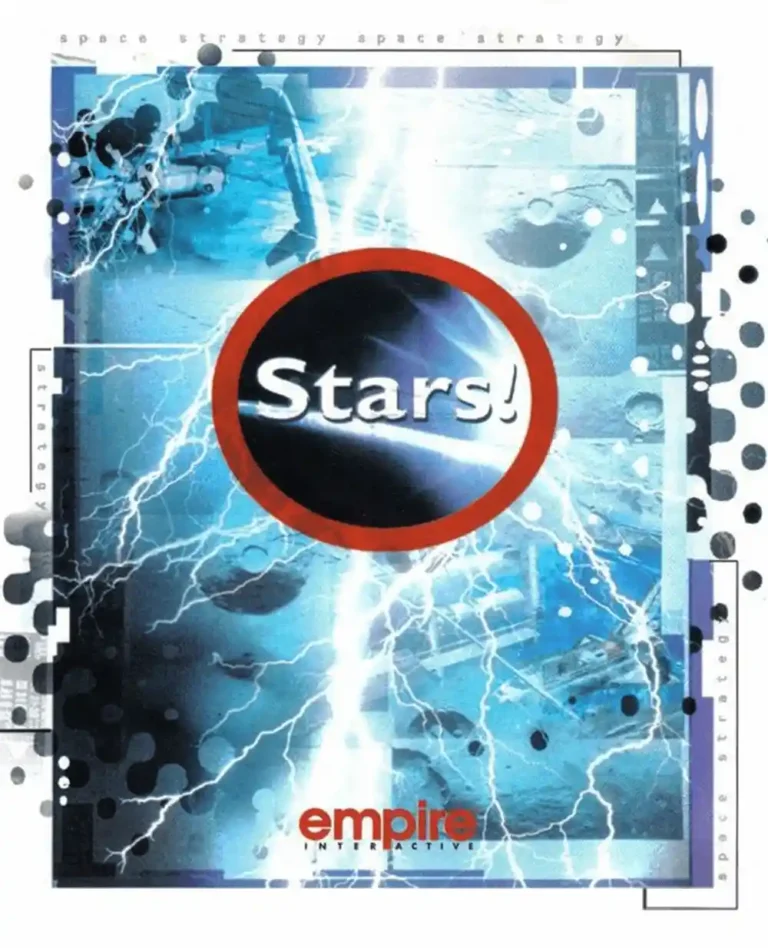
PCStars! is a critically acclaimed turn-based science-fiction space grand strategy 4X video game developed by Jeff Johnson and Jeff McBride (collectively known as Jeff-Net) and published by Empire Interactive. Originally released as shareware in 1995, with a definitive retail version deploying in 1996 for Windows 3.1x and Windows 95, the title occupies a legendary, highly unique position in the history of the 4X genre.
Stars! is famously referred to by strategy veterans as the ultimate “spreadsheet space opera.” It completely eschewed immersive 3D graphics, cinematic cutscenes, or elaborate alien artwork in favor of a clean, hyper-functional, and windowed interface resembling Microsoft Excel or a Windows 95 productivity suite.
By prioritizing raw mathematical depth, a deep point-buy race customization engine, and a design optimized for massive multiplayer campaigns, it became the gold standard for Play-by-Email (PBEM) grand strategy gaming in the late 1990s.
Technical Specifications
| Attribute | Details |
| Developer | The Jeffs (Jeff Johnson, Jeff McBride, Jeffrey Krauss) |
| Publisher | Empire Interactive |
| Designers | Jeff Johnson, Jeff McBride |
| Engine | Native 16-bit Windows API WinG Layout Interface |
| Platform(s) | Windows 3.1x, Windows 95 / 98 |
| Release Date | • Shareware Debut: 1995 • Retail Launch: 1996 |
| Genre(s) | Turn-based strategy, Space Grand Strategy, 4X |
| Mode(s) | Singleplayer (vs. CPU), Multiplayer (Up to 16 players via Play-by-Email) |
The Spreadsheet Philosophy: Numbers Over Visuals
During a mid-90s era where video games were frantically rushing to adopt primitive, blocky 3D graphics, Stars! took a proud, uncompromising step backward. The entire user interface is built out of cascading Windows menus, text boxes, sliders, and color-coded vector dots representing solar systems.
This minimalist design was a stroke of strategic brilliance: by ignoring the resource-heavy graphics cards of the era, the developers were free to push the game’s underlying processing simulation to an unprecedented level of mathematical depth.
The game loop operates with absolute scannability. Players can manage an empire spanning hundreds of planets and thousands of moving starships through a series of interlocking spreadsheets, quickly sorting fleets by fuel capacity, grouping planets by industrial output, and programming long-term queue tasks with just a few clicks.
The Masterclass Race Creator (PRTs & LRTs)
The absolute crown jewel of Stars! is its incredibly robust, highly balanced Custom Race Designer. Using a strict, zero-sum point-buy system, players engineer an asymmetric alien species by selecting a Primary Racial Trait (PRT) and combining it with various Lesser Racial Traits (LRTs).
Primary Racial Traits (PRTs)
Your choice of PRT fundamentally dictates your empire’s macro-strategy and structural win conditions:
- Hyper-Expansion (HE): Your population reproduces at double the baseline galactic rate, and your worlds generate massive industrial outputs. However, your citizens are so physically fragile that your maximum planetary population caps are permanently sliced in half.
- Super-Stealth (SS): All your starships are natively equipped with invisible cloaking fields, and your planetary scanners can detect enemy hulls through deep space without revealing your own positions.
- Interstellar Traveler (IT): Your stargates can safely teleport physical space fleets directly across the galaxy, and your shipyards gain exclusive access to advanced, long-range propulsion components.
- Jack of All Trades (JOAT): A flexible, generalist species that starts the match with elevated tech levels and expanded environmental tolerances across the board.
Lesser Racial Traits (LRTs)
To harvest extra design points to fund your primary perks, players toggle structural debuffs or minor utility skills known as LRTs. Options include Bleeding Edge Technology (making research more expensive but upgrading high-tier module power) or Only Over My Dead Body (making your ground troops completely immune to enemy psychological subversion, ensuring they fight to absolute extinction during planetary invasions).
The Habitability Triangle & The Three Minerals
Planetary exploitation in Stars! completely rejects generic wealth metrics to implement a rigorous environmental tracking system based on three independent variables: Gravity, Temperature, and Radiation.
When creating your species, you define your biological comfort zones across these three sectors. Every planet on the map spawns with randomized values for these metrics. If a world’s raw environment aligns perfectly with your species’ biological parameters, the planet registers as a green “garden world” where your population will multiply exponentially.
If the environment drops out of your safety margins, the world registers as a red, toxic death trap. Landing colonists on a red world causes them to systematically die off turn-by-turn from environmental friction, forcing players to invest heavily in specialized Terraforming Tech to slowly pull the planet’s atmospheric dials closer to your species’ ideal baseline.
The Three Structural Minerals
To build structures and assemble modular starships, empires must extract and transport three fundamental mineral types:
- Ironium: The heavy, dense metal mandatory to manufacture basic ship hulls, structural armor plating, and localized planet defenses.
- Boranium: A highly reactive elemental resource spent to build weapon arrays, shield generators, and high-energy torpedo lines.
- Germanium: The rare, precious element required to construct advanced electronic components, planetary scanners, and research facilities.
The Play-by-Email (PBEM) Realm
Because Stars! was built around highly compact text-based turn files, it became the undisputed king of the late-90s Play-by-Email (PBEM) community.
To play a multiplayer match, a host player would initialize a galaxy file and email a tiny .xy data file to up to 15 other human competitors. Players would open the file locally in their own game clients, tweak their planetary sliders, map out fleet vectors, and save their orders into an independent .m1 file to email back to the host.
The host would then drop all player files into a single directory, hit the execute button to let the engine calculate the simultaneous movements and combats, and distribute the fresh turn files back out.
Because the game files were incredibly small (often measuring under 50 kilobytes), matches could comfortably play out across early dial-up internet connections. These epic, high-stakes PBEM campaigns frequently lasted for months of real-world time, fostering intense, secretive diplomatic backstabbing, cloaked ambush operations, and multi-front proxy wars coordinate entirely behind the scenes via email threads.
Modern Preservation Status (2026 Perspective)
As of May 2026, Stars! occupies a sacred, tightly guarded niche within retro gaming circles. Due to complex, long-standing legal gridlocks stemming from the historical collapse of Empire Interactive and the obscurity of the original developer licenses, the game has never received an official commercial digital re-release on mainstream storefronts like Steam or GOG.com. It is classified as historic Abandonware.
Furthermore, running the original retail executable on contemporary operating systems introduces a massive technical hurdle: Stars! is a native 16-bit application. Because modern 64-bit Windows 11 architectures completely lack the internal structural layers required to execute legacy 16-bit code out-of-the-box, running the raw binary directly is completely impossible.
To keep the flame alive, the dedicated retro community maintains preservation pathways:
- OTVDM / WineVDM Wrappers: Contemporary tech-savvy players leverage open-source emulation wrappers like otvdm (WineVDM). This lightweight utility intercepts legacy 16-bit Windows API calls and seamlessly translates them into modern 64-bit instructions in real-time, allowing the original Stars! client to run natively on a Windows 11 desktop with perfect UI window rendering and stability.
- Windows 3.1 Emulation Containers: Alternatively, players load the game inside a pre-configured DOSBox wrapper running an emulated instance of Windows 3.1, completely preserving the authentic, mid-90s spreadsheet environment.
- Open-Source Clones: The community has actively coded functional, modern open-source clones—such as Stars! Reborn—which seek to completely replicate the exact mathematical formulas, PRT/LRT point balances, and habitability triangle mechanics of the 1995 original inside modern, cross-platform codebases to ensure the legendary “spreadsheet space opera” remains playable forever.