Spaceward Ho!
 Amiga,
  Android,
  iOS (iPhone/iPad), Palm OS,
  PC
PC
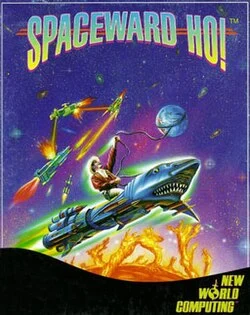
Spaceward Ho! is a seminal turn-based science-fiction space grand strategy 4X video game written by Peter Commons, designed by Joe Williams, and developed and published by Delta Tao Software. Originally launched in 1990 exclusively for the Apple Macintosh, the game proved so immensely popular that it spawned successful ports to MS-DOS, Amiga, and Microsoft Windows via New World Computing, eventually earning a permanent place in the Macworld Game Hall of Fame.
Spaceward Ho! holds a legendary, highly unique position in the history of the 4X genre. Arriving right at the dawn of the 1990s, it actively pioneered the early space expansion formula alongside titles like Reach for the Stars.
However, while subsequent strategy series embraced dense, hyper-complex micro-management and sterile data grids, Delta Tao Software went in the exact opposite direction. The team created a “beer and pretzels” space opera that managed to be mathematically deep while remaining fiercely minimalist, fast-paced, and wrapped in a satirical, tongue-in-cheek Space Western theme.
Technical Specifications
| Attribute | Details |
| Developer | Delta Tao Software |
| Publisher | Delta Tao Software (DOS/Win/Amiga ports: New World Computing) |
| Designers | Joe Williams, Peter Commons |
| Artist | Howard Vives |
| Engine | Proprietary 2D Top-Down Graphical Interface Engine |
| Platform(s) | Mac OS/OS X, MS-DOS, Windows, Amiga, Palm OS, iOS, Android |
| Release Date | • Macintosh: 1990 • MS-DOS / Windows: 1992 |
| Genre(s) | Turn-based strategy, 4X Space Strategy |
| Mode(s) | Single-player, Parallel Multiplayer |
The Space Western Aesthetic & Planetary Holiday Modifiers
The first thing that immediately set Spaceward Ho! apart from typical sci-fi strategy games was its completely unpretentious, quirky sense of humor. The game threw out grim alien threats and cosmic dread to frame galactic manifest destiny through a whimsical Space Western lens.
Spaceships look like abstract visual geometry, and every single star system on the map features exactly one monolithic planet that is comically adorned with a giant, floating brown Cowboy Hat directly on its map tile.
The developer slipped in a famous system-clock Easter Egg based on real-world calendars: if you execute the software executable on Thanksgiving, the cowboy hats automatically swap out for traditional Pilgrim caps. If you play on December 25th, the entire galaxy gets into the festive spirit as every colonized world sports a bright red Santa Claus hat for the duration of the day, establishing a colorful, lighthearted character that drew in legions of non-traditional strategy gamers.
Complex Minimalism: The “No Micromanagement” Economy
The core design philosophy of Spaceward Ho! relies on an unyielding pursuit of elegant reductionism: strip away every mechanical layer that doesn’t actively contribute to fun or challenge. Multi-planet star systems were condensed into single generalized worlds to reduce visual clutter.
Furthermore, the domestic economy completely bypasses complex building lists or manual resource-hauling networks, consolidating empire management into two primary resource pools managed entirely via intuitive interactive Bar Chart Sliders:
1. Money
Generated directly from a planet’s local civilian population count. Money is the liquid currency spent to fund raw scientific research, construct orbital defenses, or trigger deep terraforming projects.
2. Metal
The physical currency mandatory to build starships. Metal is systematically mined from finite planetary deposits.
The Automation Mandate
In a masterclass of 1990s user interface engineering, players never have to manually manufacture cargo freighters to ferry cash or ore across the galaxy. The game engine assumes that in the decades that pass between turns, your automated background staff seamlessly transports assets right to the shipyards where they are needed, completely eliminating end-game logistical tedium.
Planets are managed via localized temperature metrics. If a world’s raw environment doesn’t match your species’ biological comfort zone, you pump funding into Terraforming. As the planet becomes more habitable, its maximum population cap skyrockets, generating exponential tax revenues back into the state treasury. Advanced players routinely use a “strip-mine” strategy: cranking mining sliders to 100% on awful, toxic rocks to extract their metal payloads in just a few turns before completely abandoning the dead system.
Modular Ship Design & Tech Vectors
Instead of offering a rigid menu of pre-built spaceships, the software features a highly modular Ship Creator Terminal. When forging a new hull classification, players name their design and allocate funding across six independent, interlocking technological vectors:
- Range: Controls how many grid sectors a fleet can traverse in hyperspace before running dry and being restricted to home borders.
- Speed: The absolute defining vector of military superiority. Speed determines which fleet physically maneuvers and strikes first during a space engagement.
- Weapons: Multiplies the raw attack damage dealt per round. High-tier weapons can instantly vaporize primitive fleets before they can return fire.
- Shields: Provides a flat absorbing buffer to minimize incoming damage loops.
- Miniaturization: Reduces the total amount of raw Metal required to construct the ship hull. Advanced miniaturization allows you to produce massive swarms of high-tech dreadnoughts at a fraction of their historical cost.
- Radical (Random Research): An unpredictable wildcard track that feeds funding into randomized tech breakthroughs to catch opponents off-guard.
Parallel Execution & The No-Retreat Combat Rules
Because Spaceward Ho! was architected from day one to excel as a lightning-fast, high-intensity network multiplayer game, the engine utilizes a Simultaneous Turn Parallel Execution system. All players plot their economic sliders and drag their fleet movement vectors concurrently. Once everyone hits the end-turn button, the engine resolves all movements, combats, and colonization loops simultaneously, meaning you never have to sit idly waiting for a competitor to finish their turn.
Interstellar warfare operates under a set of strict, uncompromising rules designed to favor underdogs and force decisive outcomes:
- The Absolute No-Retreat Rule: Once a task force enters a star system containing a hostile fleet, dropping out of hyperspace takes years. Retreating or calling a fleet back mid-transit is hardcoded to be completely impossible. The battle simulates automatically until one side is completely obliterated.
- Target Priority AI: Players do not issue micro-tactical commands during space clashes. Fleet captains automatically prioritize targets logically: they will actively hunt down and blow up fragile, high-value enemy Colony Ships and fuel Tankers first before engaging defensive fighters or static orbital satellites, turning unprotected logistics chains into an absolute deathtrap.
- Zero Ground Combat: The game completely omits land infantry invasions. Taking a planet requires absolute orbital dominance. Your warships over the coordinate sector must continuously pulverize the planet surface from space until every living organism and defensive network is fully annihilated. Once the world is a clean slate, you immediately drop a colony pod to inject your own custom-engineered ecosystem.
Current Preservation & Mobile Adaptations (2026 Perspective)
As of May 2026, Spaceward Ho! stands as one of the most heavily revised, beautifully preserved, and enduring independent microcomputer games ever coded. Delta Tao Software famously iterated the desktop client all the way up to its definitive, rock-solid Version 5.0.5, creating an open sandbox that has kept fans playing continuous online multiplayer matches across decades.
The game’s preservation took a major leap forward when developer Ariton officially acquired the mobile rights, engineering native, beautiful ports of Spaceward Ho! for both iOS and Android ecosystems. Utilizing custom translation layers handled via Apportable, the mobile editions perfectly preserve the classic top-down spatial maps, cowboy-hat aesthetics, and slider-driven economic mechanics.
For desktop strategy purists, while the classic 1990s MS-DOS versions can be run flawlessly on modern Windows 11 architectures utilizing DOSBox wrappers, the modern, optimized OS X and mobile editions distributed on digital marketplaces remain the gold standard for testing your cosmic cowboy strategies. The game’s competitive AI does not cheat or give itself artificial resource buffers on high difficulties, offering contemporary strategy players a remarkably pure, brilliantly balanced masterclass in macro-scale space conquest.