Pax Imperia: Eminent Domain
 PC
PC THQ,
THQ,  THQ Nordic
Where to buy

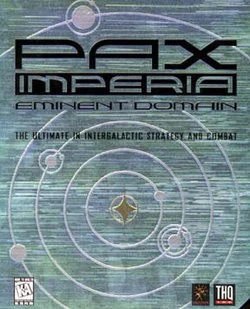
Pax Imperia: Eminent Domain (alternatively known during its development cycle as Pax Imperia 2) is a turn-based and real-time hybrid science-fiction space grand strategy 4X video game developed by Heliotrope Studios and published by THQ. Released in November 1997 for Microsoft Windows and Mac OS, the game serves as the direct commercial successor to Changeling Software’s acclaimed 1992 Macintosh exclusive Pax Imperia.
Pax Imperia: Eminent Domain occupies a unique, hyper-competitive slot in strategy history. Arriving shortly after the release of genre juggernauts like Master of Orion II: Battle at Antares, the title distinguished itself by pivoting away from purely slow-paced, turn-based macroeconomics.
Instead, it introduced a fully real-time simulation layer where technological research, construction queues, and galactic expansion occur simultaneously on an active global clock—offering built-in game speed adjusters and strict pause functions to give players total control over a chaotic universe.
Technical Specifications
| Attribute | Details |
|---|---|
| Developer | Heliotrope Studios (formerly Changeling Software) |
| Publisher | THQ (Modern digital rights: THQ Nordic) |
| Designers | Andrew Sispoidis, Peter Sispoidis |
| Engine | Proprietary 16-bit real-time graphics and windowing layer |
| Platform(s) | Microsoft Windows, Mac OS |
| Release Date | November 3, 1997 |
| Genre(s) | Turn-based / Real-time strategy hybrid, 4X Space Grand Strategy |
| Mode(s) | Single-player, Multiplayer (Up to 16 players over IPX/TCP-IP LAN) |
The Blizzard Fallout & The Wormhole Network
The structural architecture of Eminent Domain was profoundly impacted by industry politics in the mid-1990s. Changeling Software had initially partnered with industry giant Blizzard Entertainment to co-publish the title as a massive flagship project.
However, as development dragged deep into 1996, Blizzard officially canceled their involvement to consolidate their internal resources toward finishing StarCraft and Diablo, prompting the developers to rebrand as Heliotrope Studios and sell the global publishing rights over to THQ.
Concurrently, the sequel enacted a major geometric layout shift from its 1992 predecessor. The original title allowed completely node-free, open-grid transit across deep space.
Eminent Domain restricted star system travel strictly to hardcoded Wormhole Star Lanes. Fleets can only navigate systems connected by these spatial bridges.
While this removed the freedom of deep-space scouting arrays, it concentrated territorial friction. Star systems containing entry or exit nodes for multiple wormholes function as critical geographic choke points, allowing empires to stack defensive space installations to permanently choke out rival expansion vectors.
Species Customization & Planet Demographics
The game features an advanced Custom Species Point-Buy Editor that lets players build a completely customized asymmetric alien faction from scratch:
1. Atmospheric and Thermal Profiles
Civilizations must select a native chemical dependency—choosing to breathe Oxygen, Nitrogen, Carbon Dioxide, Hydrogen, or Methane. Furthermore, you define your species’ ideal planetary environment tier (Gas Giant, Volcanic, Rocky, Oceanic, Desert, Ice, or Terran) and native temperature thresholds.
If an empire attempts to land a colony pod on a world that clashes with their biological profile, population growth hits a total ceiling. The colony will slowly bleed treasury upkeep cash until players can discover high-tier Colonial Engineering paths to manually terraform the planet.
2. Demographic Quality Filters
Planets vary across distinct resource densities: Sterile, Poor, Normal, Abundant, Rich, and Opulent. These attributes determine the localized output of your citizen tax pools, technology points, and industrial manufacturing velocities.
Unlike games with rigid queues, planets can be assigned a generalized automated focus (e.g., prioritize Finance, Research, or Espionage). The local AI governor will autonomously zone facilities while you focus your attention strictly on macro-level galactic maneuvering.
The Custom Ship Workshop & Hybrid Battles
Eminent Domain abandons preset military templates, tasking players with manually designing every class of vessel active inside their starfleet armadas.
The Fleet Command Workshop features five baseline hull scales: Scouts, Destroyers, Cruisers, Battleships, and massive Aircraft Carriers. Every chassis has a strict maximum internal component weight capacity. Players spend liquid wealth and construction points to drag and drop distinct custom sub-systems directly onto the blueprint:
- Weapon Mount Fancings: Weapons must be assigned explicit firing arcs. Players choose to bolt heavy plasma batteries or missile lines facing Fore, Aft, Port, or Starboard, or utilize swiveling, low-damage Point-Defense Interceptors built specifically to shoot down incoming torpedo salvos.
- Modular Enhancements: Hulls must be manually packaged with specialized thruster sub-engines, warp-jump drives, defensive energy shields, structural armor plates, anti-missile counter-measure modules, repair drones, or fully operational internal fighter squadron bays.
The Pacing of Engagement
When two adversarial task forces intercept each other inside a star sector, the screen opens an independent tactical combat overlay resolved like a traditional 90s real-time strategy (RTS) arena.
Players drag boxes over ship sprites and click targets to initiate fire. Because battles play out concurrently in real-time alongside your empire management, research notifications will continue to pop up mid-fight.
To survive a surprise ambush, players lean heavily on the tactical game speed clock—slowing the game down to micro-manage shields or stopping time completely to plan complex flanking maneuvers before executing the battle sequence.
Deep Espionage & Cunning Subversion
For players who prefer to avoid brute-force military starship campaigns, Pax Imperia commands one of the deepest, most ruthlessly effective Espionage Matrices of its era. Factions can divert large portions of their planetary income straight into generating Espionage Points to train covert shadow networks.
Agents are secretly dispatched down wormhole paths to infiltrate competing sovereign capitals to execute five high-impact operations:
- Technology Piracy: Siphoning blueprints from an enemy’s scientific core, letting you reverse-engineer high-tier weapons without spending research funds.
- Industrial Sabotage: Planting thermal charges inside rival orbital shipyards or defensive shield generators, freezing their production queues before a space raid.
- Economic Infiltration: Embezzling state treasury funds straight out of an opponent’s tax accounts, sending their national economy into a sudden deficit.
- Biochemical Terrorism: Poisoning municipal civilian water lines or introducing genetic pathogens to forcefully tank an opponent’s population density.
- Fleet Subversion: The ultimate intelligence coup. Master spies can mentally brainwash or politically bribe elite enemy Starfleet commanders, causing an entire fleet of foreign battleships or cruisers to instantly switch allegiances and fall permanently under your control mid-match.
Modern Preservation Status (2026 Perspective)
As of May 2026, Pax Imperia: Eminent Domain occupies a secure, stable position as an eccentric and highly respected cult classic within the retro 4X retro gaming ecosystem. While it was largely overlooked at launch due to the massive commercial dominance of Master of Orion II, the strategy community deeply appreciates its pioneering real-time pacing and deep espionage layers.
The title is actively preserved and legally distributed on GOG.com for a baseline retail price of $5.99. The modern digital installer features pre-configured compatibility layers that allow the 1997 Windows 95 application executable to install and boot cleanly on modern 64-bit multi-core Windows 11 environments.
Crucial Compatibility Note for Modern Architecture
Strategy purists running the retail GOG release on modern Windows 11 frameworks should track one known technical limitation: due to unresolvable DirectX 7 and DirectDraw video scaling asset issues with modern operating systems, the game’s classic introductory and outro Full-Motion Video (FMV) cinematic movies will not play natively upon launch.
The game client automatically bypasses these broken media paths to boot you directly into the main gameplay terminal. The entire core real-time 4X loop—including the interactive star maps, custom species terminal, modular ship workshops, and 16-player local LAN multiplayer simulations—executes with absolute, rock-solid performance stability on modern widescreen monitors.