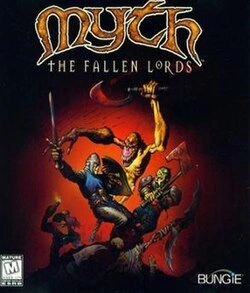
Myth: The Fallen Lords
 91
★ /10
91
★ /10
 PC
PC
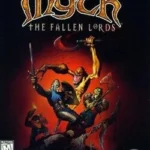
Myth: The Fallen Lords is a dark-fantasy real-time tactics (RTT) video game developed and published by Bungie Software. Released in November 1997 for Microsoft Windows and Classic Mac OS, it is the first entry in the Myth franchise, preceding Myth II: Soulblighter (1998) and the prequel Myth III: The Wolf Age (2001).
Historically, the title was a massive milestone for Bungie, serving as the studio’s first simultaneous multi-platform PC/Mac development cycle. It is widely celebrated for revolutionizing the strategy genre by completely abandoning resource micromanagement and base building in favor of pure tactical combat and an uncompromising, realistic 3D physics simulation engine.
Technical Specifications
| Attribute | Details |
|---|---|
| Developer | Bungie Software Products Corporation |
| Publisher(s) | • NA: Bungie Software • EU: Eidos Interactive |
| Lead Designer / Producer | Jason Jones |
| Programmers | Jason Jones, Ryan Martell, Jason Regier, Alex Rosenberg |
| Composers | Martin O’Donnell, Michael Salvatori, Paul Heitsch |
| Engine | Custom Myth Engine (True 3D terrain physics) |
| Platform(s) | Microsoft Windows, Classic Mac OS |
| Release Date | • NA: November 7, 1997 • EU: February 2, 1998 |
| Genre | Real-time tactics |
| Modes | Single-player, Multiplayer |
The RTT Revolution
Myth: The Fallen Lords explicitly distanced itself from the standard macroeconomics defined by contemporary titles like Warcraft II and Age of Empires. The game features zero extraction of raw resources, zero worker management, and zero stationary base structures.
Pre-Assembled Armies and Structural Controls
Every mission or multiplayer skirmish initializes with a finite, pre-assembled army assigned to the player. Victory requires total force conservation, as reinforcements are rarely provided mid-fight. The game utilizes advanced user interface implementations for the late 1990s, offering a fully rotatable, free-roaming 3D camera that allows players to orbit, pan, and tilt to survey terrain topography from any angle.
To organize troops efficiently, players rely on a combination of keyboard-allocated geometric formations (such as lines, wedges, and columns) paired with gesture clicking—dragging the mouse cursor across the ground coordinates to instantly dictate the exact physical direction the units will face upon arriving at their destination.
Unforgiving Physics Engine
The core strategic layer is governed by an unusually realistic, object-oriented 3D physics engine that dictates the absolute trajectory and behavior of every projectile on the field. Ranged weapons possess no guaranteed lock-on metrics; arrows, ballistic explosives, and magical bursts are calculated as independent, physical objects traveling through simulated space.
Environmental Dynamics and Friendly Fire
- Terrain Topography: Height advantages drastically alter combat parameters. Archers firing down from high plateau nodes achieve significantly expanded range metrics and velocity tracking. Conversely, if a Dwarf throws an explosive bottle or grenade at an enemy uphill and misses, the physical canister will realistically bounce, roll back down the slope, and detonate directly inside the player’s own frontline ranks.
- Weather Conditions: Spontaneous rainstorms affect the battlefield dynamically by extinguishing the lit fuses of Dwarven explosives, rendering explosive charges duds upon hitting the mud.
- Absolute Friendly Fire: Arrows fired into a chaotic melee melee will strike any organic hitbox in their direct pathing arc, meaning undisciplined positioning results in archers systematically slaughtering their own frontline infantry.
- Dismemberment and Debris: Casualties result in visceral, permanent physical consequences. Torso segments, severed limbs, and pools of blood remain mapped across the terrain throughout the duration of a match, interacting with subsequent explosives which can blow body parts across the map to inflict minor impact damage.
Plot and Setting
The narrative unfolds in a dark fantasy landscape gripped by a cyclical, cataclysmic struggle between the forces of the Light (Humans, Dwarves, and the Fir’Bolg archers) and the Dark (undead legions, ghols, and mutated monsters).
The Dawn of Collapse
The storyline documents the 17th year of a brutal war in the West. Fifty years after the sudden rise of Balor, a sorcerer of immense power, the civilized world is on the absolute verge of extinction. The Dark forces have methodically systematically obliterated almost every major kingdom, leaving only one surviving fortress city, Madrigal, holding the line.
Balor directs his campaigns through his principal lieutenants, a group of powerful sorcerers known as the titular Fallen Lords—including Soulblighter, Shiver, The Deceiver, and The Watcher. The Light is commanded by The Nine, an elite inner circle of powerful sorcerers known as Avatara, chief among whom is the calculating leader Alric.
The Journal of the Legion
The single-player campaign is presented like an intellectual political thriller, uniquely narrated from a ground-level perspective via the regular journal entries of an anonymous soldier serving in an elite mercenary group known as “The Legion”. Rather than portraying standard glorious fantasy tropes, the journal reads like a gritty account of psychological exhaustion, strategic retreats, desperate rear-guard defenses, and high-stakes guerrilla maneuvers.
The story chronicles the Legion’s grueling trek across frozen mountain passes and toxic swamps, tracing Alric’s desperate quest to locate lost magical relics and manipulate political fracturing among the Fallen Lords to execute a final, suicidal assassination run against Balor himself.
Multiplayer Innovation
Myth: The Fallen Lords hosted a highly competitive multiplayer ecosystem centered around Bungie’s early online service, Bungie.net. Rather than matching traditional base obliteration, multiplayer games adapted classic first-person shooter parameters and arcade sports modes into an isometric tactical framework:
- Body Count: A straightforward tactical attrition mode where victory is awarded to the player or team that inflicts the highest cumulative point metrics of structural damage within a running time limit.
- Last Man on the Hill / King of the Hill: Teams fight to secure a central geometric hill capped with a physical flag. Players accumulate real-time score points for every continuous second their forces hold uncontested proximity parameters around the flag staff.
- Steal the Bacon: A specialized arcade physics mode where a single, physical ball asset spawns at the exact center of the map. Units do not carry the item; instead, they must physically run into or detonate explosives near the ball to forcefully bump and roll it back toward their home sector while preventing opponents from touching it.
Modern Preservation & Enhancements (2026)
Following Bungie’s corporate acquisition by Microsoft in 2000, the intellectual property rights to the Myth franchise were legally transferred to Take-Two Interactive, leaving the games in a protracted period of retail distribution abandonware. The titles have never received an official digital rollout on contemporary platforms like GOG.com or Steam.
The Project Magma Codebase
The modern survival and archival maintenance of the series is handled entirely by Project Magma, a dedicated group of independent developers who continuously rewrite the legacy codebase. The current standard community patch, Myth II v1.8.5, injects comprehensive wrappers that address archaic DirectDraw anomalies, eliminate memory leaks, and optimize rendering loops. This allows the classic maps to execute flawlessly under modern 64-bit multi-core configurations on Windows 10 and Windows 11 desktops out-of-the-box, supporting crisp, native widescreen resolutions up to 1440p and 4K display formats.
Deluxe Edition Reimagining
The community ecosystem experienced a major milestone with the deployment of Myth: The Fallen Lords Deluxe Edition. Developed under project lead Jon God alongside Project Magma, this comprehensive modernization completely ports and reconstructs the entirety of the original 1997 campaign and multiplayer net maps directly into the highly refined Myth II: Soulblighter engine framework.
This project addresses the infamously punishing learning curve of the 1997 original by applying the fluid animation smooth loops, updated unit balancing scripts, and ambient features of the sequel. Parallel to this, the community launched the Twice Born Edition, a massive, high-resolution graphic remaster package that injects beautifully updated HD sprite detail collections over the classic assets, ensuring the foundational tactics of Bungie’s early masterpiece remain fully preserved for gaming historians.