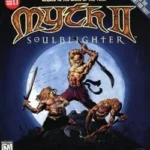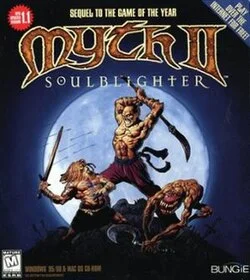
Myth II: Soulblighter
 88
★ /10
88
★ /10
 PC
PC
Myth II: Soulblighter is a dark-fantasy real-time tactics (RTT) video game developed by Bungie and published by Bungie in North America and GT Interactive in Europe. Released in December 1998 for Microsoft Windows and Classic Mac OS, it is the critically acclaimed sequel to the 1997 breakthrough title Myth: The Fallen Lords and the second installment in the Myth franchise.
The game was later ported to Linux by Loki Entertainment. Engineered with an overhauled 3D terrain physics engine, a streamlined pathfinding model, and an expansive multiplayer framework, Myth II solidified the real-time tactics genre by entirely eschewing base construction, economic micromanagement, and production lines in favor of intense, squad-level battlefield tactics.
Technical Specifications
| Attribute | Details |
| Developer | Bungie |
| Publisher(s) | • NA: Bungie • EU: GT Interactive / Eidos Interactive • Linux: Loki Software |
| Project Leader | Tuncer Deniz |
| Programmer | Jason Regier |
| Composers | Martin O’Donnell, Michael Salvatori, Paul Heitsch |
| Engine | Upgraded Myth Engine (True 3D terrain physics) |
| Platform(s) | Microsoft Windows, Classic Mac OS, Linux |
| Release Date | • NA: December 28, 1998 • EU: February 12, 1999 |
| Genre | Real-time tactics |
| Modes | Single-player, Multiplayer |
Plot and Setting
The game’s narrative takes place chronologically 60 years after the conclusion of The Fallen Lords. Following the absolute defeat of Balor on Core Prime and the fragmentation of the Dark armies, humanity enters a fragile golden age of reconstruction. The realm is overseen by King Alric, the heroic surviving Avatara from the original Galactic War who has ascended the throne of the Province.
The Resurgence of the Dark
The peace is shattered by the sudden resurgence of Soulblighter, a major supporting antagonist from the first game and one of Balor’s deadliest lieutenant sorcerers. Soulblighter has spent six decades hiding in the shadows, waiting for human complacency to peak.
To dismantle King Alric’s empire, Soulblighter executes a dark ritual to resurrect the Myrkridia—a legendary, hyper-destructive race of flesh-eating monsters that were hunted to near-extinction a millennium prior by the ancient hero Connacht.
The Journal of the Legion
Like its predecessor, the 25-mission single-player campaign is presented like an intellectual political thriller, uniquely narrated through the ground-level perspective of a lone mercenary soldier’s personal journal entries.
Serving in a small contingency of “The Legion” under Commander Crüniac, the narrator tracks what begins as a routine investigation into localized grave robbing and civilian massacres in the town of Tallow. The plot escalates as the Legion executes desperate rear-guard defenses, hunts for the elusive, decomposing Fallen Lord known as The Deceiver to forge an unstable political alliance, and marches across deep catacombs to stop Soulblighter before the free cities of the world are completely consumed.
Gameplay Architecture & Engine Enhancements
Myth II: Soulblighter preserves the foundational RTT ruleset: players initialize each mission with a finite, pre-assembled army and must exploit physical terrain positioning to defeat vastly superior numbers. Feral tactical micro-management replaced standard macroeconomic clicking.
The sequel introduced profound quality-of-life and engine mechanical expansions to the core formula:
- The Unit Control Bar: The user interface was modernized by adding a permanent Control Bar at the bottom of the screen. This interface displays dedicated command buttons for geometric formations (Wedges, Lines, Columns), unit status displays, and a direct tactical Mini-Map Overlay for real-time situational awareness.
- True Unit Altitude Physics: The physics engine tracking of physical ballistic projectiles was made more precise. Ranged units (like Bowmen) firing from high elevations receive direct mechanical velocity and range multipliers. Concurrently, the engine calculates Absolute Friendly Fire; undisciplined missile commands result in arrows striking teammate hitboxes mid-flight.
- Dynamic Weather Logic: Environmental hazards alter the maps in real time. Heavy rainfall and wet snow loops dynamically interact with the fuses of Dwarven explosive bottles and static satchel charges, forcing a high percentage of explosives to turn into complete duds upon hitting muddy terrain blocks.
- The “Fear and Loathing” Toolkit: Bungie bundled Myth II with its proprietary internal development tools: Fear (a comprehensive unit and asset editor) and Loathing (a map geometry and terrain layout builder). This sparked an expansive grassroots modding scene that allowed players to create total-conversion scripts completely altering the engine’s parameters.
Content Expansions
The commercial and critical milestone success of the title prompted Bungie to support and authorize alternative expansions:
Myth II: Chimera (1999)
A major official expansion pack developed by the independent Badlands mapmaking group in direct association with Bungie. Set ten years after the defeat of Soulblighter, the standalone campaign tracks three veteran soldiers who form an elite task force to hunt down a vengeful, rogue sorceress. Originally deployed as a free community download, Bungie formally canonized the expansion by packaging it inside the Myth: The Total Codex retail bundle.
Green Berets: Powered by Myth II (2001)
A unique commercial total conversion modification utilizing the Myth II tactical engine shell. Developed by Take-Two Interactive, the game completely strips away fantasy magic and sword combat, re-skinning the assets to simulate a squad-based tactical strategy game set during the Vietnam War. Players direct small fireteams of American soldiers navigating dense jungle grids, handling directional fire lanes, claymore traps, and ambush mechanics.
Modern Remastering Renaissance (2026)
Because Bungie was acquired by Microsoft and the Myth intellectual property rights were subsequently transferred to Take-Two Interactive, the trilogy has spent decades classified as legal abandonware. The games have never received an official digital re-release on mainstream modern digital storefronts like Steam or GOG.com.
The Project Magma 1.8.5 Core
The architectural maintenance and modernization of Myth II is handled entirely by Project Magma, a dedicated open-source group of independent software engineering purists. The team’s definitive modern patch—Myth II v1.8.5—overhauls the legacy 1998 codebase to run flawlessly on modern multi-core processing frameworks completely out-of-the-box.
The 1.8.5 update injects native direct-IP matchmaking layers, adds full cooperative save and load features mid-match, replaces legacy DirectDraw loops with modern graphics API compatibility wrappers, and implements an advanced, dynamic shadow mapping matrix based on active sprite geometries. This allows the game to scale natively into contemporary widescreen configurations (supporting 1080p, 1440p, and 4K desktop monitor displays) under Windows 10, Windows 11, and Linux.
Myth: Twice Born Edition Remaster
The preservation ecosystem experienced a major milestone with the deployment of Myth: Twice Born Edition. Developed over a grueling 15-year lifecycle by project lead Jon God alongside Project Magma, this comprehensive fan-made remaster completely reconstructs The Fallen Lords, Soulblighter, and the Chimera expansion inside a singular, highly optimized engine architecture.
The Twice Born Edition completely replaces the low-resolution 1998 art assets with beautifully upscaled and hand-recreated high-definition sprite collections (including HD overhauls for the Warrior, Dwarf, and Thrall unit arrays). The remaster adds native compilation for Apple Silicon hardware architectures alongside classic PowerPC emulations, ensuring Bungie’s defining real-time tactics masterpiece remains fully active and optimized for digital historians.