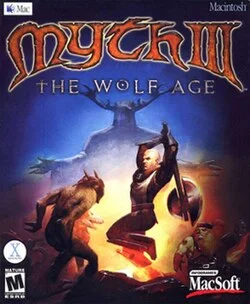
Myth III: The Wolf Age
 76
★ /10
76
★ /10
 PC
PC Gathering of Developers
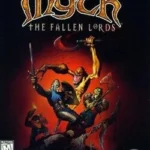
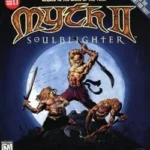
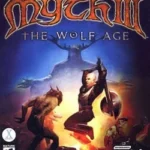
Myth III: The Wolf Age is a dark-fantasy real-time tactics (RTT) video game developed by MumboJumbo and co-published by Take-Two Interactive and Gathering of Developers. Released in November 2001 for Microsoft Windows and Mac OS, it serves as the third major installment in the Myth series and a direct prequel to Bungie’s acclaimed titles Myth: The Fallen Lords (1997) and Myth II: Soulblighter (1998).
The Wolf Age marks a major technological shift for the franchise. While the first two entries paired flat 2D character sprites with 3D terrain, MumboJumbo completely overhauled the engine architecture to render both the environments and the military units in true polygonal 3D models.
Like its predecessors, the game aggressively rejects standard real-time strategy tropes, completely bypassing base construction, resource collection, and factory queues to focus strictly on squad-level tactical positioning, realistic ballistics, and resource conservation.
Technical Specifications
| Attribute | Details |
|---|---|
| Developer | MumboJumbo |
| Publisher(s) | Take-Two Interactive, Gathering of Developers, MacSoft (Mac) |
| Engine | Custom 3D Myth III Engine (True 3D models and advanced terrain physics) |
| Platform(s) | Microsoft Windows, Classic Mac OS, Mac OS X |
| Release Date | November 2, 2001 |
| Genre | Real-time tactics |
| Modes | Single-player, Multiplayer |
Plot and Prequel Setting
The Wolf Age is set chronologically 1,000 years prior to the events of Myth: The Fallen Lords, taking place during the bleak era known as the “Wind Age.” At this point in history, humanity is on the absolute precipice of extinction, systematically hunted like wild game across the continent by the Myrkridia—a legendary, hyper-destructive race of savage, flesh-eating monsters. Only two isolated human bastions remain standing: the rugged eastern borderlands of Gower and the massive fortress city of Llancarfan.
The Legend of Connacht
The 25-mission single-player campaign documents the historic rise of Connacht, a fierce barbarian warrior from Gower. During a desperate final stand at the settlement of Yursgrad, Connacht organizes the local clans and achieves the impossible: defeating a Myrkridia pack in open combat for the first time in centuries. Heralded across the land as “Deliverance,” Connacht is summoned to the capital by the Emperor of the Cath Bruig to spearhead a total global war of survival.
The Origin of the Fallen Lords
The narrative serves as a dark political thriller and an official origin story for nearly every major villain encountered in Bungie’s original entries. As Connacht journeys across the realm alongside legendary figures like the wizard Mazzarin and the master smiths of the Dwarves, the campaign tracks the tragic transformations, ancient relationships, and political fractures that birthed the primary antagonists of the later timeline.
The story illustrates the original mortal forms of iconic villains including Soulblighter, Shiver, The Deceiver, The Watcher, and Balor (the cosmic spirit of “The Leveler” inhabiting a corrupted shell), providing contextual depth to the franchise’s cyclical lore.
Gameplay Mechanics & Engine Changes
The tactical loop of The Wolf Age mirrors the uncompromising difficulty of its predecessors: every mission begins with a pre-determined, unalterable block of troops. Dead units cannot be replaced, forcing an extreme emphasis on squad conservation and tactical awareness.
Full 3D Polygonal Models
The headline innovation was the abandonment of hybrid 2D/3D visual rendering. Transitioning to true 3D polygonal models allowed units to possess highly distinct animation skeletons, dynamic real-time shadow casting, and smoother directional turning loops. However, core purists noted that early 3D models lacked some of the sharp, crisp artistic charm inherent to the high-frame-rate 2D sprites of Myth II.
The True Physics Matrix
The object-oriented physics engine remains central to the strategic layer, calculating real-time mass, inertia, and trajectory for every weapon discharge on the battlefield:
- High Elevation Multipliers: Height advantages grant direct mechanical boosts. Archers and spellcasters positioned atop steep plateaus achieve expanded range limits and velocity tracking over targets below.
- Absolute Friendly Fire: Ballistic objects and arrows contain zero auto-lock metrics. If an infantry line fragments and steps into an archer’s line of fire, the missiles will puncture teammate hitboxes, forcing careful formation management.
- The Mana Resource Pool: Evolving the mechanical architecture of the previous games, units capable of channeling magic are equipped with a visible Mana Meter. Spells actively deplete this bar, which slowly regenerates over time based on the unit’s tier.
Unit Roster
The single-player campaign is played strictly from the perspective of the forces of Light, guiding an asymmetric roster of human warriors, mystical support units, and specialized demolitionists:
| Unit Name | Classification | Primary Weapon Vector | Tactical Specialty & Battlefield Utility |
|---|---|---|---|
| Warrior | Infantry | Broadsword & Shield | Standard front-line shock troops; can lock into defensive geometric formations to absorb heavy melee impacts. |
| Heron Guard | Elite Heavy Infantry | Dual Melee / Healing | The Emperor’s personal champion guards. They possess massive health bars, heavy armor plating, and the ability to cast localized health restorations on wounded allies. |
| Dwarven Demolitionist | Ranged Support | High-Impact Explosives | Slow-moving units that hurl volatile explosive canisters; ideal for flattening clustered enemy lines but highly prone to catastrophic friendly-fire accidents if targets are too close. |
| Warlock | Magic Caster | Fireball / Arcane Blast | Ranged glass-cannon mages that consume a running mana pool to discharge devastating area-of-effect elemental bursts. |
Rushed Production and Fan Preservation (2026)
The Stalled Release
The development of Myth III was plagued by intense corporate scheduling constraints. Take-Two Interactive rushed MumboJumbo to complete the entire full 3D overhaul within an incredibly compressed 10-month production window to hit the winter 2001 retail target.
While the game was highly praised for its exceptional narrative narrative and campaign structure, the rushed development left the initial retail Windows client severely unpolished, suffering from frequent script stalls, performance anomalies, and unstable multiplayer netcode. Shortly after deployment, MumboJumbo closed its primary California development office, abandoning formal support for the title.
The Source Code Handover
Following the studio’s collapse, Take-Two Interactive executed an unusual and highly celebrated move for video game preservation: they officially handed over the complete source code of Myth III to MythDevelopers—a dedicated, volunteer collective of community software engineers and modders.
Modern Status
As of 2026, Myth III: The Wolf Age remains classified as retail abandonware. Unlike its predecessors, which are actively kept alive under Project Magma’s modern engine ports, Myth III has never received an official digital re-release on modern platforms like Steam or GOG.com due to complex, lingering licensing webs.
However, the game is kept stable on contemporary hardware thanks to the community’s FlyingFlip Studios v1.3.1 Patch. This community-driven update strips out archaic CD-ROM check exceptions, corrects legacy DirectDraw memory crashes, and incorporates custom compatibility wrappers. This allows the original 2001 polygonal 3D battles to scale cleanly into modern widescreen formats (including 1080p and 1440p monitor displays) on Windows 10 and Windows 11 with stable frame rates.