Merit’s Galactic Reunion
 Amiga
Amiga PC
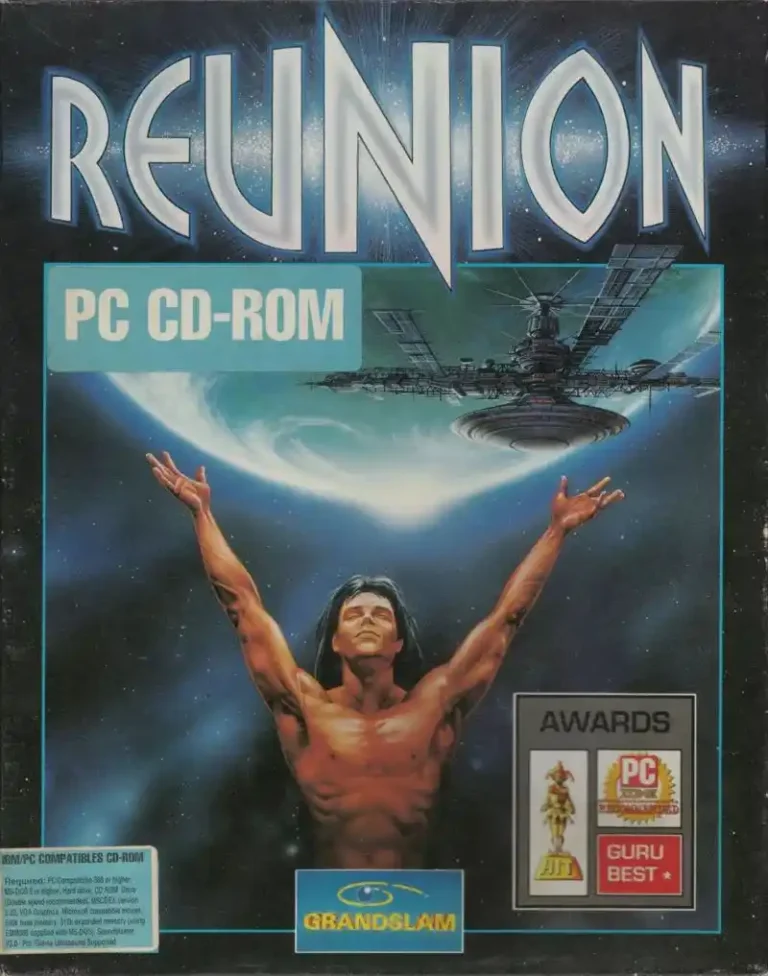
PCMerit’s Galactic Reunion (originally released in Europe simply as Reunion) is a landmark space strategy video game developed by the Hungarian studio Amnesty Design (which later rebranded as the highly celebrated Digital Reality). Released in 1994 for the Amiga and MS-DOS platforms, with an upgraded PC CD-ROM interactive multimedia edition following in 1995, the title is a unique evolutionary bridge in computer gaming history.
While it laid the foundation for the real-time space 4X genre, Galactic Reunion boldly subverted contemporary conventions by fusing rigid macroeconomic colony simulations with the aesthetic, narrative structure, and menu navigation of a point-and-click graphic adventure game.
Distributed in North America under sub-license by Merit Studios Inc., the game is fondly remembered for its sweeping cyberpunk-inspired cinematic visuals, highly immersive storytelling, and a legendary electronic soundtrack composed by Tamás Kreiner.
Technical Specifications
| Attribute | Details |
| Developer | Amnesty Design (later Digital Reality) |
| Publisher(s) | • EU: Grandslam Entertainment • NA: Merit Studios Inc. |
| Programmers | János Kistamás (Amiga), Krisztián Jámbor (Amiga), István Kiss (MS-DOS) |
| Composer | Tamás Kreiner |
| Engine | Proprietary Bitmapped 2D Room and Vector Grid Engine |
| Platform(s) | Amiga (OCS/AGA), MS-DOS |
| Release Date | • Floppy Disk: 1994 • CD-ROM: 1995 |
| Genre(s) | Real-time strategy, Space grand strategy, Graphic Adventure |
| Mode | Single-player |
The Narrative Premise: The Great Return
The narrative setup of Galactic Reunion unfolds across an epic, multi-generation timeline starting in the 27th century. Following centuries of unbroken global peace, Earthen scientists achieve the ultimate technological breakthrough: the first operational interstellar warp drive. Two experimental explorer vessels, Explorer-1 and Explorer-2, are deployed into the deep void to map out viable star systems for extra-terrestrial colonization.
Only Explorer-2 successfully returns to solar orbit. However, just as the vessel is refitted as a massive colony ship, peace on Earth abruptly collapses. A sudden, planet-wide militant rebellion stages a violent political coup, overthrowing the centralized government and plunging the solar system into total, bloody chaos. Crewed by a desperate contingent of government loyalists, Explorer-2 barely manages to slip past the rebel orbital blockades, executing a blind warp jump out of the solar system.
Years later, the heavily damaged ship arrives at its distant destination, establishing a lone, vulnerable settlement named New Earth. After generations of complete isolation, the colony becomes entirely self-sufficient.
As the newly elected President of New Earth, you are tasked with a supreme historical mandate: explore the surrounding sectors, extract vital resources, research high-tier space technologies, construct an unassailable military fleet, and systematically conquer your way back to your ancestral solar system to execute the greatest galactic reunion in human history.
Gameplay Architecture: A Multidisciplinary Space Opera
The primary design hallmark of Merit’s Galactic Reunion is its highly stylized, menu-driven interface. Instead of interacting with abstract floating data grids or spreadsheet windows, players manage their interstellar empire from a fully illustrated, static Central Command Room.
Players click on physical doorways and hardware terminals within the command deck to actively transition between specialized, real-time administrative bays:
1. The Personnel Office & Advisor Mechanics
Before specific rooms can even function, players must navigate to the Personnel Office to hire distinct Commanders (Advisors). Advisors are drafted from a dynamic, scrolling resume pool, with candidates tracking unique salaries and independent efficiency ratings across four distinct specializations: Research, Production, Logistics, and Military Leadership.
Assigning a highly competent, expensive researcher speeds up your tech development, while hiring a top-tier general provides passive offensive damage and evasion buffs during space battles. Players can visit the local “Space Local” galactic bar terminal to listen to rumors, gather tips from eccentric patrons, or cross-examine their advisors for strategic guidance.
2. Granular Extraction & Resource Warehouses
The domestic economy relies on discovering and mining six distinct raw mineral commodities scattered across the solar system. Within the Colony Building Room, players manage their settlements turn-by-turn, zoning housing grids to expand the workforce while constructing surface mining facilities over scanned resource veins.
Materials are not instantly pooled globally; they must be physically hauled. To expand your manufacturing, players must assign specialized Miner Droids directly to operational veins to automate output into local planet warehouses.
3. The Unforgiving Logistics Friction
Galactic Reunion is heavily cited by strategy historians for its intense, highly uncompromising approach to micro-logistical friction. The game completely lacks automated trading networks or passive resource routing.
Every single starship fleet transaction must be executed manually by the player: you must explicitly order a freighter fleet to take off from New Earth, manually input flight vectors to travel to a mining colony, land the ships, physically transfer the stored ore into the fleet’s cargo bays, order a takeoff, fly them back home, and manually unload the haul into your primary forge warehouses. If a player loses track of their shipping lines, outlying colonies quickly experience resource starvation.
Strategy as an Interactive Scripted Narrative
Unlike sandbox 4X games where matches are entirely emergent and randomized, Galactic Reunion plays out as a highly scripted, event-driven interactive story. The gameplay loop functions as a chronological sequence of specific triggers and cosmic milestones that the player must unfold.
“The primary challenge of Galactic Reunion stems from its absolute lack of margin for error. If you fail to research a highly specific shield component or build up your tank divisions before a hardcoded script fires, an invading alien empire will effortlessly obliterate New Earth, triggering an immediate Game Over.”
Diplomacy with the game’s alien species (such as the aggressive, predatory Morgruls) is largely non-linear; foreign empires will typically initiate contact only when the story’s event triggers demand it.
When warfare inevitably breaks out, the game shifts to dedicated tactical combat displays. Space battles are resolved automatically based on your fleet configurations and the technology level of your lasers and shielding modules.
Conversely, capturing or defending planets triggers an independent Real-Time Ground Battle Overlay, where players deploy heavy tanks and atmospheric ground-attack fighters to forcefully hold or seize local city squares.
The Digital Reality Connection & Soundscape
Despite selling poorly in Western retail markets due to its immense difficulty and localized translation quirks, Galactic Reunion is structurally vital to the history of European game development. The game’s success in Central Europe allowed Amnesty Design to expand and permanently rebrand themselves as Digital Reality.
The exact building blocks engineered for Galactic Reunion—most notably the transition between isometric surface management, space fleets, and ground vehicle deployment—served as the direct conceptual blueprint that Digital Reality later perfected to launch their global 1997 real-time strategy hit, Imperium Galactica.
Furthermore, the game’s audio design is considered a masterpiece of 16-bit tracker sequencing. Composer Tamás Kreiner utilized the limited sound channels of the Amiga and early PC soundcards to craft a deeply atmospheric, haunting, and electronic synth score.
The music seamlessly dynamically tracks your gameplay state—shifting from ambient chill-out pads during command-room planning phases to high-energy, pounding industrial beats during fleet combat encounters, heavily driving the game’s immersive, cinematic character.
Modern Preservation Status
As of May 2026, Merit’s Galactic Reunion stands preserved as a fascinating and historically significant retro artifact from the golden age of PC DOS and Amiga strategy gaming. While it has never received an official, commercial remaster or modern digital storefront re-release on platforms like Steam or GOG, it remains highly requested across GOG’s community “Dreamlists.”
For contemporary strategy enthusiasts and digital historians seeking to experience the original 1994 Amnesty Design blueprint, the complete MS-DOS CD-ROM client is beautifully preserved and fully playable directly within web browsers via emulator containers hosted on the Internet Archive.
Alternatively, players running the game locally on modern desktop environments execute the software using DOSBox frameworks. By utilizing native aspect ratio locking and mapping the directory alongside original text walkthrough reference guides, modern players can experience the precise, high-stakes room navigation, demanding micro-logistics, and striking hand-drawn art of humanity’s journey back to Earth with absolute, stable performance.