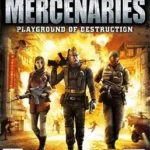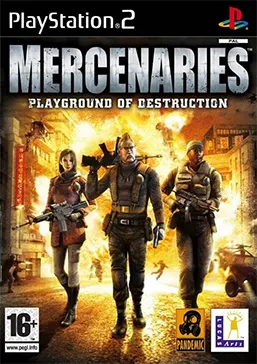
Mercenaries: Playground of Destruction
 PS 2
PS 2 Xbox
XboxMercenaries: Playground of Destruction is a 2005 open-world action-adventure video game developed by Pandemic Studios and published by LucasArts. Released in January 2005 for the PlayStation 2 and Xbox, the title stands as the foundational debut installment of the Mercenaries franchise and a towering, historically vital milestone in the evolution of 3D sandbox design.
Arriving just as the sixth generation of console hardware was reaching its absolute absolute creative peak, Mercenaries boldly challenged the urban, car-jacking boundaries popularized by Grand Theft Auto. Pandemic Studios built a massive, fully interactive geopolitical warzone that prioritized real-time structural destruction, a fluid multi-faction reputation system, and a highly addictive, military-inspired bounty hunting loop. The game was an immense critical and commercial triumph, universally praised for its masterclass pacing and its empowering sandbox freedom.
Technical Specifications
| Attribute | Details |
| Developer | Pandemic Studios |
| Publisher | LucasArts |
| Composer(s) | Michael Giacchino, Chris Tilton |
| Engine | Zero Engine (Integrated with Havok Physics framework) |
| Platform(s) | PlayStation 2, Xbox |
| Release Date | January 11, 2005 (North America) / February 18, 2005 (Europe) |
| Genre | Action-adventure, Third-person shooter, Sandbox |
| Mode(s) | Single-player |
The Second Korean War: Narrative Framework
The single-player campaign takes place within a volatile, near-future North Korea. The geopolitical crisis triggers when the progressive North Korean President, Choi Kim, successfully negotiates a historic, peaceful reunification treaty with South Korea. However, during the ultimate peace ceremony, his own son, the hyper-nationalist General Choi Song, launches a violent, bloody military coup d’état. Supposedly executing his father and seizing absolute military control, General Song completely seals North Korea’s borders from the global eye.
The crisis hits an absolute boiling point months later when the Royal Australian Navy intercepts a distressed North Korean freighter, discovering a cargo of nuclear warheads bound for international terrorist syndicates. Realizing Song possesses functional launch capabilities, an international coalition named the Allied Nations (AN) launches a full-scale conventional invasion to dismantle the regime.
To expedite the collapse of Song’s forces, a private military corporation named Executive Operations (ExOps) deploys a solo elite operator onto the frontlines to systematically dismantle the regime’s infrastructure from the bedrock up.
Players choose from three legendary mercenary operators, each possessing distinct tactical languages and passive physics gameplay modifiers:
- Chris Jacobs: A calm, imposing former American Special Forces operative. Built for extended conventional combat, Chris boasts immense physical strength, allowing him to carry vastly superior ammunition reserves and endure far more ballistic damage before collapsing. He natively speaks English and Korean.
- Jennifer Mui: A highly tactical, calculating ex-MI6 operative from Hong Kong. Jennifer excels at high-speed stealth and hit-and-run tactics, benefiting from a massive passive movement speed bonus across all terrain and a highly quiet crouching profile. She natively speaks English and Chinese.
- Mattias Nilsson: A wild, mohawk-sporting Swedish ex-biker with an insatiable appetite for absolute explosive chaos. Mattias relies on sheer adrenaline, possessing a hyper-fast passive health-regeneration speed boost. He natively speaks English and Russian.
Hunting the Face Cards: The Deck of 52
The definitive mechanical core of Mercenaries is the Deck of 52 progression system, directly modeled on the actual playing cards created by the United States Defense Intelligence Agency to help troops identify high-value targets within Saddam Hussein’s government during the Iraq War.
The North Korean military hierarchy is divided into four structural suits, each ruling over a distinct logistical branch of Song’s regime:
- Clubs: The internal security and transport networks.
- Diamonds: The heavy armored divisions and conventional military strongholds.
- Spades: The elite special forces units and covert counter-intelligence branches.
- Hearts: The chemical, biological, and nuclear weapons development programs.
To unlock the high-tier Ace Contracts that push the primary story forward, players must scout the warzone to hunt down the lower-tier number cards and face cards.
The game enforced a strict high-stakes choice during active apprehensions: players can easily open fire to execute a target and take a quick snapshot of the corpse for a baseline cash reward, or they can choose to non-lethally pistol-whip, subdue, and handcuff the target. Handcuffing a card required players to defend the coordinate while calling in an Allied Nations extraction helicopter to airlift the prisoner out safely, rewarding the player with double the financial payout.
The Geopolitical Powder Keg: Faction Dynamics
The open world operates as a complex political ecosystem split between a central mercenary hub and four major, competing factions. Balancing your standing across these entities is imperative, as completing contracts for one group often directly sabotages your relationship with another:
- The Allied Nations (AN): A heavily armored United Nations-style peacekeeping coalition led by the bureaucratic American General Garrett. Their operations heavily emphasize stabilization, humanitarian escorts, and base defense structures.
- China: A dominant global military superpower led by the cold, calculated Colonel Peng. China aims to aggressively annex North Korea under Beijing’s sovereignty, deploying heavy armor columns and prioritizing the absolute destruction of South Korean assets.
- South Korea: Supported directly by the CIA and overseen by agent Mitchell Buford. South Korea fights to unify the peninsula under a democratic framework, relying heavily on asymmetric guerrilla operations, counter-intelligence strikes, and targeted assassinations against Chinese logistics.
- The Russian Mafia: Operating out of the shadows as the “Merchant of Death” under the leadership of Sergei Voronov. The Mafia holds zero ideological stake in the war; they operate exclusively to exploit the chaos for illegal capital. They manage the digital black-market storefront ShopToDone.net, serving as the player’s lifewire to purchase advanced heavy vehicles, ammunition drops, and airstrikes.
The Disguise and Infiltration Metric: Pandemic Studios implemented a brilliant, ahead-of-its-time vehicular disguise mechanic. If a player commandeers a faction-specific vehicle (such as a North Korean military jeep) out of the line of sight of enemies, they cleanly take on that faction’s profile. This allows players to pass straight through hostile border blockades and slip deep into enemy camps completely unnoticed—though the disguise is instantly blown if the player drives recklessly, triggers an explosion, or lingers too close to high-ranking officers who sport a visible detection circle over their heads.
Real-Time Cataclysm: The Merchant of Death Arsenal
Long before modern hardware popularized unscripted structural destruction, Mercenaries leveraged the Havok Physics Engine to turn its world into an interactive laboratory of demolition. Using the funds secured from capturing the Deck of 52, players interact with their technical handler, Fiona Taylor, to call down devastating orbital and aerial support:
- Bunker Busters: Laser-guided kinetic darts that plunge vertically through heavy architecture, cleanly crumbling reinforced concrete command fortresses into piles of structural rubble.
- Fuel-Air Explosives (FAE): Colossal unguided bombs that generate a massive, screen-shaking pressure wave, instantly vaporizing entire columns of enemy tanks, trees, and outpost walls in a massive firestorm.
- Air Superiority Strikes: High-velocity carpet-bombing runs designed to cleanly clear out massive military airstrips and defensive mortar lines in seconds.
Contemporary Stance
The original Mercenaries is universally revered as an untouchable, pristine masterpiece of sandbox history. While its 2008 Venezuelan sequel (Mercenaries 2: World in Flames) is widely criticized for janky vehicular handling, loose AI scripting, and an abandoned abandonware client state, the 2005 original is increasingly celebrated for its flawless pacing, atmospheric orchestral score, and raw, punchy combat physics loop.
Unlike its sequel, Playground of Destruction has enjoyed an immaculate long-term technical conservation cycle:
The title stands as a brilliant showcase for Microsoft’s long-term video game preservation engineering. Available natively on Xbox One, Xbox Series X, and Xbox Series S via native backward compatibility, the original Xbox game client runs in an absolute dream state. Modern systems effortlessly brute-force the legacy software limits, rendering the game at a stunning, crisp native 4K resolution (on Series X) with system-level Auto HDR integration.
The old sixth-generation framerate hitches and low-resolution fog filters are completely wiped away, locking the performance to a fluid, flawlessly smooth presentation profile with near-instant SSD load times. On the Sony side, while native PS5 backward compatibility is absent, the game remains highly accessible via modern PlayStation 2 emulation frameworks on PC (PCSX2), ensuring that the hunt for General Choi Song’s deck of cards remains perfectly playable for sandbox purists today.