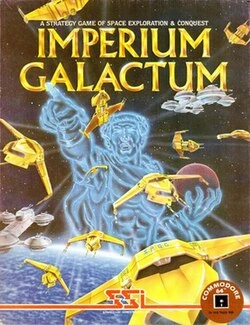
Imperium Galactum
 Apple II,
  Atari 8-bit,
  Commodore 64
 Strategic Simulations, Inc.
Imperium Galactum is an incredibly early, foundational turn-based science-fiction grand strategy video game designed by Paul Murray and published by Strategic Simulations, Inc. (SSI). Launched in 1984 for the Apple II and Atari 8-bit family of home computers, and subsequently ported to the Commodore 64 in 1985, it stands as one of the earliest commercial ancestors of the 4X genre (eXplore, eXpand, eXploit, and eXterminate).
Arriving just one year after Strategic Studies Group’s Reach for the Stars (1983), Imperium Galactum significantly pushed the operational limits of early 8-bit systems.
While it featured the rudimentary, text-heavy user interfaces typical of mid-1980s mainframe ports, the title successfully introduced complex concepts that would not become standardized in space grand strategy until a decade later—including modular starship blueprint configuration, multi-world supply chain management, and asymmetric guerrilla resistance forces on occupied planets.
Technical Specifications
| Attribute | Details |
|---|---|
| Developer | Paul Murray |
| Publisher | Strategic Simulations, Inc. (SSI) |
| Designer | Paul Murray |
| Engine | Text-based / Graphical 2D Map Interface |
| Platform(s) | Apple II, Atari 8-bit, Commodore 64 |
| Release Date | • 1984 (Apple II, Atari) • 1985 (Commodore 64) |
| Genre(s) | Turn-based strategy, 4X Space Grand Strategy |
| Mode(s) | Single-player, Multiplayer (1 to 4 players, hotseat or CPU) |
The Spatial Sandbox and Planetary Parameters
A standard match features up to four competing factions (any combination of human or variable-difficulty computer entities) expanding outward across a star cluster featuring 50 unique star systems. Every star system can generate anywhere from zero to two habitable planets, with environmental traits heavily dictated by one of five distinct stellar classifications. Factions can select a pre-set static historical layout or a completely procedurally randomized map configuration.
Unlike contemporary strategy games of its era that treated worlds as uniform supply caches, Imperium Galactum models every planet across two independent, variable metrics rated from 1 to 100:
- Environment (Life Support Capacity): Dictates how well the planet naturally handles colonization. An environment rating surpassing 50 allows the establishing player to open Agriculture sectors. Every unit of agricultural investment requires half a point of citizen manpower to operate, outputting four points of food to organically multiply population growth.
- Resources (Mineral Abundance): Governs the exact maximum number of Mines a faction can physically erect on the world surface. Extracted ore from these mines is routed straight into the local Industry hubs, generating liquid manufacturing points used to construct starships, planetary defensive shield hubs, or fund empire-wide technological development.
This dual-tier layout forces high-level logistical coordination. Advanced players routinely move away from making uniform, self-sufficient worlds to actively engineering specialized planets. A mineral-rich, ecologically dead radioactive rock can be stripped completely bare by automated mining outposts whose entire ore payload is ferried via specialized Trader cargo ships straight across the sector to feed a mega-industrial forge world.
High-Level Logistics and Transport Capacities
The absolute bottleneck of your empire’s macro-expansion is its logistical transit fleet. Resource payloads do not instantly deposit themselves into a centralized global inventory; they must be physically hauled step-by-step across grid sectors using tailored civilian hulls:
- Traders: Specialized, unarmed cargo vessels tasked with hauling surplus food and industrial ore among planets to resolve systemic agricultural or raw mineral deficiencies. The engine enforces a hard 1:1 rule: transporting a point of commodity requires assigning an active Trader hull to the shipping lane.
- Transports: Heavy civilian vessels explicitly used to ferry raw population pools or standing land infantries across the stars to establish fresh colonies or launch planetary planetary invasions.
If an empire’s industrial production outpaces its available transport hulls, supply loops completely stall, stranding valuable raw resources on remote world tiles. Advanced tech development allows players to allocate funding directly into a global Technology Level, which progressively multiplies the sub-light travel speeds of all active fleets while eventually unlocking high-tier Terraforming capabilities to permanently upgrade a planet’s raw Environment rating.
Pioneering Modular Starship Blueprint Engineering
One of the game’s most highly praised and visionary design hallmarks is the complete lack of hardcoded combat ship blueprints. Decades before Master of Orion popularized the feature, Paul Murray integrated a fully customizable Warship Blueprint Terminal.
Players can maintain up to eight completely custom starship designs concurrently. Ship customization involves first choosing a base hull scale (Small, Medium, or Large) and then spending collected manufacturing points to manually distribute traits across seven distinct tactical attributes:
- Planetary Bombardment: Governs the ship’s ability to soften up ground armies or glass surface industry from orbit.
- Energy Weapons: Heavy, direct-fire laser batteries optimized for punching through physical armor plates during fleet-to-fleet clashes.
- Missile Systems: High-impact, explosive ordinance payloads designed to overwhelm defensive planetary bases.
- Evasion: Multiplies the vessel’s innate agility rating, drastically lowering the hit probability of incoming enemy projectiles.
- Armor & Anti-Missile Interceptors: Direct defensive tracking systems built to absorb energy strikes or shoot down incoming missile salvos before hull contact.
- Speed: Dictates operational movement metrics across sectors and grants a distinct positioning advantage during combat resolution.
Blockades, Economic Embargos, and Guerrilla Warfare
When diplomatic interactions fail (which include basic options to sign peace treaties, form military alliances, or trade with sovereign independent worlds), Imperium Galactum opens an unforgiving warfare engine. Space combat is handled by the computer based on ship specifications, but players retain the tactical option to coordinate retreats mid-engagement.
For players seeking to bypass massive, resource-draining fleet-on-fleet actions, the game pioneered Asymmetric Unconventional Warfare. Empires can position task forces over a rival’s system coordinates to initiate a Commerce Raid or a strict Economic Embargo. This tactical action forcefully severs the host planet’s trade lines. The local Traders cannot exit or enter, completely blocking the target faction from exporting or importing critical food and mineral resources.
Furthermore, ground invasions enforce a brutal Guerrilla Warfare Penalty. If an invading army captures a world without deploying enough troops to completely pacify or systematically exterminate the native population, the remaining citizens organize armed insurgencies. Turn-by-turn, hidden guerrilla units launch random saboteur strikes, destroying surface factories, melting local mines, and ambushing the occupying army until the planetary resistance is forcefully suppressed.
Historical Preservation Status
As of May 2026, the 1984 original Imperium Galactum sits preserved as a rare, highly revered holy text of early computer strategy design. Because it shares a highly confusing linguistic root with Digital Reality’s completely unrelated 1997 real-time strategy hit Imperium Galactica, finding an isolated copy requires explicitly targeting the 1984 SSI catalog. The game is not legally hosted on modern mainstream digital retail storefronts like Steam or GOG.
However, the complete 1984 client is immaculately preserved on vintage abandonware databases and emulation hubs, most notably the Internet Archive, where players can boot and execute the classic Apple II and Commodore 64 editions directly inside integrated web browser containers.
Strategy historians running the raw software locally utilize dedicated 8-bit emulators such as VICE (for the C64 version) or AppleWin (for the Apple II files). When properly run, these tools allow the dense text resource matrices, pioneering modular ship design terminals, and brutal guerrilla warfare loops of Imperium Galactum to perform with absolute historical accuracy on modern desktop setups.