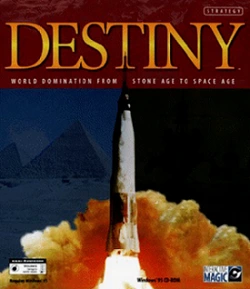
Destiny: World Domination from Stone Age to Space Age
 PC
PCDestiny: World Domination from Stone Age to Space Age is a turn-based and real-time hybrid historical 4X grand strategy video game developed by the British studio Dagger Interactive Technologies and published by Interactive Magic. Released in October 1996 for Microsoft Windows 95, the game was produced by military simulation icon and MicroProse co-founder “Wild” Bill Stealey, aiming to directly challenge the historical dominance of Sid Meier’s Civilization series.
Destiny stood out in the mid-1990s strategy boom by offering an incredibly massive historical spectrum, unique nation-specific military artwork, an intricate macroeconomic web of 24 raw and refined resources, and a localized tactical battle engine that allowed players to micro-manage frontline combat maneuvers across distinct historical epochs.
Technical Specifications
| Attribute | Details |
| Developer | Dagger Interactive Technologies |
| Publisher | Interactive Magic |
| Producer | Bill Stealey |
| Composer | Donald S. Griffin |
| Platform | Windows 95 |
| Release Date | • North America: October 15, 1996 • Europe: 1997 |
| Genre(s) | Turn-based strategy / Real-time hybrid, 4X Grand Strategy |
| Mode | Single-player, Multiplayer |
The Asymmetric Historical Sandbox
While contemporary historical 4X games used uniform structural blueprints and identical army clones for all factions, Destiny prioritized unique cultural flair and visual diversity across its map. The game features 12 playable historical civilizations: The United States, United Kingdom, China, Egypt, France, Germany, India, Israel, Italy, Japan, Russia, and Sweden.
Instead of reusing baseline unit models across nations, Dagger Interactive hand-crafted custom architectural sets and bespoke military sprites for each country. The military roster charts the complete evolutionary timeline of human warfare, spanning from primitive Stone Age club-wielding warriors to highly specialized, culturally accurate units like medieval Mongolian rockets, French Arquebus infantry, 19th-century Hussars, and World War II-era bazooka teams.
The endgame transitions deep into modern nuclear physics and late-stage deterrence. The engine makes an explicit strategic distinction between basic atomic bombs and devastating, system-clearing hydrogen-bomb ICBMs launched from fortified silos or nuclear-powered stealth submarines.
The Dual-Mode Engine & Tactical Battlefields
Destiny was technically unique for breaking away from rigid, purely turn-based game loops. Matches play out across a sprawling map grid, and players are given the toggle option to run their empire in either a contemplative Turn-Based Mode or a fast-paced, simultaneous Real-Time Strategy (RTS) Mode.
Furthermore, the game completely rejects abstract, automated combat resolutions. When two adversarial armies intercept each other on the global map, the engine doesn’t merely roll digital dice.
Instead, the player can dive straight down into a localized Tactical Combat Layer. This tactical arena grants you total operational agency over the battlefield: you manually direct individual division formations, coordinate flanking routes across terrain boundaries, and execute targeted artillery barrages—allowing a smaller, low-tech army to successfully rout a larger force through pure tactical maneuvers.
Macroeconomics, Material Chains, and Religion
The domestic management loop of Destiny features an incredibly deep economic and cultural layout that stood entirely unmatched by its 90s peers.
The 24-Resource Matrix
Empires do not accumulate a single generic “production” currency. Industrial growth is heavily bottlenecked by an intricate matrix tracking 24 distinct types of materials.
Factions must manage non-linear, multi-tiered supply lines, mining raw assets like crude iron ore and routing them through localized manufacturing networks to process them into specialized intermediate materials, such as armored steel, mandatory to construct modern mechanized armored divisions and nuclear bombers.
The Six Structural Faiths
Societal stability and public morale are driven directly by the game’s fully interactive cultural engine, which tracks six global religions: Paganism, Judaism, Christianity, Islam, Buddhism, and Hinduism. Every faith features distinct behavioral traits, civilian humors, and dedicated, physical architectural places of worship.
Managing a multi-faith empire requires continuous planning. If a conquering player aggressively swallows a foreign territory practicing a deeply clashing faith without funding regional places of worship to pacify the populace, the world will quickly break out into intense religious civil unrest, triggering grinding worker strikes and localized rebellions that freeze your domestic tax pipelines.
Modern Preservation Status (2026 Perspective)
Following the historical winding down of Interactive Magic and Dagger Interactive shortly after the deployment of the game’s final Version 1.146 patch on April 29, 1997, Destiny: World Domination from Stone Age to Space Age quickly drifted into relative obscurity. Due to long-standing, fragmented corporate licensing entanglements, the title has never received an official commercial digital re-release on mainstream storefronts like Steam or GOG.com. It is officially classified as historic Abandonware.
For retro 4X strategy purists and gaming historians seeking to experience this forgotten gem, running the original 1996 retail Windows 95 CD-ROM client on contemporary 64-bit multi-core Windows 11 environments presents a notable technical challenge. Because the codebase relies on early, un-emulated Win95 architecture hooks and direct color palette swapping scripts, executing the binary natively is completely impossible.
The definitive preservation pathway requires running the software inside specialized x86 virtualization environments like PCem or 86Box, pre-configured to emulate an authentic Pentium-era PC executing a native Windows 95 operating system.
Alternatively, community-modded variants packed into DOSBox-X wrappers running a lightweight Windows 95 installation container can cleanly mount the game’s ISO disk image files. This completely bypasses legacy resolution crashing errors to let the custom unit sprites, intricate resource chains, and unique tactical battlefields of Destiny render flawlessly on contemporary widescreen configurations.