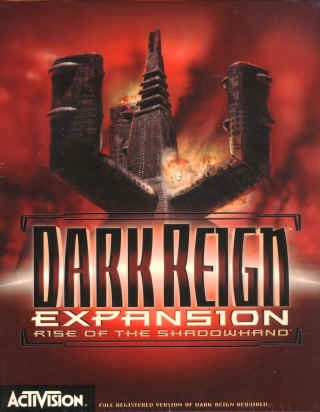
Dark Reign: Rise of the Shadowhand
Expansion of Dark Reign: The Future of War PC
PC Activision
Where to buy

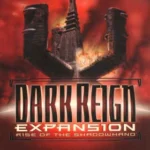
Dark Reign: Rise of the Shadowhand is a 1998 expansion pack for the critically acclaimed 1997 real-time strategy (RTS) game Dark Reign: The Future of War. Developed by Auran and published by Activision, this expansion is widely celebrated by classic PC strategy fans for doing exactly what an expansion should do: rather than just tossing in a handful of new units, it introduced two entirely new, radically distinct playable factions and a rich, heavily story-driven campaign that expanded the game’s grim, sci-fi universe.
The narrative shifts the focus slightly away from the main civil war of the base game. Following the emergence of the Tograns as a credible threat, the despotic Imperium becomes increasingly desperate, launching a massive armada to purge the galaxy of the Freedom Guard. A severely damaged Freedom Guard transport ship, the Emancipator, makes a desperate, blind jump through a secret Imperium spatial foldgate. They emerge in orbit around the uncharted planet of Nineveh. Here, they discover the Shadowhand—a top-secret, elite black-ops division of the Imperium. Furthermore, the planet is ground zero for a catastrophic event: the Shadowhand has lost control of a highly advanced, psychotic prototype AI codenamed Osiris, which is actively trying to break off-world and exterminate all life in the galaxy.
Gameplay
Rise of the Shadowhand runs on Auran’s incredibly advanced 1997 engine, which boasted features that were years ahead of its competitors (like Command & Conquer or Warcraft II).
Key gameplay mechanics and expansion additions include:
- The Dual Economy: Players must manage two distinct resources. You harvest Water (which is sold off-world for pure financial credits) and Taelon (a radioactive mineral used to power your base structures and high-tech units).
- Advanced Unit AI: Dark Reign was famous for its pathing and behavioral AI. You could assign individual units specific behaviors, such as “Scout,” “Harass,” or “Search and Destroy,” and dictate their tolerance for taking damage before automatically fleeing to a repair station.
- Terrain and Elevation: The 3D terrain actually mattered. Units on high ridges could shoot further and had a massive line-of-sight advantage over units trapped in valleys, and infantry could utilize forests for stealth cover.
- Terraforming: The expansion introduced common Terraformer units for all factions, allowing players to physically alter the map—paving roads to increase vehicle speed or creating marshes to bog down enemy tank columns.
The New Factions
The expansion brought the total number of playable factions up to four. While the base game featured the high-tech, heavily armored Imperium and the stealthy, guerrilla-warfare Freedom Guard, the expansion introduced two wildly unique armies:
- The Shadowhand: The absolute elite of the Imperium’s military forces. Operating in secrecy on Nineveh, they expand upon the Imperium’s hovering tank technology but feature highly specialized units designed specifically to hunt down the rogue AI Osiris. Their arsenal includes advanced base-disruption infantry like the Power Spiker, who can completely shut down enemy power grids and defensive turrets.
- The Xenites: Formed when the stranded Freedom Guard forces allied with the local human population of Nineveh. The locals had successfully tamed the planet’s vicious indigenous alien wildlife. The Xenites replace traditional anti-armor tanks with massive, heavily mutated beasts like the melee-focused Gant and the lightning-spewing Grendel.
- The Controller Mechanic: The Xenites possess one of the most unique mechanics in 90s RTS history. Because their beasts are wild animals, they must remain within the radius of a “Controller” unit (like a human Ranger or a Grendel Rider). If a beast wanders outside the controller’s radius, or if the controller is killed in combat, the beast instantly goes feral—turning neutral and violently attacking any unit nearby, including your own troops.
Development and Legacy
Released in March 1998, Rise of the Shadowhand was heavily praised by strategy veterans. During an era where many expansion packs were just quickly assembled “mission disks” designed to make a quick buck, Auran delivered a massive mechanical shake-up that completely altered the competitive multiplayer meta.
The inclusion of the Xenites’ feral mechanic and the deep, challenging AI of the campaign cemented Dark Reign as one of the smartest, most tactically demanding strategy games on the market. It successfully bridged the gap between the mid-90s Command & Conquer clones and the release of Blizzard’s genre-defining StarCraft later that same year.
While the Dark Reign franchise eventually stumbled with a highly divisive, fully 3D sequel (Dark Reign 2) in 2000, the original game and its Shadowhand expansion are still revered as hidden masterpieces of the golden age of PC real-time strategy.
Key Features:
- Four Playable Factions — Command the classic Freedom Guard and Imperium, or master the newly introduced elite Shadowhand and the beast-taming Xenites.
- The Feral Threat — Micro-manage your Xenite armies carefully; keep your alien beasts under control, or watch them turn feral and tear your own base apart.
- Advanced Tactical AI — Utilize the franchise’s legendary waypoint and behavioral systems to automate patrols, harassment, and hit-and-run tactics.
- The Rogue AI — Fight a desperate, multi-faction war to stop the psychotic Osiris program from escaping the planet Nineveh.
- Topographical Warfare — Exploit the game’s brilliant line-of-sight and elevation mechanics to set up devastating ambushes from the high ground.
Release Platforms:
- Microsoft Windows (PC) — March 26, 1998
- (The expansion requires the base game, Dark Reign: The Future of War, to play).