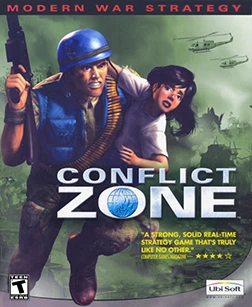
Conflict Zone
 59
★ /10
59
★ /10
 Dreamcast
 PC
PC PS 2
PS 2 Ubisoft
Conflict Zone (often subtitled Modern War Strategy) is a fascinating and highly experimental real-time strategy game released in 2001 by the French developer Masa Games and published by Ubisoft. Launched during the peak of the 3D RTS transition, Conflict Zone attempted to move away from the “tank rush” tropes of the era by introducing sophisticated AI delegation and a unique meta-game involving media perception and public opinion.
As of May 2026, the game is remembered as a “visionary but flawed” pioneer. While it has not yet received a high-profile modern remake or a GOG/Steam re-release (making it one of the few high-budget Ubisoft titles currently categorized as abandonware), it maintains a dedicated following of retro strategy enthusiasts who use community-made wrappers to run its early DirectX 8 architecture on modern Windows 11 systems.
The Premise: The War of Public Perception
The game is set in the then-near-future of the 2010s. The world is gripped by a new kind of conflict where military victory is meaningless if you lose the “media war.” The narrative follows the struggle between two fundamentally different organizations:
- The International Corps for Peace (ICP): A NATO-like global coalition. Their goal is to maintain world order and minimize civilian casualties. They have access to superior technology but are heavily restricted by public opinion; if they kill civilians or lose too many soldiers, their funding is cut.
- GHOST: A shadowy, decentralized mercenary organization funded by private interests and rogue states. They care nothing for human rights or public perception. They use terror tactics, human shields, and propaganda to achieve their goals, thriving in the chaos that the ICP is trying to prevent.
Gameplay: The “DirectAction” AI and Media Management
Conflict Zone introduced two major systems that were years ahead of their time, aimed at reducing the “click-intensity” of the RTS genre:
- DirectAction AI (The Commander System): This was the game’s primary innovation. Instead of micro-managing every single unit, you can hire “Commanders”—AI sub-units with distinct personalities (Aggressive, Defensive, Balanced). You assign these Commanders a group of units and a zone of the map, and they will autonomously handle the tactical execution of your orders. This allows the player to focus on high-level strategy, such as base expansion and media management, while your AI generals handle the “grunt work” of localized skirmishes.
- The Media and Public Opinion: Resource management in Conflict Zone is tied to your reputation. The ICP gains “Popularity Points” by rescuing civilians, building hospitals, and avoiding “collateral damage.” High popularity leads to increased funding and better technology. Conversely, GHOST can use their own media vans to film staged incidents or “fake news” to frame the ICP, manipulating the global audience to their advantage.
- Base Building and Logistics: The game features a robust base-building system with a focus on modern military realism. You build barracks, hangars, and radar stations, but you must also manage civilian refugee camps and media centers. The technological gap between the two factions creates an asymmetrical challenge; the ICP relies on high-precision air strikes and heavy armor, while GHOST excels in guerrilla warfare, kamikaze units, and cheap, expendable infantry.
Visual Style and Technological Ambition
At its release, Conflict Zone was one of the most visually impressive RTS games on the market. It featured a fully 3D engine with a completely rotatable and zoomable camera, real-time lighting, and detailed unit models that showed visible damage. The environments ranged from the jungles of Southeast Asia to the deserts of the Middle East, all rendered with a focus on tactical verticality.
The audio design was equally striking, featuring a dynamic soundtrack that ramped up during combat and voice-overs for your AI commanders who would report their successes or failures via “picture-in-picture” video feeds, further immersing the player in the feeling of being a high-level military director.
Key Features:
- Advanced AI Delegation — Command your armies through autonomous AI sub-commanders, reducing micromanagement and focusing on the “Big Picture” of the war.
- The Popularity System — Balance your military objectives with the “Media War.” Your actions on the ground directly affect your funding and technological access.
- Asymmetrical Warfare — Experience two completely different playstyles: the high-tech, rule-abiding ICP or the ruthless, propaganda-driven GHOST.
- Refugee and Civilian Management — Civilians are an active part of the battlefield; protecting them is a mission-critical objective for the “good guys” and a tactical resource for the “bad guys.”
- Cinematic “Picture-in-Picture” — Stay updated on the battlefield with live video feeds from your AI generals and news broadcasts that react to your tactical decisions in real-time.
- Diverse Global Campaigns — Engage in over 30 missions across varied climates, each requiring a different balance of military force and media manipulation.
Release Dates:
- PC (Windows) — June 20, 2001.
- Sega Dreamcast — July 12, 2001 (One of the few RTS games on the platform).
- PlayStation 2 — May 24, 2002.
- Modern Status — Currently not available on modern digital stores.
Conflict Zone remains a fascinating case study in RTS design. It dared to ask if a strategy game could be about more than just blowing things up—it challenged the player to consider the political and social consequences of modern warfare. It offers a strategic depth that still feels surprisingly relevant in the age of 24-hour news and digital propaganda.