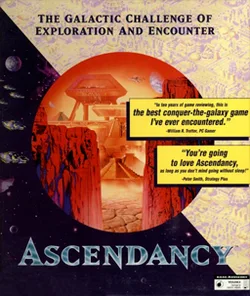
Ascendancy
 iOS (iPhone/iPad),
  PC
PC
 Virgin Interactive Entertainment
Ascendancy is a critically acclaimed turn-based science-fiction space grand strategy 4X video game developed by The Logic Factory. Originally released on September 24, 1995, for MS-DOS, the title arrived during a historic “golden age” for the space 4X genre, directly competing alongside titans like Master of Orion.
Ascendancy won the prestigious Codie Award for Best Strategy Software in 1996, celebrated for its immersive 3D rotatable galactic maps, an intricate three-dimensional technology tree, and a highly stylized universe.
The game rejected traditional human factions in favor of 21 wildly asymmetric, bizarre alien species. Each group possessed game-altering biological special abilities, cementing the title as an enduring, beloved cult classic of 1990s PC gaming.
Technical Specifications
| Attribute | Details |
| Developer | The Logic Factory |
| Publisher(s) | Virgin Interactive Entertainment, Broderbund, Softgold |
| Designer / Writer | Todd Porter, Jason Templeman |
| Engine | Proprietary 3D Rotatable Star Cluster & 2D Planetary Grid Engine |
| Platform(s) | MS-DOS, Microsoft Windows, iOS (2011 Mobile Remake) |
| Release Date | September 24, 1995 |
| Genre(s) | Turn-based strategy, Space Grand Strategy, 4X |
| Mode | Single-player |
The Asymmetric Alien Menagerie
In a radical departure from mainstream sci-fi tropes, Ascendancy completely omits the human race. Instead, players select from 21 distinct, heavily customized alien species. Every faction features unique behavioral traits, distinct starship hull art styles, and a specific Racial Special Ability that can be activated on fixed day cycles to entirely disrupt the galactic balance:
- The Minions: Inorganic, extra-dimensional mechanical lifeforms. Their special ability ensures that any planetary ground invasion they launch automatically succeeds with absolute certainty, bypassing defensive infantry numbers.
- The Snovemdomas: A structurally immense, hyper-dense warrior race. Natively built for survival, their special ability causes all starships produced in their orbital shipyards to sport double the baseline structural hull integrity of any other race.
- The Orfa: Bizarre, silicon-based entity clusters. They are the lone civilization capable of bypassing environmental blockades to freely build heavy industrial facilities directly on a planet’s toxic “Black Squares.”
- The Chronomyst: Ethereal, temporal manipulators who possess the innate capacity to warp the flow of time. They navigate the space lanes at twice the velocity of any other species on the map using identical hyperdrives.
- The Chamachies: Uncompromising, hyper-focused academic researchers. Once every 89 days, their scientific collective can instantly complete whatever technology project is currently sitting in their research queue.
The 3D Cluster Map & Color-Coded Star Lanes
The main navigational dashboard of Ascendancy was a massive graphical leap forward in 1995, utilizing a fully interactive, rotatable 3D Vector Star Cluster Map. Players can pivot, pitch, and zoom across the galactic plane to track solar systems, fleet positions, and interstellar borders.
Interstellar transit completely rejects free-form open flying, operating instead through a fixed web of cosmic paths called Starlanes. Ships must be physically guided into the mouth of a starlane to cross coordinates, spending several game turns traveling in limbo before emerging at the destination.
The game engine utilizes a unique Color-Coded Logistics System to structure galactic geography:
- Blue Starlanes: Normal, high-velocity links. These form compact local “neighborhoods” of star systems that can be rapidly navigated using primitive starting engines.
- Red Starlanes: Long-distance, high-resistance connections. These function as major geographic boundaries linking different star clusters. Traveling down a red link without researching advanced, late-game Hyperdrives slows fleet transit to a crawl, leaving your starships vulnerable to interception.
Planetary Topography & Orbital Slots
When selecting an explored world, the screen transitions to a localized 2D grid representing the planet’s surface. Infrastructure management requires players to balance three primary societal resources: Industry (local build speeds), Research (global technology points), and Prosperity (organic population growth).
Planets vary from tiny husks to massive worlds, with their surface terrain divided into colored squares that act as natural localized multipliers:
- White Squares: General-purpose terrain providing zero bonuses.
- Red Squares: Heavy mineral zones that multiply the output of any Industrial Factory placed on top of them.
- Blue Squares: Magnetic or psychic anomalies that provide a massive boost to Research Laboratories.
- Green Squares: Highly fertile regions that rapidly accelerate Prosperity and population caps.
- Black Squares: Hostile, uninhabitable zones that block standard building construction entirely until late-game terraforming techs are fully mastered.
The 10 Orbital Slots
Encircling every planet grid is a fixed ring containing exactly ten orbital construction squares. Players utilize these slots to manufacture orbital shipyards, deploy static defensive missile bases, or mount high-yield weapon systems like the legendary Orbital Mega Whopper to obliterate invading armadas from the safety of the planetary core.
Furthermore, players can deploy surface archeology teams to excavate glowing Xeno Ruins left behind by ancient vanished civilizations, instantly unlocking high-tier tech blueprints or triggering planet-wide growth bombs.
The 3D Technology Web & Modular Ships
Scientific progression abandons standard vertical lists to implement a fully rendered 3D Hierarchical Tech Tree. Players spin and expand branches of physics, sociology, and engineering.
The Logic Factory packed the tech tree with whimsical, math-inspired nomenclature, tasking your scientists with investigating things like the Tonklin Diary (unlocking Frequency Analyzers) or Momentum Deconservation (unlocking advanced weaponry).
Once specialized components are researched, players navigate to a modular Ship Design Terminal. Hulls track a square grid layout where players manually bolt down functional sub-systems.
Every ship requires a balance of power generators, propulsion drives, and scanner devices alongside specialized tactical modules—such as shields, hull auto-repair drones, and heavy weapon platforms like the Quantum Singularity Launcher.
Combat maps do not transition to an external arena; battles play out turn-by-turn directly inside the active 3D solar system view, forcing players to utilize the local star positions and planetary orbits as physical shields to block incoming fire.
The AI Controversy & “The Antagonizer” Salvation
Upon its retail debut in late 1995, Ascendancy was met with a highly polarized reception that remains a famous chapter in strategy game history. Mainstream critics and casual players praised the game for its beautiful graphics, incredible music, and visual interface, earning it a high 93% editor’s choice score from PC Gamer.
However, strategy purists and grognards quickly exposed a massive flaw: the game’s artificial intelligence was completely broken and non-aggressive. The base retail AI script routinely failed to design functional starships, left its home planets un-defended, and refused to expand down starlanes, stripping any late-game challenge from the match.
To rescue the title’s legacy, The Logic Factory quickly engineered a legendary software overhaul patch known as The Antagonizer. The patch completely rewrote the computer’s operational AI scripts, turning the passive alien races into hyper-aggressive, expansionist warmongers that actively hunted down player weak spots.
However, because the patch was deployed in late 1995 when home internet access was highly restricted, many retail buyers never successfully received the update, cementing the game’s historic reputation as a flawed, beautiful masterpiece.
Modern Preservation Status (2026 Perspective)
As of May 2026, Ascendancy is fondly preserved and deeply revered as a shining jewel of the mid-90s DOS strategy boom. In 2011, The Logic Factory briefly revived the IP by deploying a native, beautifully optimized mobile remake for iOS devices, adapting the 3D vector maps and grid menus for smooth touchscreen controls.
While that mobile edition has since been retired from active app stores due to modern OS 64-bit architecture shifts, the classic 1995 personal computer original is heavily preserved across abandonware networks.
Executing the original 1995 MS-DOS client on modern Windows 11 environments requires loading the game files inside a DOSBox emulation container.
By mounting the directory alongside the community-distributed Antagonizer patch files and applying native 4:3 aspect ratio display wrappers, contemporary strategy grognards can experience the deep planetary grids, quirky 3D tech trees, and brilliantly bizarre asymmetric alien empires with flawless performance stability.