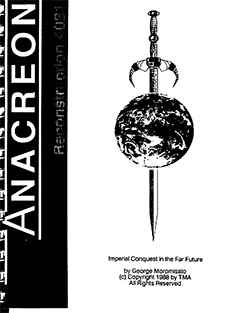
Anacreon: Reconstruction 4021
 PC
PC
Anacreon: Reconstruction 4021 is a landmark 1987 turn-based space strategy 4X video game written by George Moromisato and published by Thinking Machine Associates (TMA) for MS-DOS.
Arriving years before the titles that popularized space grand strategy—such as Master of Orion (1993) or Galactic Civilizations (1993)—Anacreon is widely celebrated by strategy historians as one of the earliest and most conceptually complex examples of the 4X genre (eXplore, eXpand, eXploit, and eXterminate).
The game single-handedly introduced the strategy ecosystem to macroeconomic simulation on a galactic scale. Eschewing basic arcade space battles, it tasked players with managing interstellar supply chains, configuring specialized logistics networks across hundreds of star systems, navigating non-renewable energy dependencies, and maintaining a totalitarian grip over restive colonial populations.
Technical Specifications
| Attribute | Details |
| Developer | Thinking Machine Associates (George Moromisato) |
| Publisher | Thinking Machine Associates (TMA) |
| Designer / Programmer | George Moromisato |
| Engine | Text-and-Symbol Grid Layout (Turbo Pascal Core) |
| Platform | MS-DOS / PC DOS |
| Release Date | 1987 |
| Genre(s) | Turn-based strategy, 4X Space Grand Strategy |
| Mode | Single-player, Turn-based Local Multiplayer |
Galactic Premise and Asimovian Roots
The narrative milieu and thematic tone of Anacreon are directly, deeply inspired by Isaac Asimov’s seminal Foundation series of science-fiction novels. The game takes its title explicitly from the planet Anacreon, a powerful, warlike splinter province that broke free during the historical decay of Asimov’s Galactic Empire.
The campaign kicks off centuries after the violent collapse of a sprawling, system-wide interstellar civilization. Space has devolved into a dark age of fragmented worlds, isolated tribal societies, and forgotten technologies.
Players assume the absolute role of a totalitarian dictator steering a small, ambitious star nation. By dispatching exploratory probes and military task forces across dark sectors, empires must locate primitive or neutral worlds, aggressively subjugate them, and slowly reconstruct the shattered blueprint of the ancient galactic empire while fending off rival computer or human sovereigns.
The Industrial Backbone: Cargo Routes & Specialization
While subsequent space strategy games leaned on uniform, self-sufficient planets that manufactured their own food and defenses simultaneously, Anacreon pioneered the concept of Planetary Specialization.
The game maps out an intricate, raw-to-processed macroeconomic grid. Conquered worlds are defined by their unique planetary classes, local climates, resource abundances, and starting technological tiers (ranging from primitive agrarian cultures to advanced atomic age metropolises).
To maximize imperial output, players must forcefully shift worlds away from self-reliance to act as hyper-specialized cogs in a macro-industrial wheel:
- University Planets: Sacrificed completely of manufacturing to focus entirely on academic research, fast-tracking your progression through the tech tree.
- Forge and Mining Worlds: Stripped of agriculture to focus 100% of their labor slots on refining raw Chemicals and Metals to churn out continuous lines of warships.
- Agricultural Breadbaskets: Tasked purely with harvesting massive food and tool Supplies to feed worker populations on inhospitable volcanic or gas giant outposts.
The Logistics Bottleneck & The Trillum Crisis
Linking this specialized empire requires managing a continuous, fragile network of autonomous Transport Fleets. Resources must be physically hauled across sector coordinates using tailored cargo vessels.
This creates an immense strategic vulnerability: if a rival player intercepts and destroys your food transports or chemical cargo routes mid-transit, your mining and military forge worlds will experience immediate industrial collapse.
Furthermore, space travel is governed by a strict energy dependency: Trillum. Trillum serves as the absolute non-renewable fuel source mandatory to power all interstellar ship engines.
While chemicals and metals can be manufactured infinitely, every planet contains a strictly finite, non-replenishable deposit of Trillum. Once an empire’s home deposits are sucked dry, they must continuously wage aggressive imperial expansionist wars to seize foreign fuel nodes, turning the late-game strategy into a cutthroat, desperate struggle for energy survival.
Fleet Combat and Planetary Defenses
Military logistics in Anacreon are resolved through an uncompromising, numbers-driven mathematical engine. When an invading battle fleet enters a host planet’s coordinates, the screen shifts to a specialized orbital tactical display.
The defending player’s standing military forces, automated satellites, and four distinct classifications of planetary defense shields are permanently arranged in explicit, concentric orbital paths around the world grid.
Combat ignores randomized dice rolls or evasion metrics; it is solved through a strict, automated calculation of raw fleet firepower numbers.
The attacker maintains full operational agency to dictate which specific orbital lanes to assault and which defensive nodes to target first, while the defending computer automatically responds based on fleet sizes.
Because high-tier units are brutally expensive, tactical victory relies on leveraging proper ship velocities—matching slow, hyper-armored Warp Drive cruisers with blindingly fast, expensive Jump Drive capitals capable of blinking ten sectors in a single turn to execute devastating surprise attacks.
Megastructures & The Ambrosia Dilemma
The game engine is highly noted for incorporating a massive library of cosmic engineering projects and speculative assets decades ahead of its time. Advanced players can dedicate massive industrial sectors to construct high-tier Space Megastructures, including massive interstellar minefield barriers, automated orbital space stations, fully synthetic artificial planets, and Stargates capable of instantly tele-transporting entire military battle fleets across the expanse of the galaxy.
Concurrently, players manage public order using an insidious, high-reward resource: Ambrosia. Ambrosia is an elite, state-manufactured performance-enhancing narcotic drug.
Piping Ambrosia into a colony’s infrastructure triggers an immediate, massive spike to local worker manufacturing speeds while allowing you to train highly disciplined, elite shock infantries. However, the drug features a devastating catch: it permanently addicts the population of any world that consumes it.
If your cargo fleets suffer an enemy blockade or if you run out of chemicals to produce the drug, the sudden disruption in the Ambrosia supply line triggers catastrophic civilian withdrawal. The planet instantly plunges into extreme civil unrest, sparking massive public rebellions and armed insurgencies that can rip your empire apart from the inside out.
Legacy & Open-Source Preservation
Following its initial 1987 commercial launch via Thinking Machine Associates, George Moromisato eventually re-acquired the complete intellectual property rights to his creation, officially releasing Version 1.3 of the MS-DOS client as free, open-source freeware alongside its original Turbo Pascal source code.
Moromisato went on to leverage the game’s foundational design philosophy to launch two successful modern iterations under his studio banner, Kronosaur Productions: the 2004 Windows remake Anacreon: Imperial Conquest in the Far Future, and the persistent multiplayer browser-based grand strategy platform Anacreon: Galactic Conquest.
The classic 1987 DOS codebase remains fully preserved, active, and deeply studied by strategy historians. Because the original 16-bit executable cannot boot natively within modern 64-bit multi-core operating systems, contemporary strategy purists execute the freeware client utilizing DOSBox emulators.
The official game directories and scenario map configuration text files remain freely hosted and maintained on Moromisato’s design hub (neurohack.com/anacreon), allowing the brilliant, Asimovian resource-flowing lines, non-renewable Trillum crises, and high-stakes addictive Ambrosia trade loops of Anacreon: Reconstruction 4021 to perform with absolute, performance stability for the modern era.