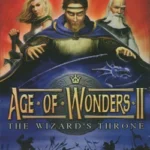
Age of Wonders II: The Wizard’s Throne
 86
★ /10
86
★ /10
 PC
PC 1C Company
 Gathering of Developers

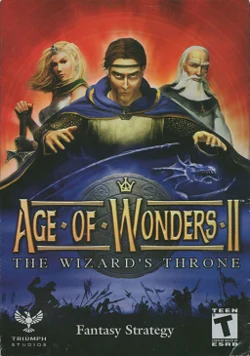
Age of Wonders II: The Wizard’s Throne is a critically acclaimed turn-based high-fantasy grand strategy 4X video game developed by the Dutch studio Triumph Studios and published by Gathering of Developers (with Take-Two Interactive handling wider distribution). Released in June 2002 for Microsoft Windows, the game serves as the structurally ambitious, visually vibrant successor to 1999’s Age of Wonders.
While the first game blended traditional role-playing elements with classic hex-grid strategy, the second installment shifted the entire franchise blueprint to focus squarely on the demi-god status of the Wizard archetype. By engineering a unique system centered on Wizard Towers, localized magical domains, and a completely overhauled story mode starring the legendary mage Merlin, the title elevated the fantasy grand strategy genre to new heights of tactical depth.
Technical Specifications
| Attribute | Details |
|---|---|
| Developer | Triumph Studios |
| Publisher | Gathering of Developers / Take-Two Interactive (Current Rights: Paradox Interactive) |
| Lead Designer | Lennart Sas |
| Composer | Mason B. Fisher |
| Platform | Microsoft Windows |
| Release Date | • North America: June 12, 2002 • Europe: June 28, 2002 |
| Genre(s) | Turn-based strategy, 4X Fantasy Grand Strategy |
| Mode(s) | Single-player, Multiplayer (LAN, Internet, Hotseat, Play-by-Email) |
The Core Innovation: The Wizard’s Domain
The defining structural departure from its predecessor is how Age of Wonders II reimagines the player’s primary avatar. Instead of a standard military commander wandering the wilderness, you are an immortal Wizard bound to a physical Wizard’s Throne inside a multi-story Wizard Tower. This physical anchor alters gameplay through two major loops:
- The Domain of Magic: Your Wizard Tower projects a glowing circle of influence across the strategic overworld map. This zone expands or contracts based on your technological progression and control over ancient magical nodes. Crucially, a Wizard can only cast global strategic spells or project tactical battlefield incantations inside their own active Domain.
- The Logistics of channeling: If your standing armies engage an enemy outside your domain boundary, your Wizard cannot directly hurl fireballs or invoke healing spells. To bypass this restriction, you must recruit specialized Heroes to act as physical conduit conduits, manually marching them to frontline sectors to project a localized sub-domain.
- The Throne Room Penalty: Leaving your Wizard Tower is an immense tactical gamble. While a Wizard is a powerhouse unit on the battlefield, if they are slain while away from their home throne, they are permanently eliminated from the match. If they are killed while safely meditating inside their throne room, they will simply resurrect a few turns later, provided their tower remains standing.
Merlin’s Pilgrimage and the Elemental Circles
The narrative campaign centers on the coming-of-age journey of Merlin, a young, exceptionally gifted human mage navigating a world on the brink of absolute structural collapse. Following centuries of unyielding racial warfare, the cosmic balance of the universe has fractured, causing the elemental spheres of magic to systematically unravel.
Guided by a mysterious, ethereal entity named Gabriel, Merlin must travel across the elemental planes to master the Seven Spheres of Magic: Life, Death, Air, Earth, Fire, Water, and Cosmos.
To claim the legendary Wizard’s Throne and restore global stability, Merlin cannot simply rely on brute force. He must systematically confront, out-maneuver, or forcefully overthrow the corrupt, squabbling members of the Circle of Evermore—the supreme council of elder wizards who have abandoned their cosmic duties to hoard raw magical energy for their own selfish political gains.
Expanding Faction Asymmetry: The Twelve Races
The game map houses 12 highly asymmetric fantasy races, deeply divided into three distinct behavioral moral alignments. The expansion of the roster introduced several brand-new cultures built from the ground up to utilize the upgraded 3D-rendered tactical graphics:
The Good Factions
- Archons: Celestial, holy humanoids that replaced the Highmen of the original game; they excel at divine magic, fielding hyper-armored paladins and flying chariots.
- Elves: Masters of deep forestry navigation and long-range archery tracking.
- Dwarves: Heavy subterranean mountain miners outfitted with immense defensive shields.
- Halflings: Nimble, deceptively lucky generalists who rely on high morale multipliers.
The Neutral Factions
- Humans: Unmatched industrial generalists with flexible expansion traits and heavy siege equipment.
- Draconians: A brand-new race of bipedal dragon-kin born from pure reptilian lineage; they boast built-in fire resistance, rapid health regeneration, and flying shock units.
- Tigrans: Desert-dwelling, agile feline humanoids heavily optimized for high movement velocity, physical athletics, and localized shape-shifting abilities.
- Frostlings: Polar, ice-dwelling clans that turn snowy mountain passes into fortified, freezing deathtraps for invading forces.
The Evil Factions
- Undead: Immune to mental charms, poison vectors, and morale penalties; they expand aggressively by converting conquered populations into mindless thralls.
- Orcs: Brutal, high-damage physical shock-troopers built entirely to win grinding wars of attrition.
- Goblins: Cheap, fragile swarm units that utilize venom weapons and subterranean tunneling loops to overwhelm defenses.
- Dark Elves: Corrupt, shadow-dwelling exiles focused on cold execution, poison arrow barrages, and deep psychological subversion.
Tactical Arena Overhauls and Siege Mechanics
When opposing task forces intercept each other on the strategic grid, the game drops the camera down to a beautifully detailed Tactical Combat Map. Armies travel in tight, seven-unit hex stacks, but because adjacent hexes are automatically pulled into the combat circle, battles can comfortably balloon into chaotic, multi-stack cinematic clashes.
Tactical maps feature multi-tier structural elevations and fully destructible environments. Launching a city assault requires managing a dedicated Siege Engine Phase, where players build and position heavy battering rams to crack armored gates, construct catapults to flatten stone fortifications, or deploy wall-climbing infantry to clear defensive parapets.
If a battle breaks out within a friendly Wizard’s Domain, the spellcasting interface transforms the arena: players can drop cataclysmic meteor storms, charm high-value enemy giants, or resurrect fallen heroes mid-fight to completely swing a losing battle.
Modern Preservation Status
As of June 2026, Age of Wonders II: The Wizard’s Throne stands perfectly preserved and legally accessible as a beloved high-fantasy classic. Following Paradox Interactive’s acquisition of the underlying intellectual property, the compiled game is actively distributed on major personal computer digital platforms, including Steam and GOG.com, for a standard retail baseline price of $9.99.
Because the game engine was built around legacy 32-bit parameters and early DirectX 7/8 frameworks at the turn of the millennium, booting the stock retail executable directly under a modern 64-bit Windows 11 operating system will typically trigger immediate resolution-switching errors, unhandled DirectDraw page faults, or severe graphical color distortion.
To enjoy the game with flawless technical performance on contemporary widescreen setups, the strategy community utilizes two primary, lightweight preservation methods:
- dgVoodoo2 Wrappers: Players drop the open-source dgVoodoo2 graphics translation utility directly into the game’s root installation folder. This lightweight framework intercepts legacy DirectX API instructions and translates them smoothly into modern DirectX 11 or 12 calls in real-time. This entirely bypasses rendering bugs, allows the vibrant 2D isometric environments to render cleanly on modern displays, and prevents the client from crashing when you execute an Alt+Tab command.
- Compatibility Executive Configurations: Prior to launching the game client, players navigate to the application property options to manually check the box to force the game to execute under Windows XP (Service Pack 3) Compatibility Mode while enabling administrative privileges.
These quick configurations ensure that the deep elemental domain mechanics, massive tactical hex sieges, and Mason B. Fisher’s enchanting musical score execute with absolute, rock-solid technical stability on modern high-definition monitors.