Marathon
 82
★ /10
82
★ /10
 PC
PC PS5
PS5 Xbox Series X/S

Marathon is a 2026 multiplayer extraction shooter developed by Bungie and published by Sony Interactive Entertainment. Released on March 5, 2026, for PlayStation 5, Xbox Series X/S, and PC (Steam, Epic Games Store, Microsoft Store), it is the first new entry in Bungie’s original Marathon trilogy — a series dormant since 1996 — reimagined as a PvPvE live-service game.
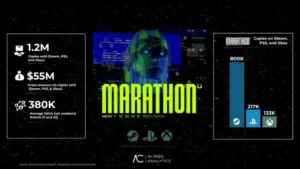
It received “generally favorable” reviews from critics and failed to meet Sony’s sales expectations. Multiple outlets described its release as a “punishing but rewarding extraction shooter” with exceptional gunplay and a steep barrier to entry. A concurrent review-bombing campaign from Destiny 2 players frustrated by that game’s end of development pushed user scores significantly below critical consensus. Season 2, “Nightfall,” launched June 2, 2026.
Technical Specifications
| Attribute | Details |
|---|---|
| Developer | Bungie |
| Publisher | Sony Interactive Entertainment |
| Game Director | Joe Ziegler |
| Platform(s) | PlayStation 5 · Xbox Series X/S · PC (Steam, Epic, Microsoft Store) |
| Release Date | March 5, 2026 |
| Price | $40 / £30 |
| Genre | Extraction shooter, FPS, PvPvE |
| Mode | Multiplayer (up to 16 players per map) |
What Marathon Is
An extraction shooter is a genre in which players load into a shared map alongside enemy teams, scavenge for weapons and valuables, complete objectives, and attempt to reach an extraction point before anyone kills them. Death means losing everything carried into the match — any gear, weapons, and loot collected in that run. This is not a battle royale (there is no zone shrinking), not a standard competitive shooter (there is no respawning), and not a cooperative PvE game (other player teams actively hunt each other for loot). The genre is defined by Escape from Tarkov and Hunt: Showdown; Marathon sits in a more accessible, higher-movement interpretation of the same premise.
The maps contain both AI enemies (hostile automated systems and alien forces that protect high-value loot and objectives) and rival human teams (other players who want what you’ve collected). The PvPvE combination means engagements can shift from careful AI-clearing to sudden ambush from a competing squad at any moment. The core tension is managing that uncertainty while accumulating enough to justify the risk of staying longer versus extracting safely with what you have.
The Original Marathon (1994–1996)
Before Halo, before Destiny, Bungie made the Marathon trilogy: three science fiction first-person shooters for the Apple Macintosh, released between 1994 and 1996. Set on the colony ship UESC Marathon in the Tau Ceti system, the games followed a lone Security Officer navigating a conflict between three rogue artificial intelligences — Durandal, Leela, and Tycho — while fending off alien Pfhor attackers. They were critically acclaimed at the time and retain a dedicated following; Marathon Infinity (1996) is still actively discussed for its labyrinthine narrative.
After the trilogy, Bungie moved into Myth (strategy), then Oni (action), then sold a partial stake to Microsoft and developed the Halo series from 2001. Marathon lay dormant for thirty years.
The 2026 Marathon is not a sequel in narrative terms — it is a reimagining in a different genre, using the same setting and some of the same lore architecture. Joe Ziegler described the design intent as: “a version of Marathon that exists in 2026, not a copy of what Marathon was in 1994.”
Tau Ceti IV in 2893
The game is set on Tau Ceti IV in 2893 — ninety-nine years after the events of the original trilogy. The UESC Marathon, a colony ship constructed from the Martian moon Deimos, established a colony on the planet. The colony has since gone dark following attacks by alien forces and devastating biological agents. Players are Runners: mercenaries who upload their consciousness into synthetic bodies called Runner Shells and are deployed to the abandoned colony to retrieve alien artefacts, scavenge corporate tech, and compete with other mercenary teams for whatever valuables remain.
The lore is delivered through the Codex — an in-game text archive that grows as players discover lore items in the field — and through the mystery structures that define the maps themselves. The Destiny tradition of environmental storytelling through world design and collectible text entries is present, and critics noted the world-building as one of the game’s genuine strengths.
Runner Shells: Seven Classes
The game’s hero-shooter dimension comes from Runner Shells — seven synthetic body types, each with a unique kit of passive abilities, active skills, and an ultimate. The Shell determines movement profile, ability set, and playstyle; loadout customisation within that Shell determines specific weapon configurations and augmentations.
Confirmed Shells at launch include Thief (drone deployment, evasion, enemy disruption), Vandal (movement-amplifying buffs, vertical traversal), and Rook (survivability, tanking). Sentinel, added in Season 2, is a new Shell described as a ranged support archetype. Each Shell’s kit creates distinct tactical identities that affect how teams compose against each other and against AI content.
Loadouts — weapons, modifications, and equipment brought into a match — persist until death. Higher-tier gear takes longer to accumulate; losing a well-built loadout to a better squad is the game’s primary source of stakes. The game’s economy is built around rebuilding after losses and the risk calculation of fielding better gear in more dangerous maps.
The Cryo Archive and End-Game
Cryo Archive is the game’s final map — the hardest and most loot-dense location, accessible only by players with sufficient gear and experience. It was unlocked through an alternate reality game (ARG) that ran during the game’s first weeks post-launch, with the map becoming available on approximately March 20, 2026. Reviews that incorporated the Cryo Archive were significantly more positive about the game’s ceiling. Game Informer noted: “Marathon works hard to rebuff your advances and could do with playing less hard to get. But for the player who’s seduced, this could be your next great love affair.”
PC Gamer’s review, written over 77 hours of play, captured the experience: “I’ve had triumphant nights of tens of thousands in valuables plundered, pried rare guns off the blue-stained corpses of rival squads. I’ve also visited Marathon rock bottom: a cold, unyielding cycle of squad wipes. Marathon is brutal.”
Season Structure and Progression
Marathon operates on a seasonal structure. Season 1 ran from launch (March 5) through June 1, 2026, at which point all players’ Vault loot was wiped — returning to the game with only cosmetics, Codex progress, and faction standing intact. This seasonal wipe is a deliberate design choice: Bungie stated it ensures “the game stays dangerous, loot feels meaningful, and there’s always a good opportunity to get back into the game or bring a friend in without feeling behind the curve.”
Season 2: Nightfall launched June 2, 2026. It introduced Night Marsh, a new zone; the Sentinel Runner Shell; two new weapons; and The Cradle, a system for customising Runner Shell stats outside of field loadouts. Bungie also introduced early-season quality-of-life improvements including “duo” lobby experiments, responding to player feedback about squad-size friction.
The progression model keeps all core content (maps, Runner Shells, activities) accessible to all players within a season. A battle pass and cosmetic store offer optional spending; no gameplay-affecting content is paywalled.
The Voice Cast
In January 2026, Bungie revealed Marathon’s voice cast. Notable inclusions: Roger Clark (Arthur Morgan in Red Dead Redemption 2), Neil Newbon (Astarion in Baldur’s Gate 3, TGA Best Performance 2023), Jennifer English (Shadowheart in Baldur’s Gate 3), Elias Toufexis (Deus Ex: Human Revolution, Cyberpunk 2077), and Ben Starr (Final Fantasy XVI, Honkai: Star Rail). The cast’s profile reflects the scale of production investment.
The Destiny 2 Shadow
Marathon‘s commercial trajectory cannot be discussed without the context of what was happening simultaneously at Bungie. The decision to end Destiny 2‘s active development — announced May 21, 2026, after the game had been Bungie’s primary product for nine years — was understood by much of the Destiny community as a consequence of redirecting resources toward Marathon. Review bombing on Steam from Destiny 2 players using negative Marathon reviews as a protest vote significantly affected user score aggregates, producing a gap between critical reception (“generally favorable”) and user scores that an analysis described as “a feedback loop where players feel that their time and money spent in the previous game were not properly acknowledged.”
Joe Ziegler had stated in pre-launch interviews that Marathon was not intended to replace Destiny 2 and that both games had separate audiences. Events rendered that framing retroactively inaccurate.
Reception
Marathon received “generally favorable” reviews according to Metacritic, with OpenCritic recording a 74% recommendation rate. Critics consistently praised the Bungie gunplay (“sublime,” “feels better than it has any right to in an extraction context”), the world design and visual identity, and the Cryo Archive’s end-game tension. Consistent criticisms: steep learning curve, barrier to casual players, and early-season pacing that required significant time investment before rewards felt proportionate.
GameSpot’s review in progress was titled “Incredible Highs, Painful Lows” — a phrase that captures the community’s experience of the genre itself as much as the specific execution. The game commercially fell short of Sony’s expectations, a factor contributing to the financial pressure at Bungie that accelerated Destiny 2‘s end of development.
The PC Gamer review’s closing note: “Bungie’s first game in nine years has reminded me what it means for a studio to have a ‘house style’. I’m not just talking about an eye for world building, gorgeous environments and skyboxes, or a dense codex that inspires main menu idling—I’m talking raw first-person shooting excellence.”