Indiana Jones and the Great Circle
 86
★ /10
86
★ /10
 Nintendo Switch 2,
  PC,
PC,  PS5,
PS5,  Xbox Series X/S
 Bethesda Softworks
Where to buy



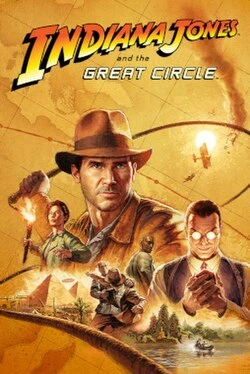
Indiana Jones and the Great Circle is a 2024 first-person action-adventure game developed by MachineGames and published by Bethesda Softworks. Released for PC via Xbox Game Pass and Steam, and for Xbox Series X/S, on December 9, 2024 — with PlayStation 5 following on April 17, 2025 and Nintendo Switch 2 on May 12, 2026 — it is the first major Indiana Jones game in over two decades and the first developed without LucasArts.
It received Metacritic scores of 87 on PC and 86 on Xbox Series X, placing it in the 96th percentile of all reviewed games on OpenCritic. GameSpot called it “the quintessential Indiana Jones game.” One OpenCritic reviewer placed it alongside Batman: Arkham and GoldenEye 007 in what they described as “the god tier of licensed games.”
Technical Specifications
| Attribute | Details |
|---|---|
| Developer | MachineGames |
| Publisher | Bethesda Softworks |
| Composer | Gordy Haab |
| Platform(s) | PC (Steam, Xbox Game Pass) · Xbox Series X/S (Dec 9, 2024) · PS5 (Apr 17, 2025) · Switch 2 (May 12, 2026) |
| Price | $69.99 (Standard) · $99.99 (Premium — includes The Order of Giants DLC) |
| Genre | First-person action-adventure, Stealth |
| Mode | Single-player |
MachineGames and the Wolfenstein Pedigree
MachineGames is a Swedish studio based in Örebro, known for the modern Wolfenstein revival: Wolfenstein: The New Order (2014), Wolfenstein II: The New Colossus (2017), and their sequels and spin-offs. Their Wolfenstein games were first-person action titles known for combining kinetic gunplay with surprisingly ambitious storytelling. Indiana Jones and the Great Circle is their first non-Wolfenstein project and requires a substantially different approach: Indy is not a trained soldier, and the game should not play like one.
The studio spent considerable time working out what “Indiana Jones gameplay” means: not precision gunplay, not martial arts choreography, but improvisation under pressure — an archaeologist who punches harder than he probably should, shoots accurately enough when he has to, and prefers to have never needed to do either. The result is a game that GameSpot described as resembling Dishonored “more than any of MachineGames’ previous output” — stealth-forward, environment-aware, and built around the specific kind of problem-solving that Jones canonically uses in the films.
1937: Between Two Films
The game is set in 1937, placing it between Raiders of the Lost Ark (1936) and Indiana Jones and the Last Crusade (1938), and canonically within the franchise’s established continuity. Indy is teaching archaeology at Marshall College when a theft sets the story’s central mystery in motion: someone has taken an artefact that connects to an ancient phenomenon called the Great Circle — a geometric alignment of sites around the globe with possible connections to a power source predating recorded history.
The investigation takes Indy across six major locations: from the Vatican’s ruins beneath the Sistine Chapel, to Gizeh and the Egyptian complex beneath the plateau, to Sukhothai in Thailand, to the Marshall Islands, and several connecting environments. Each location is a semi-open area that GameSpot’s reviewer spent more than three hours exploring without completing every available task. The Vatican level in particular is described as the game’s largest single area — a densely layered environment with surface streets, underground catacombs, ancient ruins, and a Sistine Chapel whose ceiling Indy can stop and observe.
Troy Baker as Indiana Jones
Troy Baker voices Indiana Jones — not Harrison Ford, though Ford’s likeness is the visual reference for how the character looks and moves. Baker’s performance was praised by critics and, notably, by Harrison Ford himself, who said in a public statement that Baker had “captured something essential” about the character.
Jump Dash Roll’s review described the performance: “It’s not mimicry; it’s an embodiment. He captures the wry humour, the academic intelligence, the moments of exasperation, and the underlying heroism with uncanny accuracy. Close your eyes, and you could easily mistake it for Ford himself.” GameSpot corroborated: “It’s often almost impossible to tell you’re not listening to a young, charismatic Harrison Ford.”
Baker brings a specific reading of Jones at this point in his career — aware of his own reputation, occasionally weary of it, genuinely passionate about archaeology in ways the action of the films tends to obscure. The character’s reactions to finding exceptional historical artefacts — excited pointing at objects on tables, the posture that belies sudden bursts of exertion — were built from close study of Ford’s physicality across three decades of performances.
Alessandra Mastronardi voices Gina Lombardi, an Italian photojournalist who becomes Indy’s primary companion and whose agenda is not entirely aligned with his from the start.
First-Person and the Stealth Emphasis
The first-person perspective was a deliberate choice to increase immersion — placing the player in the experience of being Indiana Jones rather than watching a character who resembles him. Jump Dash Roll noted that “the way Indy excitedly points at things on tables… his slightly weary posture that belies sudden bursts of action… are not just animations; they are imbued with character.”
The gameplay philosophy is stealth-forward. Indiana Jones in the films is not a mass killer — he knocks people out, avoids confrontations he doesn’t need, and creates messes he’d rather not. The game rewards this approach: stealth eliminations, misdirections, environmental distractions, and moving through spaces undetected accumulate advantages unavailable to a player who simply shoots everyone. The stealth system was compared to Dishonored‘s approach, where player creativity and environment awareness determine outcome more than reaction time.
The Whip
The whip is Indiana Jones’s signature tool and the game’s primary multipurpose instrument:
In combat: Disarming enemies, pulling them off balance, creating openings for follow-up strikes, and occasionally neutralising opponents at range without violence.
For traversal: Swinging across gaps, reaching high platforms, grabbing distant objects. The first-person perspective makes whip swinging feel physically immediate in ways a third-person camera would not produce.
For puzzles: Connecting mechanisms, reaching switches, interacting with environmental elements at a distance. Many of the game’s puzzles are built around using the whip in combination with other tools.
The Improvised Combat System
Combat was the most divisive element in critical discussion. Indy is not a trained fighter, and MachineGames designed the combat to reflect this: fist fights are “desperate affairs, less about elegant combos and more about ducking, weaving, throwing opportunistic punches, and using the environment.” Weapons found in the environment — shovels, pipes, bottles, tools — are disposable (they break or must be dropped when climbing) rather than permanent inventory items.
This “improvised” quality was praised as authentically Indy by reviewers who found it appropriate to the character. It was criticised by players who expected MachineGames’ Wolfenstein-level combat precision. The same design philosophy split critics: GameSpot found it “distinct” and appropriate; others found the constant item-management interrupting cinematic flow.
A specific mechanical complaint repeated across reviews: to lean around corners for stealth observation, Indy must be holding an item. Empty hands trigger a punch instead. This requires carrying a random object at all times to use a basic stealth mechanic.
Emmerich Voss
The game’s primary antagonist is Emmerich Voss, a Nazi archaeologist for the Third Reich’s Special Antiquities Collection who shares Indy’s obsession with ancient history and mirrors his drive with a considerably more twisted moral compass. GameSpot called him “a compelling foil to Indy… manipulative and sneeringly evil while also sharing similar traits with our hero.” Several reviewers cited Voss as one of the better-written antagonists in the franchise’s history — a villain with internal logic rather than simple malevolence.
The Order of Giants DLC
The Order of Giants is the game’s primary DLC expansion, included in the Premium Edition ($99.99) and available separately. It adds an additional storyline connecting to the Great Circle’s mythology and expands the game’s runtime beyond the base campaign. No separate reviews have been conducted of the DLC at time of writing.
Platform Context and Game Pass
Indiana Jones and the Great Circle launched day one on Xbox Game Pass for PC and Xbox — the highest-profile Game Pass release of 2024 and one of the arguments for the service’s value as a day-one delivery platform for major titles. Players who subscribe to Game Pass can access the full game without additional purchase; the $69.99 standard price applies to those who want to own it outright.
The PS5 version, released April 17, 2025, includes PS5 Pro enhancements (higher resolution and performance options when played on the Pro hardware). It is described as “comparable to Xbox Series X” in visual quality at equivalent settings.
The Nintendo Switch 2 version, released May 12, 2026, targets 30fps and represents the “play it on the go” compromise — technically proficient but at reduced fidelity compared to the PC and console versions.
Reception
Indiana Jones and the Great Circle ended 2024 as the highest-rated Xbox console exclusive of the year by Metacritic average. The r/patientgamers review in the game’s Knowledge Panel — “Indiana Jones and the Great Circle review: great…” — reflects sustained positive engagement nearly six months after the PC/Xbox launch.
The consistent characterisation across reviews: MachineGames understood the assignment at the level of writing, voice, presentation, and tone, and delivered a game that feels like a missing film in the series rather than a licensed product built around existing IP. The mechanical clunkiness — item management, corner-leaning quirks, combat that polarises — is the consistent caveat. Whether those issues outweigh the achievement of making a genuinely good Indiana Jones game depends on which dimension of the experience the player values more. Adam Savage (of MythBusters), reviewing the game on his YouTube channel, called it “one heck of a game, fan service at its finest.” Gordy Haab’s score, built on John Williams’s original themes, is the other consistent point of unreserved praise.