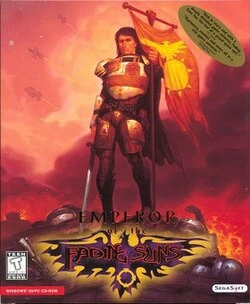
Emperor of the Fading Suns
 PC
PC


Emperor of the Fading Suns is a landmark turn-based science-fiction space grand strategy 4X video game developed by Holistic Design and originally published by SegaSoft. Released in January 1997 for Microsoft Windows, the title is universally celebrated as a sprawling, hyper-complex cult classic that uniquely adapted the universe of Holistic Design’s own dark science-fantasy tabletop role-playing game, Fading Suns.
Set within a neo-feudal galactic dark age where the literal stars are mysteriously burning out, the game combines macroscopic planetary diplomacy, multi-tier economic exploitation, deeply atmospheric lore, and an intricate, dual-layer space and ground warfare system.
Though the 1997 retail release was notoriously rushed to market with severe programming flaws and an unoptimized AI, the game’s unparalleled thematic depth spawned a decades-long preservation movement. This ultimately culminated in the original creators completely reclaiming the intellectual property to deploy a massive, modernized definitive edition titled Emperor of the Fading Suns Enhanced.
Technical Specifications
| Attribute | Details |
| Developer | Holistic Design, Inc. |
| Publisher(s) | SegaSoft (1997), Holistic Design / V Publishing (Enhanced) |
| Designers | Ken Lightner, Brian Campbell, Andrew Greenberg |
| Engine | Proprietary Multi-Layer Hexagonal Grid Engine |
| Platform(s) | Microsoft Windows, Linux (via Proton / SteamOS) |
| Release Date | • Original Retail: January 23, 1997 • Enhanced Relaunch: April 4, 2025 |
| Genre(s) | Turn-based strategy, Space Grand Strategy, 4X |
| Mode(s) | Single-player, Multiplayer (Play-by-Email, Hotseat, LAN) |
The Dark Ages of Space: Lore & Factions
The narrative of Emperor of the Fading Suns launches players into a grim, deeply immersive feudalistic future. Following the catastrophic structural collapse of the democratic, hyper-advanced Second Republic, human space fractured into fragmented territories ruled by a squabbling nobility.
Following the death of the Grand Emperor, the empire has been frozen in an uneasy stalemate governed by a rotating interim Regent. However, the Regency has mutated into a corrupt vehicle used by nobles to plunder human assets.
Matches initialize with players taking absolute command of one of five major Royal Houses, competing to manipulate the galactic senate, crush rivals, and secure enough political or military support to permanently claim the Imperial Throne:
- House Hawkwood: Honorable, traditionalist nobles mimicking classical Earth aristocracy; they start on stable, temperate worlds providing a balanced early-game baseline.
- House Decados: A treacherous, deeply manipulative family heavily optimized for clandestine espionage, cybernetic body modification, and structural backstabbing.
- House Hazat: A fiercely proud, expansionist military aristocracy whose martial culture grants passive combat and training multipliers to their active legions.
- House Li Halan: An austere, deeply pious house that holds a close mechanical and political alliance with the Orthodox Church.
- House Al-Malik: An eccentric, forward-thinking faction obsessed with preserving ancient artifacts and fostering close mercantile ties with the Merchant Guild.
Aside from competing houses, players must navigate powerful, non-playable global entities: the totalitarian Universal Church, the corporate Merchant Guild, the highly advanced and insular alien Vau, and the horrifying, parasitic, flesh-crafting alien swarm known as the Symbiots.
Dual-Layer Simultaneous Hexagonal Grids
The defining gameplay innovation of Emperor of the Fading Suns is its handling of galactic geography. The game map tracks 43 unique, fully explorable planets linked together by a web of static jump gates.
Instead of treating space travel and planetary management as separate menus, the engine runs a simultaneous dual-layer grid ecosystem:
1. The Orbital Space Layer
Every planet is enveloped by an active space grid. Fleets of capital warships, starfighters, bulk cargo freighters, and troop landers maneuver across orbital hex tiles to secure planetary blockades or unleash devastating orbital bombardments against fortified surface structures.
2. The Planetary Surface Layer
Clicking directly onto a planet drops the camera viewport down to a separate, localized isometric hexagonal grid map. Cities and individual military units occupy physical hex spaces on the terrain.
When launching planetary invasions, players must coordinate complex combined-arms tactics across variable planetary climates (temperate, jungle, frozen, desert, river deltas), utilizing a massive roster of hundreds of specialized units—including atmospheric gunship helicopters, long-range artillery batteries, chemical-weapon shock legions, cloaked scouts, and heavy armor divisions.
Proscribed Technology & The Inquisition Matrix
Scientific progression features a brilliant, high-stakes political hurdle driven entirely by the Universal Church. The Church views high-tier technological breakthroughs—such as advanced artificial intelligence, cybernetic body upgrades, or mass genetic engineering—as absolute heresy that threatens the human soul.
Consequently, the technology tree is governed by a Proscribed (Banned) Status system. If your scientists begin to actively research forbidden knowledge paths, the Church’s feared Inquisition will dynamically react.
Players must actively pilot this systemic restriction. You can choose to play as an Orthodox loyalist, ignoring high-tech to rely on sheer numbers; run hidden, underground black-market laboratories masked by camouflage relics; bribe the Church with massive cash infusions to legally lift specific proscriptions; or launch an all-out holy war against the Papacy to forcefully install a puppet Patriarch from a favorable heretical sect to rewrite church law in your favor.
Relaunch, Modern Preservation, and the 2026 Status
“The original game was a Watcom-built engine running on ancient DOS architectures. Transitioning it to a modern Visual Studio environment allowed us to finally fulfill the game’s true structural potential.”
For over two decades, Emperor of the Fading Suns survived solely on the backs of dedicated community programmers who coded extensive overhaul mods—such as the famous Hyperion and Emperor Wars patches—to repair stability flaws and balance unit production equations. Recognizing this immortal community footprint, Holistic Design officially returned to active development, rolling out Emperor of the Fading Suns Enhanced on Steam and GOG.
The Enhanced Edition fundamentally modernized the game’s infrastructure. It migrated the entire source codebase to modern Visual Studio frameworks, entirely fixing the notorious end-of-turn crashes and memory leaks that plagued the 1997 client.
Through consecutive post-launch patch cycles leading up to the definitive v1.52b release, Holistic Design systematically introduced game-altering upgrades:
- Nested Cargo Support: Modders and players can load cargo inside cargo inside cargo (transports within capital ships) infinitely deep, streamlining macro-logistics.
- Tactical Overhauls: Integrated tactical plague vectors to artillery lines, implemented fuel gauges, fixed ship officer space-combat math, and introduced robust map and planet editors.
- AI Stack Bounds: Enforced strict 20-unit stack limitations on computer AI factions, permanently ending the “Vau ship spam” that used to break late-game balance.
As of June 2026, Emperor of the Fading Suns Enhanced stands completely preserved, fully operational, and natively compatible out-of-the-box under 64-bit Windows 11 and Linux environments.
The game is officially verified as fully playable on the Steam Deck (SteamOS), packing crisp UI font rendering, tooltips explaining hidden itemized unit stats, and optimized high-resolution widescreen scaling—allowing contemporary strategy grognards to experience the unproscribed technology wars, planetary infiltration grids, and shifting senatorial votes of the Fading Suns universe with absolute technical perfection.