Crimson Desert
 77
★ /10
77
★ /10
 PC
PC PS5
PS5 Xbox Series X/S
 Pearl Abyss
Where to buy



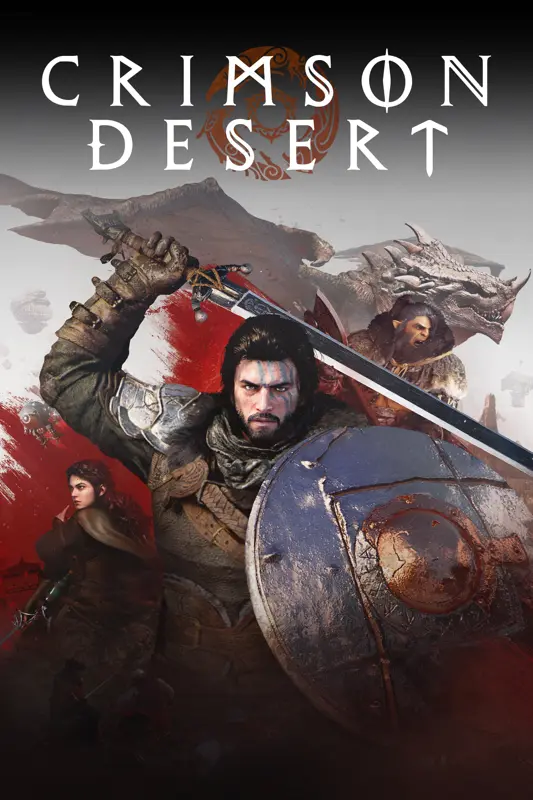
Crimson Desert is a 2026 open-world action-adventure game developed and published by Pearl Abyss, the South Korean studio behind the long-running MMORPG Black Desert Online. Released on March 19, 2026 for PlayStation 5, Xbox Series X/S, Windows, and macOS, it is Pearl Abyss’s first single-player game — originally conceived as a prequel to Black Desert Online before evolving into a standalone title over roughly seven years of development.
It sold over 2 million copies within 24 hours and surpassed 6 million within three months of release. As of this writing, it holds a Metacritic score of 77 (“Generally Favorable”) on PC from 115 critic reviews, alongside a notably higher user score of 8.8 from over 13,000 ratings — the critic score settled a point or two lower than the 78–79 it opened at during launch week as more reviews came in, while the user score has remained consistently well above it. That gap between critics and players is unusually wide for a “Generally Favorable” title and reflects a real split in what each audience weighted most heavily. On the day review embargoes lifted, Pearl Abyss’s stock dropped nearly 30% in a single trading session, reflecting investor expectations that had been priced for something closer to a 90-plus blockbuster.
Technical Specifications
| Attribute | Details |
|---|---|
| Developer | Pearl Abyss |
| Publisher | Pearl Abyss |
| CEO | Heo Jin-young |
| Engine | BlackSpace Engine (proprietary) |
| Platform(s) | PS5 · Xbox Series X/S · Windows · macOS |
| Release Date | March 19, 2026 |
| Metacritic | 77 (PC, 115 critics) |
| User Score | 8.8 (13,000+ ratings) |
| OpenCritic | 81 (“Strong”) |
| Genre | Open-world action-adventure |
| Mode | Single-player (no multiplayer) |
Pywel and Kliff
The game is set on Pywel, a fictional high-fantasy continent fractured by rival clans, mythical creatures, and older forces working beneath the surface conflict. The player initially controls Kliff, leader of a mercenary group called the Greymanes, on a mission to track down and reassemble his scattered comrades after some unspecified disaster has broken the group apart. According to Wikipedia, players are not locked to Kliff for the entire experience — the game features multiple playable perspectives as the story develops, though Kliff remains its central figure and the actor cast in the role has publicly noted he pushed for a more cohesive central narrative than the finished game ultimately delivers, with Pearl Abyss prioritising open-world systems over story cohesion.
Combat blends melee combos, magic, and horseback engagements, including large-scale boss encounters against dragons and other giant creatures. One post-launch breakdown counted 76 bosses across the game — 28 tied to the main campaign, the remainder scattered through the open world as optional encounters (source) — a figure that by itself communicates the scale Pearl Abyss was building toward.
A World Built From Familiar Parts
The most consistent observation across reviews is that Crimson Desert wears its influences openly. One reviewer described it as carrying “The Witcher 3‘s spirit” in how the world is structured around exploration and side content, “Red Dead Redemption 2‘s DNA” in its slower horseback pacing, puzzle mechanics reminiscent of Tears of the Kingdom, and the free-roaming sandbox energy of Skyrim or Grand Theft Auto V — concluding that the game “does all of those things but does none of them quite as well as the games that inspired it” (source).
What nearly every review agreed on regardless of overall score: the world itself is the strongest reason to play. GameSpot wrote that the game “might not be too good to be true, but it’s a world worth getting lost in.” Vice called it “the real deal,” praising a “jaw-dropping sandbox world that you can easily get lost in for hours.” GamingTrend, at the more enthusiastic end of the spectrum, called it “a once-in-a-generation action RPG that redefines the genre.”
Where It Struggled
The critical middle ground converged on a specific and consistent set of frustrations rather than a single dominant complaint:
Combat inconsistency. Boss fights were widely praised for spectacle but criticised for pacing — long, multi-phase encounters that several reviewers felt relied more on stamina and healing management than on genuinely reactive fight design, with difficulty spikes that could follow several manageable encounters without warning.
A convoluted, thin story. Polygon’s review-in-progress stated bluntly that after ten hours, the open world “hasn’t shown me a single interesting thing.” Game Informer’s review — titled “Open World Overload” — echoed this, citing a “lack of a meaningful narrative” alongside numerous crashes during their playthrough.
Menus, inventory, and controls. A “pared-down skill tree,” a requirement to route nearly every system decision through Kliff specifically, confusing menus, and clunky inventory management were the most repeated technical complaints — enough that one outlet’s headline the week of launch warned the game’s “downfall will be caused by its controls if they’re not fixed pronto.”
No Intel Arc GPU support at launch, a decision that drew public criticism after Intel stated it had offered Pearl Abyss early hardware, drivers, and engineering help “multiple times” before release. Pearl Abyss’s initial response directed affected purchasers to seek refunds; the studio later stated it was “working on compatibility and optimization support.”
Disclosed use of generative AI. Pearl Abyss confirmed that generative AI tools were used “as part of early-stage iteration” to explore tone and atmosphere during production, adding a Steam storefront disclosure after the fact. The studio pledged a “comprehensive audit” of in-game assets and committed to replacing any AI-generated content with human-made work in a future update.
The Multiplayer Question
Despite Pearl Abyss’s history with the fully online Black Desert Online, Crimson Desert has no multiplayer component of any kind — a distinction pointed out often enough after launch (via outlets like Radio Times and GamesRadar) that it’s clearly a common point of confusion for players approaching the game through Pearl Abyss’s back catalogue. It is entirely single-player, and CEO Heo Jin-young has stated the studio’s post-launch focus is on improving the base game itself rather than adding either DLC or multiplayer features.
Patched Into a Different Game
Crimson Desert‘s reception has a genuine before-and-after quality tied to Pearl Abyss’s post-launch patch cadence. At launch, Steam user reviews sat in Mixed territory, with reports of over 40% negative reviews in the first days — driven by missing NPCs during key story beats, softlocks, and the rougher edges reviewers had already flagged. Two months after release, Steam sentiment had climbed to Very Positive at 86% positive across more than 56,000 user ratings, a shift attributed directly to the pace and substance of Pearl Abyss’s fixes.
One reviewer writing after that patch window made a broader point about the game’s place in a shrinking corner of the RPG landscape: with studios like Piranha Bytes and Spiders having closed in the two years prior, “patient, systemic” RPGs built for players willing to meet a game on its own terms have become an endangered design philosophy — and Crimson Desert, whatever its flaws, was read as one of the few current titles carrying that torch with a AAA budget behind it, “finally match[ing] the ambition.” The same review had one specific, widely echoed request for Pearl Abyss going forward: add an option to skip dialogue.
Reception
Crimson Desert holds a Metacritic score of 77 (OpenCritic 81, “Strong”) built from a genuinely wide spread — IGN gave it 6/10, DualShockers gave it 9.5/10, and dozens of outlets landed everywhere between. Comparisons to Black Myth: Wukong (Metacritic 81, multiple Game of the Year nominations) were common in coverage arguing the critic score undersold the game relative to its ambition and scale — an argument the persistently high 8.8 user score lends some support to.
The split in critical opinion mapped closely to what players were looking for: reviews weighted toward exploration and open-world density skewed positive; reviews weighted toward narrative cohesion and mechanical polish skewed more critical. Both readings are documented extensively in the game’s own review aggregate, and — unusually for a major release — neither position clearly “won” the discourse in the weeks after launch. What did change, measurably, was the post-patch Steam community verdict, which moved decisively toward positive as Pearl Abyss continued updating the game through its first several months on the market.