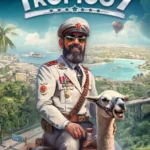
Tropico 2: Pirate Cove
 75
★ /10
75
★ /10
 PC
PC
 1C Company,
  Gathering of Developers, Kalypso Media, MacSoft


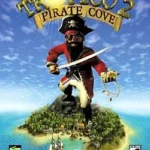
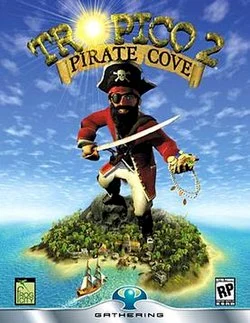
Tropico 2: Pirate Cove is a single-player construction and management simulation video game developed by Frog City Software and published by Gathering of Developers under the Take-Two Interactive umbrella. Released in April 2003 for Microsoft Windows and Mac OS X, the title is the direct sequel to the 2001 breakout hit Tropico.
Designed by Bill Spieth, the game completely discards the 20th-century Cold War “banana republic” themes of its predecessor. Instead, it travels back to the 17th-century Golden Age of Piracy, tasking the player with acting as a notorious Pirate King managing a hidden island hideaway in the Caribbean. The ultimate objective is to establish a self-sustaining criminal empire, send fleets out to plunder international shipping lanes, and maintain absolute authority over lawless buccaneers and captured laborers.
Technical Specifications
| Attribute | Details |
|---|---|
| Developer | Frog City Software |
| Publisher | Gathering of Developers / Take-Two Interactive (Current IP holder: Kalypso Media) |
| Designer | Bill Spieth |
| Producer | Chris Lacey |
| Composer | Daniel Indart |
| Platform(s) | Microsoft Windows, Mac OS X |
| Release Date | April 8, 2003 |
| Genre(s) | Construction and management simulation, City-builder |
| Mode | Single-player |
Gameplay Mechanics: The Reverse Economy
Lead designer Bill Spieth described Tropico 2 as a “reverse economy” simulation. While traditional city-builders require players to foster a civilian workforce that produces domestic goods for sale, a pirate island generates zero native export wealth. Money and resources must be forcefully stolen from the high seas and spent internally to satisfy the population.
To simulate this lawless society, the island’s population grid is split into two asymmetric, diametrically opposed classes:
1. The Captive Labor Force
Captives (or “guests”) are the industrial backbone of the island. They are harvested dynamically by raiding wealthy European settlements, intercepting trade ships, or salvaging local shipwrecks. Captives do not fight; instead, they perform all physical manual labor. They harvest corn, chop timber, operate heavy sawmills, forge cutlasses, and bake sea rations.
To prevent these workers from escaping or instigating a widespread riot, players must manage a strict Fear and Awe Matrix. Constructing terrifying structures along their transit routes—such as hanging skeletons, gallows, and heavy guard towers—drives up their fear gauges, paralyzing their desire to defect.
If a captive’s fear drops too low, they will actively try to escape the island; if successful, they report your secret coordinates to European crowns, triggering massive naval invasions by English, French, or Spanish warships.
2. The Pirate Horde
Pirates are the military arm of your colony and are entirely indifferent to work. They live for total Anarchy, demanding an unyielding loop of food, booze, gambling, and weapons.
When ships return to port with treasure chests, the plunder is split into the individual pockets of the crew. The Pirate King extracts this gold back into the state treasury by constructing high-end entertainment zones—including Smuggler’s Dives, Breweries, Casinos, Inns, and Brothels (Wench Tents). Pirates happily spend their personal wealth to fulfill their behavioral meters.
If a pirate becomes bored due to lack of grog or a lack of structural defense on the island, their mutiny thresholds will spike, leading to an immediate duel for your crown.
Maritime Raids & Captains
Unlike the original game’s focus on macro-politics, the primary active tool of progression in Pirate Cove is the construction of a private navy. Players utilize specialized skilled captives (such as Shipwrights and Sailmakers) to construct various classifications of warships, ranging from small, agile Sloops to colossal, heavily armed Galleons.
The Expedition Loop
Once a ship is constructed at the boatyards, the player recruits a crew and assigns an elite Captain to lead the voyage. Ships are launched onto an abstract map of the Caribbean to execute custom operational orders:
- Plundering Shipping Lanes: Intercepts merchant vessels to harvest raw gold bullion.
- Raiding Settlements: Attacks coastal towns to forcefully abduct specialized captives, such as surgeons, gunsmiths, or cooks.
- Ransoming Wealthy Captives: Safely detains noble aristocratic prisoners. While they refuse to work and consume your domestic food resources for free, their baseline ransom value increases exponentially the longer they spend using your island’s luxury entertainment amenities, allowing you to eventually trade them back to their home nations for massive cash payouts.
Players maintain dynamic control over a ship’s behavioral ruleset mid-voyage. You can order a captain to avoid attacking ships belonging to specific superpowers, allowing you to orchestrate fragile, lucrative political alliances with nations like France or England while focusing your piracy entirely on sacking Spanish gold fleets.
Narrative & Pop-Culture Influence
The conceptual background of Tropico 2 intentionally avoids historical grimness, adopting a lighthearted, comedic science-fiction and swashbuckler tone. The visual style and text scripts take direct creative cues from classic 20th-century adventure novels, most notably Rafael Sabatini’s Captain Blood.
Before initializing the single-player campaign, players can choose or customize an array of legendary historical Pirate Kings—including Blackbeard, Laurens de Graaf, Anne Bonny, and Henry Morgan. Each historical avatar is balanced around personalized, myth-accurate strengths and weaknesses; for instance, Laurens de Graaf’s historical hatred of the Spanish Crown translates into an in-game penalty that permanently locks him out of executing diplomatic treaties with Spain.
The game’s jaunty, festive atmosphere is driven by an orchestral soundtrack composed by Daniel Indart, utilizing acoustic accordion patterns, rolling sea shanty woodwinds, and energetic percussion matrices that seamlessly match the chaotic nature of an open-air pirate town.
Current Status & Digital Preservation (2026)
Digital Storefront Bundling
Following the collapse of Frog City Software and PopTop Software, publisher Kalypso Media acquired the global rights to the franchise. Kalypso packaged Tropico 2: Pirate Cove alongside the 2001 original and its expansion pack into a unified digital compilation titled Tropico Reloaded.
As of May 2026, Tropico 2 remains fully preserved, active, and commercially accessible via major digital delivery storefronts including Steam and GOG.com under this compilation umbrella.
Modern OS Technical Adjustments
Because the game’s structural 2D pseudo-isometric engine is hardcoded to 2003 DirectX 8 frameworks, executing the application directly out-of-the-box on contemporary multi-core Windows 10 and Windows 11 hardware configurations can occasionally trigger fatal runtime exceptions or lock the user into a permanent black screen.
To safely stabilize the client, the retro PC gaming community relies on simple manual configuration overrides:
- Software Rendering Toggle: Players navigate to the local Steam installation directory and open the configuration initialization file (
Tropico2.ini) using a text editor. Modifying the default rendering line parameter fromSoftwareDevice=0toSoftwareDevice=1forces the client to safely process graphics via software rendering loops, entirely bypassing modern GPU driver incompatibilities. - Compatibility Launch Wrappers: Setting the main executable properties (
Tropico2.exe) to execute under a Windows XP (Service Pack 3) compatibility wrapper safely rectifies mouse acceleration acceleration hitches.
Applying these straightforward, community-tested configuration tweaks allows the bustling shipyards, grog-filled smuggler dives, and sprawling pirate bases of Tropico 2 to render cleanly on modern high-resolution widescreen monitors with steady performance.