Pragmata
 86
★ /10
86
★ /10
 Nintendo Switch 2
 PC
PC PS5
PS5 Xbox Series X/S
 Capcom
Where to buy



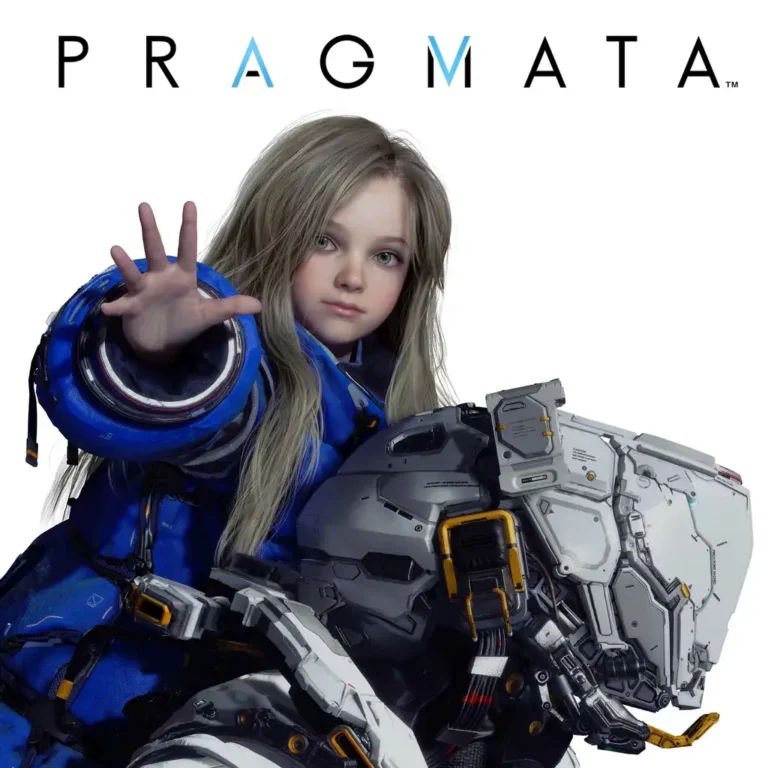
Pragmata is a 2026 sci-fi action-adventure game developed and published by Capcom, directed by Yonghee Cho. Released on April 17, 2026 for PlayStation 5, Xbox Series X/S, and PC (Steam), with a Nintendo Switch 2 version following slightly later, it is Capcom’s first original franchise in eight years — first revealed during Sony’s PlayStation 5 reveal stream on June 11, 2020, and shaped over roughly six years of development that included several delays.
It follows Hugh Williams, a stranded astronaut, and Diana, an android he meets on an abandoned lunar research base, as they fight through hostile robots controlled by a rogue AI while searching for a way back to Earth. Reviews were strongly positive: it holds an aggregate around 87% on OpenCritic across 64 reviews, with Metacritic scores ranging from 86% (PlayStation 5, Xbox Series X) to 89% (PC) and 93% (Switch 2, though from a much smaller sample). It sold more than 2 million units within 16 days, arriving as the third strong release in a run that also included Resident Evil Requiem and Monster Hunter Stories 3 earlier the same year.
Technical Specifications
| Attribute | Details |
|---|---|
| Developer | Capcom |
| Publisher | Capcom |
| Director | Yonghee Cho |
| Engine | RE Engine |
| Platform(s) | PS5 · Xbox Series X/S · PC (Steam) · Nintendo Switch 2 |
| Release Date | April 17, 2026 |
| Metacritic | 86 (PS5, Xbox) · 89 (PC) · 93 (Switch 2) |
| OpenCritic | 87% (64 reviews) |
| Genre | Third-person action-adventure |
| Runtime | ~10–15 hours (main campaign) |
| Mode | Single-player |
A New Ore and a Silent Moon Base
Humanity has discovered Lunafilament — a lunar ore that, once refined, can be fed into 3D printers to construct almost anything. A remote research facility built around this discovery goes suddenly silent, and Hugh Williams is dispatched with an investigation team to find out why. A moonquake strikes almost immediately, apparently killing the rest of his team and leaving Hugh alone in a base overrun by hostile robots. He is saved by Diana, an android who emerges from a vault damaged in the quake — printed from Lunafilament herself. When she tries to give Hugh her full alphanumeric designation, he shortens it to “Diana,” and the two become inseparable for the rest of the game.
The facility’s AI, IDUS, has turned against every living thing inside it, and half-realized architectural recreations of Earth cities — including a distorted, dreamlike New York — sprawl across parts of the lunar surface. Capcom’s own producer described the New York section as deliberately built to look as though it had been generated by AI, full of “illogical errors such as taxis sinking into floors or buses sprouting out of walls” — an uncanny effect the team achieved entirely by hand rather than through any actual generative tool, specifically to unsettle players without being mistaken for puzzle hints.
Shooting and Hacking, at the Same Time
Pragmata’s defining mechanical idea is that Hugh and Diana fight as a pair, and neither can do it alone. Hugh’s robots are effectively invulnerable to his weapons until Diana hacks them: aiming at an enemy opens a separate grid overlay that the player navigates in real time using the face buttons, tracing a path from a starting node to a hack-delivery point while still moving Hugh and dodging incoming attacks with the other controls. Once the hack lands, a robot’s armour cracks open and becomes vulnerable to gunfire. GameSpot’s review captured the effect directly: enemies “crack open like lobsters” the moment the hack connects (full review).
The hacking grids grow more elaborate as the game progresses, introducing new node types and effects that let players prioritise different outcomes — more damage, crowd control, status effects — while still under fire. Diana’s own ultimate ability is a screen-wide hack that briefly immobilises every enemy nearby, useful both in general combat and against bosses. Hugh separately carries a hip-mounted jetpack for dodging and reaching distant platforms, giving the traversal a vertical, thruster-driven feel on top of the ground combat.
Critics consistently singled out boss encounters as the game’s strongest individual moments, each built around a distinct gimmick rather than a reused template. The more repeated criticism concerned standard enemies: one review noted that regular robots share the same finishing animations across enemy types, a missed opportunity given Capcom’s track record of more varied enemy-specific finishers in other franchises.
Hugh and Diana
The relationship between the two leads is what most reviews treated as the actual centre of the game, ahead of the plot or the combat systems. Hugh is voiced by David Menkin, cast in 2024 and reportedly spending around 18 months on the role. Diana’s model was built entirely from scratch by newcomers to Capcom rather than through the studio’s usual 3D-scanning pipeline, and her performance was animated by Capcom’s own staff rather than child motion-capture actors — a choice the director’s team has said was made partly to sidestep the difficulty of conveying an “android-like” quality across different cultural contexts without leaning on gimmicks that read differently outside Japan.
The story leans into a familiar shape — a world-weary adult figure paired with a curious, sheltered companion seeing life for the first time — and several reviews compared it explicitly to The Last of Us and the broader “sad dad” subgenre it inspired. What distinguished it for most critics was the specific texture of the pairing: Diana is written as curious and sharp but also naive and oddly childlike, and Hugh’s own backstory unfolds through small anecdotes he shares with her about growing up on Earth, giving their bond room to develop gradually rather than being asserted upfront. Science-fiction worldbuilding on the project was supervised by Shoji Kawamori, the Macross creator, brought in specifically to balance out what Capcom described as its own “accessibility-focused” instincts for the genre.
The game ends with Diana safely reaching Earth and finally seeing a real beach, the dream she’d been building toward throughout the story. A harder-to-find secondary ending, unlocked through post-game “Unknown Signal” challenges, reveals that Hugh also survived — recovered by Cabin, a friendly robot who assisted the player throughout the campaign.
What Reviewers Liked, and What They Didn’t
The critical consensus treated Pragmata as a confident, polished piece of craftsmanship rather than a genre reinvention — RollingOut’s coverage put it plainly: the game “does not reinvent the genre so much as execute it with considerable confidence” (full piece). Comparisons to Vanquish, Dead Space, Prey, and Control were common shorthand for the combat and atmosphere; Horizon Zero Dawn came up specifically in reference to how the environmental storytelling doled out lore through recordings and datapads.
The most consistent reservations: a plot that several reviewers found competent but predictable in its overall shape, an uneven difficulty curve with occasional spikes that disrupted the game’s pacing, and a campaign length — commonly cited between 10 and 15 hours, occasionally stretched to 20 with side content — that some players felt was short for the asking price, even as most reviewers argued the tighter runtime kept the moment-to-moment combat from growing stale. On PC specifically, cards with 8GB of VRAM were reported to experience stutter that the game’s own performance-monitoring tools didn’t reliably flag in advance.
Availability
Pragmata is available on PS5, Xbox Series X/S, PC via Steam, and Nintendo Switch 2. A free demo, Pragmata: Sketchbook, was released on Steam ahead of launch and later ported to consoles on February 5, 2026. A Diana-themed Amiibo is available for the Switch 2 version, granting bonus weapons and recovery items when scanned. New Game+ and an additional difficulty tier unlock automatically after completing the main story.